
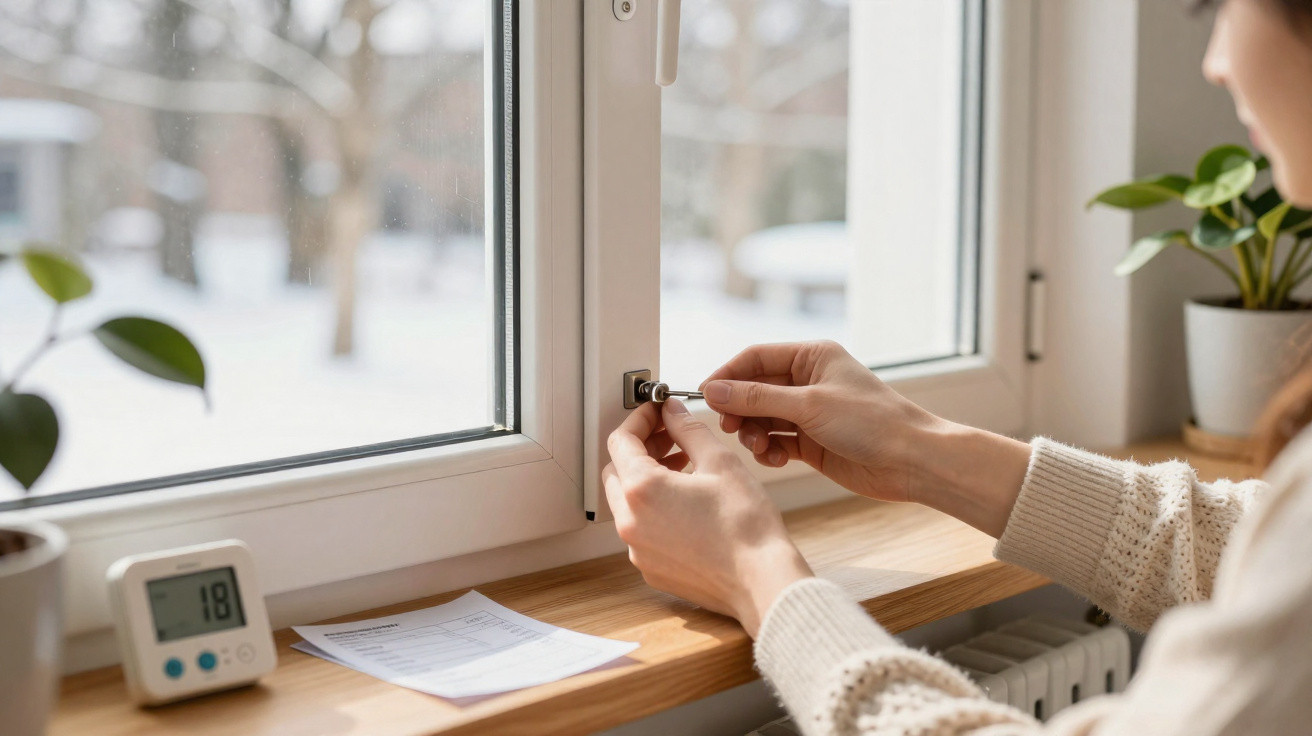
You’ll know the situation: the thermostat reads 21°C, the radiators are hot, yet it still feels unpleasantly draughty near the windows. That often leads people to costly fixes such as replacing seals or hanging heavy thermal curtains. However, many tilt-and-turn windows already include a small, easily overlooked feature that can significantly improve airtightness and noticeably reduce heating costs - in seconds and without calling in a tradesperson.
Why it can feel icy near the window even with a warm thermostat
When it turns chilly around windows, many people blame the glazing first. In reality, the cause is often elsewhere: tiny gaps between the sash and the frame let cold outside air in and warm inside air out. This can happen even with modern uPVC or aluminium windows fitted with double glazing.
Heating systems and thermostats typically measure the room’s air temperature, not the “felt” cold close to a window. A small draught at floor level or a cool current along the wall is enough to make the whole room feel uncomfortable - even though the reading on the thermostat looks fine.
“A window sash that doesn’t sit properly can push heating costs up by as much as 10 to 15 percent, without you noticing straight away.”
The reason is straightforward physics: materials such as uPVC, timber or aluminium expand in summer and contract again in winter. That tiny seasonal movement shifts the sash position slightly. As a result, the rubber seal may no longer press as firmly as intended - creating an invisible gap that air can pass through. Many people interpret this as “the window is broken” and immediately think about replacement or new seals. In many cases, though, a small mechanical adjustment is enough.
The culprit is on the side: the adjustable locking cam
The key detail is hidden in a spot most people never check: on the vertical edge of the window sash, where the metal hardware runs. Open the window fully and look closely along the edge of the sash. You’ll see several small metal parts, often cylindrical or mushroom-shaped. These are the locking cams.
These components do more than simply keep the window shut. When you turn the handle to close, they draw the sash towards the frame and compress the rubber seal. What many people don’t realise is that, on many modern tilt-and-turn windows, these cams are mounted eccentrically. In other words, they aren’t perfectly round in operation - they can be rotated to change how tightly the sash presses against the seal.
If you look closely, you’ll usually spot on the front face:
- a small dot,
- a notch or line,
- or a flat marking.
That marker indicates the cam’s current position - in other words, how strongly the sash compresses the seal when closed. Many installers hand windows over in a neutral middle setting. For transitional weather or mild winter days that’s often fine, but in sharp cold it may not be enough.
“With a simple twist, many windows can literally be switched into ‘winter mode’ - with no specialist knowledge at all.”
A quarter-turn with a big impact: how to activate winter mode
To increase the closing pressure, you simply change the position of those cams. It takes only a few steps and usually just a basic tool.
Step by step: adjusting the window to seal more tightly
Start by opening the window fully. Then run your eyes (and hand) along the entire edge of the sash and find all the cams. Depending on the model, there may be two, three or more distributed around the perimeter. For the adjustment, you typically need either:
- a 4 mm Allen key (hex key), or
- a small pair of flat-nose pliers if there’s no hex socket.
Proceed as follows:
- Find the marker on the cam (dot, line, notch).
- Insert the Allen key, or carefully grip the cam with the pliers.
- Turn the cam by roughly a quarter-turn so the marker points towards the seal - i.e., towards the room side.
- Repeat this for every cam on the window.
This increases the pressure with which the sash is pulled against the rubber seal when you close the handle. You’ll notice straight away when you shut it for the first time: the handle will feel a little stiffer, the window will sit more firmly, and the seal will be compressed more strongly.
“If the window handle feels slightly tighter after the adjustment, the seal is working at the load limit - and that’s exactly where it insulates best.”
Noticeable immediately: fewer draughts, a quieter room, a lower bill
If you previously had a clearly noticeable draught along the frame, you’ll usually feel the difference within minutes. The cold film of air at floor level diminishes, sitting near the window feels less draughty, and the temperature feels more “even” and consistent.
From an energy perspective, this small tweak can pay off as well. Depending on the condition of the seals and the quality of the window, cold-air infiltration can be reduced significantly. In practice, savings of around 10 to 15 percent on heating costs are possible if several leaky windows are readjusted. Your heating doesn’t need to work as hard because warm air is no longer escaping constantly.
There’s another benefit too: less airflow through tiny gaps also means less noise getting in. If you live on a busy road or near a railway line, the room can feel noticeably calmer. The increased closing pressure helps block sound that would otherwise enter through micro-gaps.
Why you shouldn’t leave winter mode on all year
As useful as the increased closing pressure is during the colder months, it isn’t recommended as a permanent summer setting. Rubber seals are flexible, but under continuous compression they can lose elasticity over time. If they’re kept fully compressed all year, they may “flatten out” and eventually stop springing back properly.
A simple seasonal routine helps:
- In late autumn, turn all windows into winter mode.
- In spring, set the cams back slightly (marker in the middle position or angled slightly outwards).
- While you’re there, wipe the seals with a damp cloth.
This seasonal adjustment prolongs seal life and keeps the windows easy to open and close. Keeping the pressure too high all year can also put extra strain on the hardware - another good reason to ease it off again in summer.
Other simple tricks for more warmth and comfort near the window
The hidden adjustment mechanism is a powerful lever, but a few additional small actions can improve comfort further without hitting your budget:
- Check the seals: if you can see cracks, or the rubber feels hard and brittle, replacement is worth considering in the longer term.
- Look after the seals: once a year, apply a small amount of silicone care product to keep them supple.
- Oil the hardware: put a drop of machine oil on hinges and moving parts so the handle operates smoothly, even with increased pressure.
- Keep the windowsill clear: tall plants or decorative items can restrict air circulation and worsen cold spots.
If you live in an older property with basic timber windows, you may benefit less from this adjustment trick because older fittings don’t always offer the feature. In that case, draught excluders, self-adhesive foam seals, or targeted window replacement for the worst openings can help.
How the trick shows up in everyday life
A typical example: in a rented flat with three large living-room windows, the thermostat stays at a steady 21°C. Even so, the occupants feel cold on the sofa in the evenings - especially when wind presses against the façade. After adjusting the cams, the cold feeling at floor level disappears, the heating comes on less often, and the room’s warmth is used more evenly.
The effect is particularly noticeable in rooms with laminate or tiled floors because cold air settles low down. If you have children who play on the rug, you quickly notice whether a draught is still present. A quick tweak to the fittings can do more here than putting on a thicker jumper.
Many homeowners already bleed their radiators each year before the heating season properly begins. It would be just as sensible to check the windows for winter operation at the same time. It takes only a few minutes per window, yet it can improve comfort across the entire heating season.






Comments
No comments yet. Be the first to comment!
Leave a Comment