
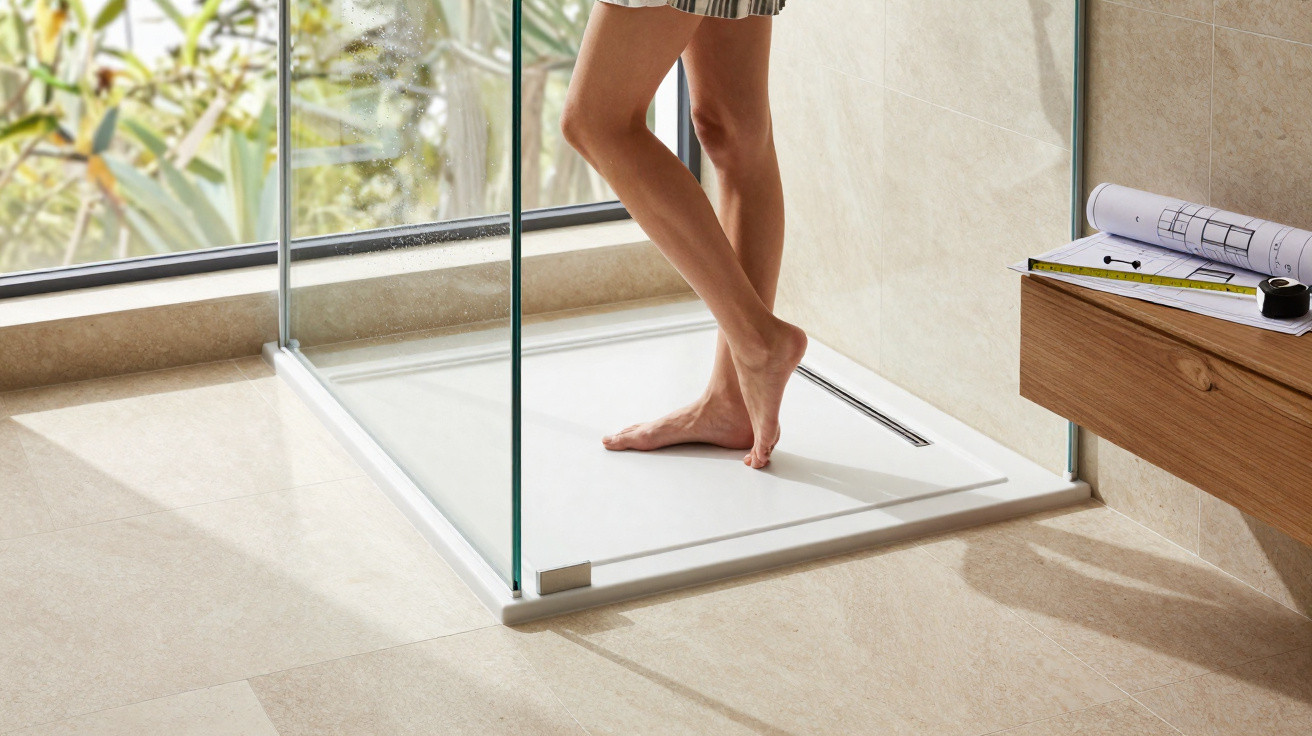
An Italian shower has been appearing more often in bathroom designs because it removes the step of a shower tray and blends the shower zone into the rest of the floor. By creating a continuous surface, it makes movement easier and can make the room feel larger, although it relies on well-planned drainage and properly executed waterproofing.
What sets an Italian shower apart from a traditional shower tray?
The key distinction is the floor level. While a conventional tray is a raised piece, the Italian model keeps the shower area almost flush with the rest of the bathroom, using a slight gradient to guide water towards the drain.
This layout changes several aspects of the space:
- Removes the step at the shower entrance;
- May do without a fully enclosed shower screen or use only a single fixed panel;
- Carries the same wall and floor finishes through the wet area and the rest of the bathroom;
- Uses a fall and drainage to manage water run-off;
- Cuts down on corners and tracks that commonly collect residue.
Why does this model make a bathroom feel larger?
Because the floor reads as one uninterrupted plane, the shower area does not look like a separate compartment. When the same finish is used across the whole surface, the room’s lines stay visually open, making compact bathrooms appear bigger and less broken up.
Which advantages explain designers’ preference?
Step-free access lowers the chance of trips and can make showering more comfortable for older people, children, and anyone with limited mobility. With no doors, frames, or tracks, day-to-day cleaning also becomes more straightforward.
Among the benefits linked to an integrated shower area are:
- Easier entry, without needing to step over a lip;
- Fewer metal parts to keep clean;
- The option to use continuous finishes;
- More freedom to set the shower’s dimensions;
- A more open look that stays in line with the rest of the bathroom.
Can every bathroom have an Italian shower?
Not always. Installation needs enough space to contain splashes, a subfloor that can be formed with the right fall, a correctly sized drain, and waterproofing across the entire wet area. Costs also tend to be higher, particularly when the work involves lowering the floor level or changing existing pipework.
The conventional tray will not disappear from every project
Despite the popularity of the level-access shower, the traditional base will remain practical for quick refurbishments, rental properties, and bathrooms where the subfloor cannot be altered. Off-the-shelf trays typically mean less building work and offer predictable control of water.
The trend for 2026 points to growing preference for the Italian shower, rather than any ban on conventional trays. The right choice depends on the structure available, the budget, and whether it is feasible to create a fall that channels water to the drain without causing leaks or damp outside the shower area.






Comments
No comments yet. Be the first to comment!
Leave a Comment