
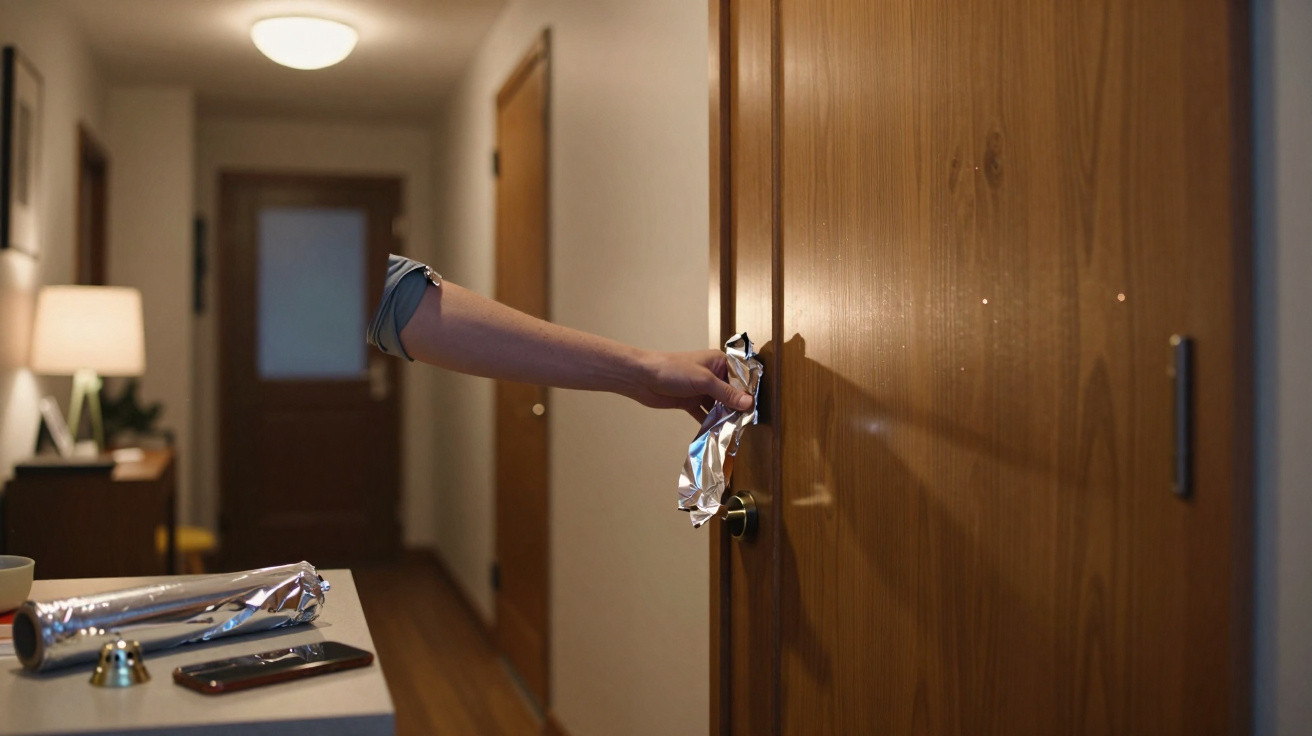
Recently, aluminium foil has found an unusual role at the front door rather than in the oven.
Households are looking for affordable, quick security improvements. That interest has brought a straightforward idea into view: wrapping aluminium foil around a door handle to create a noisy, conspicuous deterrent and a basic indicator of tampering.
Why aluminium foil is appearing on front doors
Aluminium foil may seem unremarkable, but it creases, crackles and reflects light beneath a porch lamp. Those qualities are precisely why some householders place it around external door handles overnight. The purpose is not to turn the door into a fortress, but to make it harder for somebody to test the handle without being noticed.
Foil will not replace good locks or lighting. It can create noise, draw attention and reveal tampering at a glance.
Sound, shine and surprise
Burglars tend to avoid delay and exposure. They often check doors for an easy, silent way in, and foil disrupts both of those conditions. It rustles, catches torchlight and appears unusual, increasing the perceived likelihood that someone will spot them. For an opportunist, these minor obstacles can be enough to encourage them to leave.
It also has another practical benefit: foil retains evidence of contact. If somebody takes hold of the handle, the foil may crease, dent or rip. You can notice this the following morning and review your routine, exterior lighting or door security.
How to use aluminium foil safely at home
This method requires no tools, although it does need a little attention. Keep the result temporary, neat and loud enough to be useful.
A quick setup in under a minute
- Tear off a length that will go around the outside handle two or three times.
- Wind it on securely without pulling it tight, leaving a few small folds so it crackles when touched.
- Press a loose flap into place underneath the handle, where it will rustle if brushed.
- Leave the keyhole, thumbturn and latch clear at all times.
- If wind starts to lift it, use a small piece of clear tape, but never place tape over moving components.
- Take the foil off every morning and fit fresh foil only when it is needed overnight.
The noise is the point. If it stays silent when you touch it, reshape it until it crackles on the lightest grip.
Does aluminium foil really deter intruders?
No individual measure will prevent a determined offender from entering. Burglary research indicates that layered security is most effective, combining visible protection, reliable locks, lighting and signs that somebody is at home. Foil contributes to the visible, noisy element of this approach. It may influence behaviour, but it does not create a physical barrier.
Police advice in Britain focuses on the fundamentals: secure doors and windows, anti-snap cylinders, timer-operated lights and a door viewer. Aluminium foil is not included on official recommendations. That does not necessarily make it ineffective, but it should be used as a low-risk, short-term extra rather than in place of established security measures.
Where aluminium foil helps - and where it does not
| Situation | What foil adds |
|---|---|
| Terraced street with neighbours close by | The crackling may be audible, while the shiny foil can attract attention under shared lighting. |
| Detached house with long front garden | The noise is less useful. Prioritise lighting and a camera as the main deterrents. |
| Short trips out during the evening | It provides a rapid tamper indicator, allowing you to spot dents when you return. |
| Extended holidays | It is not suitable for leaving in place, as unchanged foil could suggest that the property is empty. |
| Loose lever handles | The foil shifts and crackles readily, making it effective for creating noise. |
| Round knobs or pull handles | It is more difficult to attach neatly. Use a small foil “ruffle” rather than wrapping the entire handle. |
Potential drawbacks to manage
Foil has sharp edges and may mark lacquered brass or other soft finishes if it is twisted on forcefully. Shape it loosely in your hands before positioning it gently around the handle, and avoid rubbing it abrasively against the surface.
Conditions outdoors also matter. Wind may pull the foil loose, while rain can reduce its crackling sound. Remove it in stormy weather, and never obstruct a letterbox or thumbturn on an escape route.
Consider children, pets and visitors too. A pointed edge could catch someone’s finger, so fold all edges back to make them blunt. Ensure carers or delivery drivers can clearly see what is on the handle at night, so they do not mistake it for damage or a trap.
A smarter way to use aluminium foil
Use foil as a short-term test rather than a permanent answer. Fit it for a week while checking the security of your entry points, and make a note of any signs of interference. You can then arrange lasting improvements that deal with the weaknesses you identify.
Use foil to learn fast. Then invest where the risk is real: the lock, the light, the line of sight to your door.
Low-cost security upgrades with real impact
- Install an anti-snap euro cylinder with a three-star rating to TS 007, or fit a lock to BS 3621 on timber doors.
- Fit dusk-to-dawn lighting near the entrance. Light reduces the shadows in which intruders prefer to operate.
- Add a door viewer or a smart doorbell with motion alerts. Being visible can alter behaviour.
- Fit window locks and a letterbox cage to prevent “fishing” for handles and keys.
- Cut back shrubs that obscure the view from the street, as natural surveillance is important.
- Use plug-in timers for lamps when you are out in the evening, rather than reserving them only for holidays.
How to test your setup tonight
Stand outside with the porch light switched on and lightly touch the foil. It should crackle immediately. Move back ten paces and ask someone indoors whether they heard it. If they did not, add a loose flap or crumple the surface slightly to create more texture. Test it again with the porch light off. If the foil is barely visible, consider fitting a small reflective strip behind the handle instead.
When to avoid the aluminium foil trick
Do not use it if you live in a block with communal corridors and strict fire-safety requirements. Avoid it on heritage door furniture that could mark easily. It is also unsuitable for doors with a smart-lock motor that might catch on loose foil or tape.
Related uses that keep the idea practical
Aluminium foil can also serve as a simple tamper indicator on side-gate latches and shed handles where bicycles or tools are stored. Choose a small crimped ring instead of covering the whole handle. Replace it after rainfall, and record any changes in a notebook or on your phone. Identifying patterns can help you decide where to invest next.
The method is most useful as part of a wider security plan. Use layers: combine the audible crackle with lighting, a visibly secure lock and routines that remove straightforward opportunities for offenders. Keep it temporary and orderly, then use what it reveals to improve long-term security without wasting a pound.





Comments
No comments yet. Be the first to comment!
Leave a Comment