
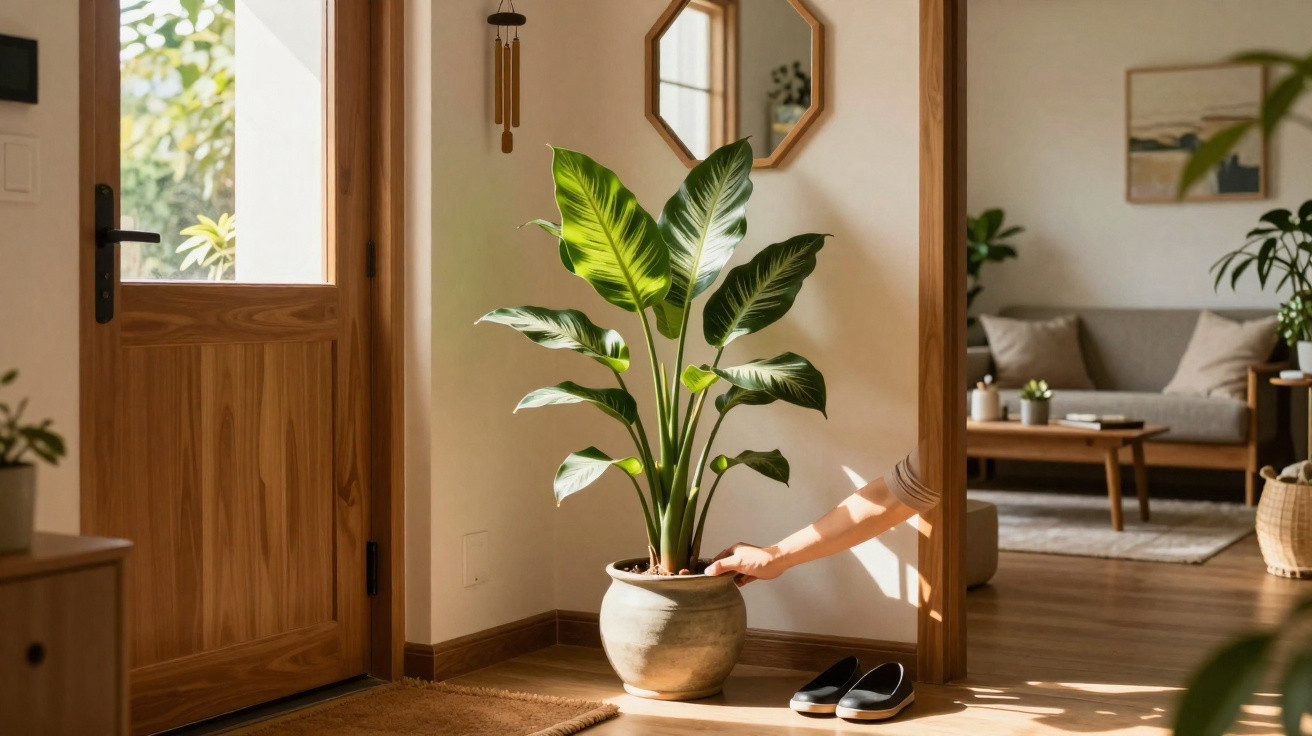
The dumb cane is used in Brazilian gardening and décor as a symbol of household protection. In popular adaptations of Feng Shui, its large leaves are linked with a barrier against negative energy, which is why its pot is often placed close to the front door, in a bright spot and always beyond the reach of children and animals.
Why is dumb cane associated with protection?
The plant’s common name itself suggests strength and resilience. Its broad, sturdy leaves, patterned in shades of green, white or yellow, visually support the idea of a barrier, while the entrance to a home is seen as the point through which people, activity and energy enter the space.
This reading brings together a Brazilian popular belief and contemporary approaches to harmonising living spaces. The protection credited to the plant is symbolic and has no scientific evidence behind it, but it commonly includes the following meanings:
- Large leaves regarded as a protective barrier;
- Vigorous growth connected with vitality;
- The main door understood as a route for energies;
- A healthy pot representing balance and renewal;
- A common name associated with keeping unwanted influences away.
Where should the pot be placed near the front door?
The plant may be positioned beside the door, on a sturdy stand or in a corner near the hallway, provided that it does not obstruct access. Feng Shui guidance on plant placement also favours tidy, well-maintained areas that suit the needs of each species.
- Pick a location with bright, indirect light;
- Keep the pot out of the path of doors and corridors;
- Place it away from cold draughts;
- Do not expose the foliage to strong afternoon sun;
- Choose a stable container with drainage holes.
What care keeps Dieffenbachia healthy?
Dieffenbachia includes ornamental plants with variegated foliage that cope with indoor settings offering moderate light. Dumb cane prefers strong indirect light: too much shade dulls its colouring, whereas direct sunlight can leave dry, scorched patches on the leaves.
Water it when the top layer of growing medium is beginning to dry. Soil that remains waterlogged encourages root rot, while extended periods without water cause the leaves to droop. A light growing medium, rich in organic matter and with good drainage, supports more balanced growth.
Why does the plant require care around children and animals?
Its leaves and stems contain calcium oxalate crystals, which can cause severe irritation if chewed or if the sap comes into contact with mucous membranes. The pot should therefore be kept beyond the reach of children, dogs and cats, and gloves are advisable when pruning, repotting or removing damaged leaves.
- Do not allow leaves to be chewed;
- Wash your hands after handling the plant;
- Avoid touching your eyes or mouth while pruning;
- Collect any leaves that fall onto the floor straight away;
- Select another species if no safe position is available.
Does the plant really attract positive energy?
There is no scientific evidence that Dieffenbachia blocks envy, the evil eye or negative energy. In popular Feng Shui practice, it serves as a visual symbol of protection, helping to define the entrance and reinforce the intention to keep the home orderly and welcoming.
The best position combines symbolism with practical growing requirements: indirect light, a well-drained pot, room for the leaves and a safe distance from children and animals. In this way, dumb cane can remain near the front door without decorative belief taking precedence over the care required by a plant that is genuinely toxic when ingested.




Comments
No comments yet. Be the first to comment!
Leave a Comment