
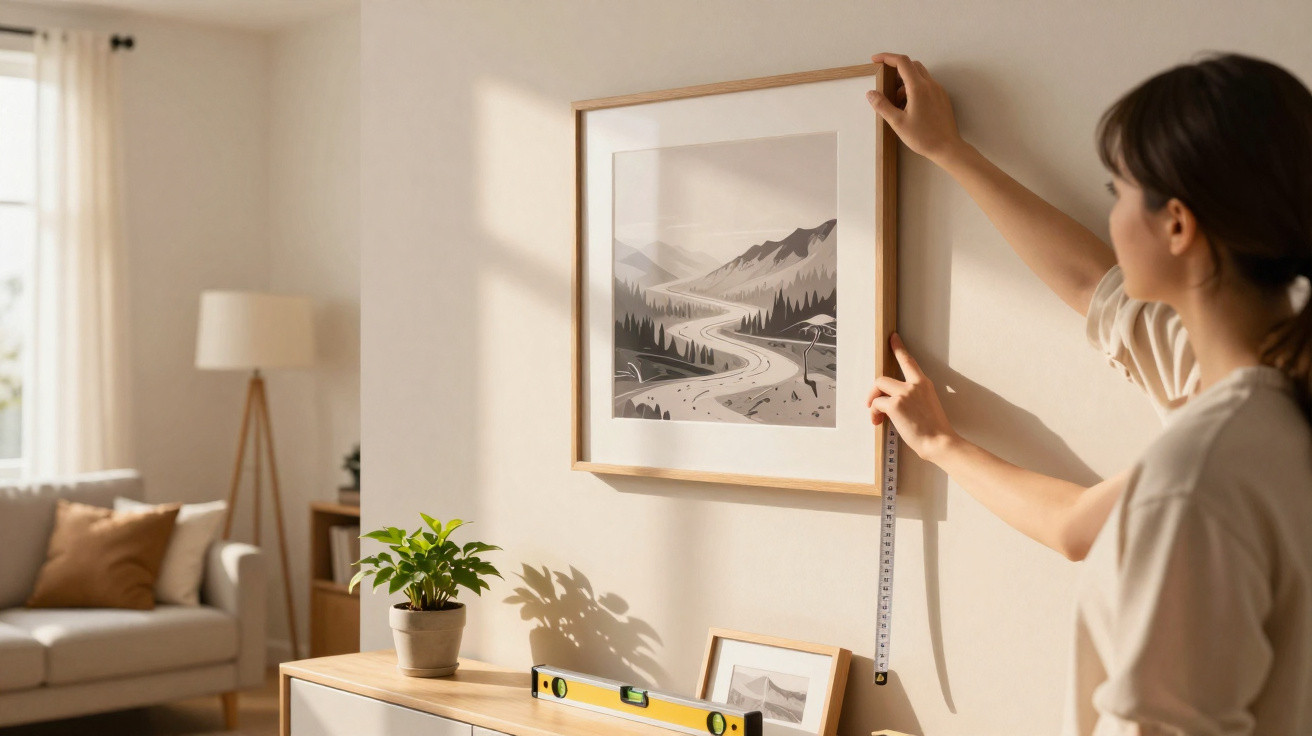
A new frame has been waiting against the wall, perched on a chair for three weeks. Every morning, we look at it and tell ourselves it is time to get the hammer out, before the seemingly simple question arises: how high should it be hung? Many people decide by eye, following the top of a door, the back of the sofa or their instinct at that particular moment. The result is often a picture hung too high, stranded on a vast white wall, or too low, as though it is apologising for being there. In museums, this detail is never left to chance. One straightforward measurement, long used by professional art hangers, genuinely changes how a work occupies a room. Yet it remains unfamiliar in many French living rooms. The eye never lies.
In museums, the centre of the picture matters more than its top edge
We all know the feeling of walking into a gallery where everything seems naturally positioned. Pictures do not hover above our heads: they appear to meet our gaze, even when they are enormous or displayed on very tall walls. The answer often lies in an unobtrusive reference point: in many museums, the centre of the artwork is placed at eye level, roughly 145 to 155 centimetres from the floor. This is not an unbreakable rule, but it provides a highly reliable starting point. Visitors do not need to raise their chin or bend their neck. They simply look.
At home, the instinct is often the opposite. We leave a great deal of empty space above the sofa, line frames up with the tops of windows, or try to keep them out of children’s reach. A decorator recently described moving a framed print by only 18 centimetres in a Paris living room: her client felt as though she had replaced the frame, even though nothing else had changed. The wall instantly seemed less empty, the sofa less overwhelming and the room more peaceful. This kind of improvement costs nothing. You simply have to accept drilling two new holes, which is never the most enjoyable part.
The misunderstanding comes from a widely held belief: people think they should measure a frame’s position from its upper edge. Professionals instead begin with its midpoint, where the eye naturally settles. For a picture measuring 60 centimetres high, with its centre at 150 centimetres from the floor, the top edge sits at 180 centimetres: that is not especially high, yet the composition immediately feels balanced. The visual centre is more useful than the frame’s outer limits. It is a small change in perspective, and it explains why so many pictures in homes feel oddly misplaced.
The 150-centimetre method, without turning your living room into an exhibition space
The simplest approach is to mark a point 150 centimetres from the floor with a piece of masking tape. Then locate the exact centre of your picture and align it with that mark, allowing for the hanging system on the back: for instance, a wire rises slightly when pulled taut. A ruler, tape measure and second person will often be enough. If you are on your own, cut a kraft-paper template to the frame’s dimensions and secure it with tape. Seeing the volume before drilling prevents plenty of regrets.
This measurement should work with the room rather than dictate it. Above a sofa, chest of drawers or sideboard, it is perfectly reasonable to lower the picture so that there are 15 to 25 centimetres between the furniture and the bottom of the frame; a large wall behind a coffee table should not be handled in the same way as a narrow corridor. Let us be honest: nobody really does this every day. Even so, spending five minutes looking at the artwork while seated, standing and from the room’s entrance helps prevent the most common mistake: hanging it too high for fear of not leaving enough space. Empty space above is not always a mark of elegance.
When several frames are intended to create a composition, the reference point remains the same: it is the centre of the entire arrangement that should sit close to eye level. Do not try to align every top edge, especially when the formats vary; it may look orderly on paper, but it quickly makes a lively wall feel rigid.
“Good hanging is not noticed at first: it simply makes you want to look at the artwork for longer.”
- Measure from the floor to the centre of the frame, rather than to its top edge.
- Keep the spacing between works in the same arrangement consistent, often between 5 and 10 centimetres.
- Test the height with a template before reaching for the drill and wall plugs.
The right picture hanging changes how the room feels
A poorly positioned picture can make a ceiling seem lower, a sofa appear bulkier or a wall feel emptier than it really is. Conversely, bringing a frame a few centimetres closer to eye level restores order without making the décor feel fixed in place. The well-known museum height is therefore not a decorating law to follow blindly: it is a starting point, almost an instinctive comfort measure. In an old house with high ceilings, a large portrait may need a little more breathing room; in a bedroom beneath a sloping roof, it may need to be lower still. The human eye remains the best judge, provided it is given the chance.
There is also something deeply personal about this act. Hanging a family photograph, a concert poster or a canvas found on holiday is not about filling a wall: it is about choosing what you want to see often, sometimes without even thinking about it. A frame placed at the right height becomes almost familiar, like a quiet presence. You could try it this weekend: move just one picture and watch how those around you react. They may not be able to explain what has changed. They will simply feel that the room breathes more easily.
| Key point | Detail | Added value for the reader |
|---|---|---|
| The museum reference | The centre of an artwork is often positioned between 145 and 155 centimetres from the floor, depending on the setting, format and visitors’ route. | This simple benchmark prevents the “perched picture” effect and provides immediate viewing comfort in a living room, hallway or bedroom. |
| The useful calculation | Measure the picture’s centre, then add or subtract the distance associated with the hook, taut wire or rear hanging bracket. | You drill in the right place from the outset, with fewer unnecessary holes and far fewer discussions in front of the wall. |
| Adapting to the room | Above a piece of furniture, generally leave 15 to 25 centimetres between the bottom of the frame and its surface, then adjust according to the proportions. | The picture connects with the furniture instead of seeming suspended in empty space, too far from the life of the room. |



Comments
No comments yet. Be the first to comment!
Leave a Comment