
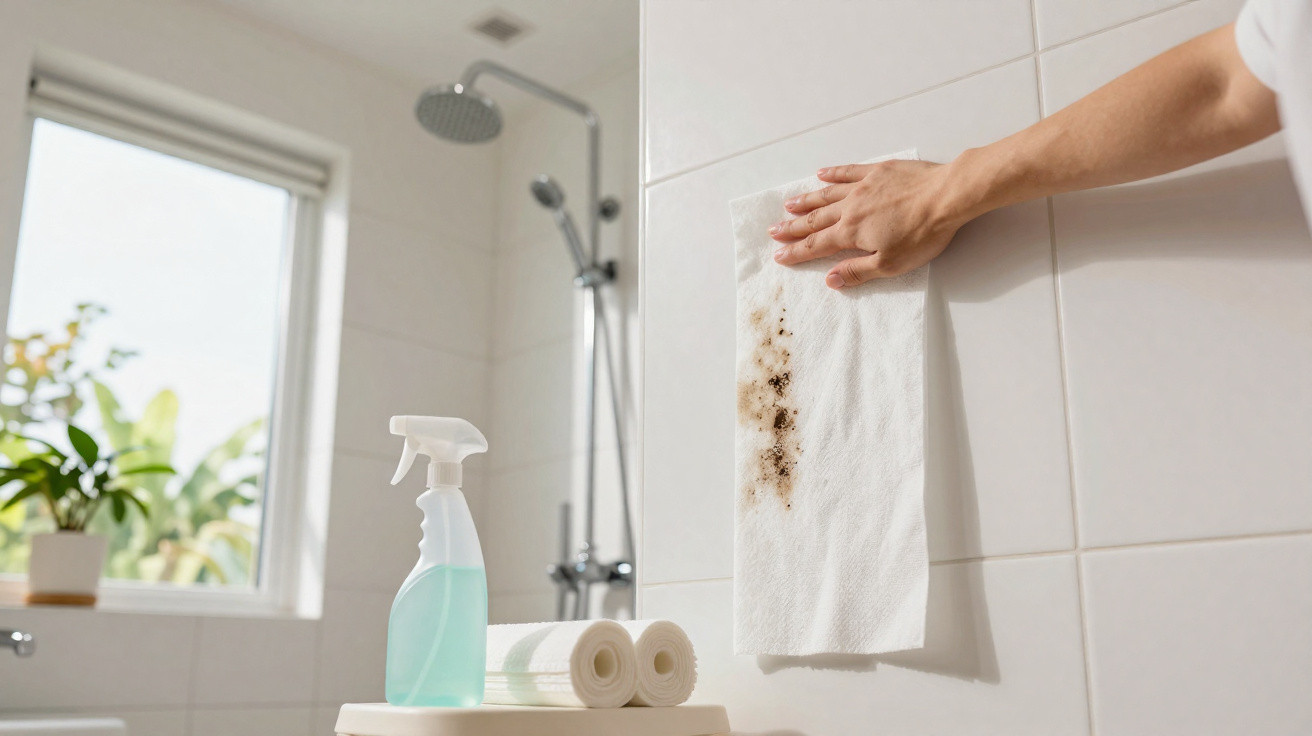
A simple, low-tech cleaning trick gaining traction on social media uses two household essentials you probably already have. It works at the source of the problem, clings to vertical tiles and removes stubborn black marks without harshly scrubbing away your grout.
The two-ingredient hack making waves
This approach combines ordinary household bleach with paper towels. On non-porous surfaces, bleach eliminates mould and mildew, while the paper towels keep the liquid against the affected area so it can work for longer where spores are concealed. That extended dwell time is more important than vigorous scrubbing, particularly on grout lines and silicone seals.
Key idea: keep a thin, wet layer of bleach pressed to the stain for hours, not minutes, and let contact time do the heavy lifting.
What you need
- Household bleach (5–6% sodium hypochlorite)
- Paper towels, toilet paper, or cotton pads for narrow seals
- Nitrile gloves and eye protection
- An open window or a running extractor fan
- A plastic bag for disposal and a damp microfibre cloth
Step-by-step in the shower
- Ventilate the bathroom, then put on gloves and eye protection.
- Cut paper towels into slim strips sized to fit the grout or sealant lines.
- Remove surface soap scum first, as this residue can prevent bleach reaching the mould.
- Saturate the strips with bleach so that they are damp but not dripping.
- Place the strips straight over the stains, pressing them smooth to remove air pockets.
- Leave them in place for 60–240 minutes, wetting them again if they begin to dry out.
- Take off and discard the strips, then wipe the area using a damp cloth.
- Rinse the surfaces thoroughly and dry them with a towel to limit fresh growth.
Safety rule: never mix bleach with vinegar, ammonia, or acids; mixing releases toxic gas.
How long is long enough?
Mild mildew on shiny tiles will often disappear within an hour. Older black marks along seals may require three to four hours. Staining embedded in silicone can lighten yet return, indicating growth beneath the sealant bead. If discolouration persists after two treatments, prepare to remove the old sealant and re-caulk the area.
Where it works and where it doesn’t
Bleach performs best on sealed or non-porous materials, but it is less effective on porous stone and may fade coloured finishes.
- Ceramic and porcelain tile: safe and effective when the surface is glazed.
- Grout: effective, though coloured grout should be tested for fading in an inconspicuous area.
- Silicone caulk: suitable for surface mildew; replace it if marks return quickly.
- Acrylic or fibreglass surrounds: safe, but avoid prolonged contact over hairline cracks.
- Natural stone (marble, limestone, travertine): do not use bleach, as it can cause etching or pitting.
Simple dilution that still works
Diluting bleach can help reduce fumes. For regular maintenance, use 1 part bleach to 3–4 parts water; for persistent marks on non-porous surfaces, use a 1:1 mixture. Maintain a long contact time to compensate for the weaker solution. Always carry out a test first.
Why mould keeps coming back
Shower areas often hold humidity above 70%, which is ideal for mould. Warm steam condenses on tiles and nourishes spores in soap scum. Because grout and silicone take in moisture and dry gradually, filaments can establish themselves below the surface. Fast sprays can help, but they seldom remain in contact for long enough to penetrate properly.
Contact time beats scrubbing; break the moisture cycle, and regrowth slows dramatically.
Aftercare that actually prevents regrowth
- Run the extractor fan while showering and for 20–30 minutes afterwards.
- If the fan is not effective enough, use a dehumidifier to keep bathroom humidity below 55%.
- Use a squeegee on walls and glass after the final shower of the day.
- Fully open the shower door or curtain to encourage quicker drying.
- Reseal grout every 6–12 months to reduce moisture absorption.
- Replace aged or cracked silicone, using mould-resistant caulk when refitting it.
A quick weekly routine
- Day 1: Squeegee the surfaces and dry the corners with a cloth.
- Day 3: Spray a non-acid bathroom cleaner onto seals and wipe it away after 2 minutes.
- Day 7: Check the grout lines and spot-treat any grey tinge before it becomes darker.
If you avoid chlorine bleach
Some homes favour chlorine-free options, although these still require adequate dwell time. Paper towel strips can hold any liquid treatment against vertical lines.
- 3% hydrogen peroxide: soak strips, press them onto stains for 1–3 hours; it is safe for most coloured grouts, but avoid natural stone.
- Oxygen bleach (sodium percarbonate) paste: spread over horizontal grout, keep it damp beneath plastic wrap and rinse thoroughly.
- Quaternary ammonium chloride cleaners: effective against mildew films; consult the label to confirm compatibility with grout and stone.
| Method | Best for | Typical contact time | Surface cautions |
|---|---|---|---|
| Bleach + paper towel strips | Black seals, glazed tile, white grout | 1–4 hours | Test coloured grout; avoid natural stone |
| Hydrogen peroxide + strips | Lighter stains, coloured grout | 1–3 hours | Avoid stone; may foam on biofilm |
| Oxygen bleach paste | Horizontal grout, shower floors | 2–6 hours | Keep damp; rinse thoroughly |
Troubleshooting stubborn stains
- If a black mark becomes lighter after one dab of bleach in 60 seconds, it is probably mildew rather than deep mineral staining.
- If there is no change, the mark may be a hard-water deposit holding trapped dirt; use a limescale remover first, then assess it again.
- If silicone repeatedly develops spots, moisture could be caught behind it; dry the joint for 24 hours before replacing the bead.
- If the bleach smell is overpowering, dilute it more, reduce treatment times and improve ventilation.
Health and household notes
- Keep children and pets away while treating the area.
- Keep bleach stored upright, away from acids and cleaning products containing ammonia.
- Do not spray warm surfaces, as heat makes fumes disperse faster and causes the liquid to dry too soon.
- Most modern septic systems can handle occasional diluted bleach, but high volumes may disturb beneficial bacteria, so use small quantities and rinse with plenty of water.
This method remains inexpensive. Treating a few feet of sealant needs only several paper towels and a small cup of bleach. Its efficiency makes monthly preventative treatments achievable, helping to avoid the need for complete re-caulking later on.
Wondering whether the bathroom needs better ventilation? Try this quick test: with the fan switched on, hold a square of toilet paper against the vent grille. If it falls away, the airflow is poor. Cleaning the fan housing, fitting a higher-CFM unit or creating a simple undercut beneath the door can reduce humidity enough to alter the mould equation.




Comments
No comments yet. Be the first to comment!
Leave a Comment