
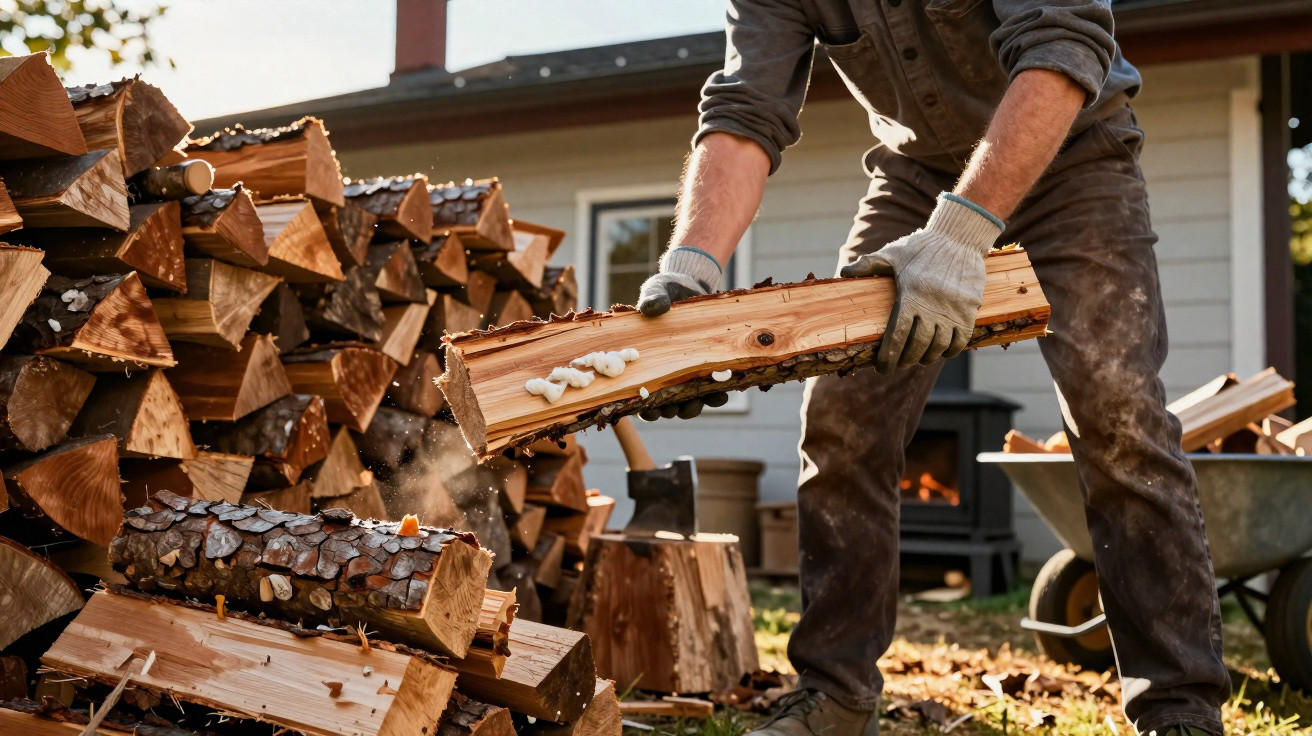
A little dusty. Slightly lighter than the rest. Easy to lift from the top of the stack. You dropped it near the cooker and a thin cloud of beige powder rose off the bark like old face powder. You likely nudged it aside with your shoe, assuming it meant nothing - just normal wood dust.
Not long after, you start seeing the same powdery film on other logs. The shed carries a faint, mushroom-like smell. One section of the pile looks almost preserved and lifeless, leaning where it once sat solidly. You press a finger into a log and it yields, soft like bread that’s gone stale.
That’s usually the moment the worry lands: is this dry rot… and is my house next?
How to spot dry rot on firewood before it spreads
Dry rot rarely announces itself with anything flashy at the start. You won’t typically see huge toadstools or bright slime. More often, it begins as a thin white or grey layer across the outside of the firewood, like cotton wool that’s been flattened onto the surface. On some pieces it turns more yellowish or pale brown, sending fine threads into splits and along the grain. It can look oddly deliberate - almost like roots feeling their way forward.
Lift a suspect log and the difference is often immediate. Instead of the solid, comforting heft you expect, it may feel unexpectedly light. Give it a tap and you hear a flat, lifeless thud rather than a crisp knock. Split it and the centre can break down into small cubed, fragile pieces. That dry, blocky crumble is one of the clearest hallmarks of dry rot.
Picture a shed at the end of a damp garden, kept in partial shade by trees. The owner stacks a fresh delivery of firewood in early autumn, tight to a wall, then pulls a plastic sheet over the top “just in case it rains”. There’s no sun, barely any airflow, and the ground is still holding moisture from late-summer storms. By January, the back third of the pile looks faded and dusty, as though someone dusted it with flour and left it untouched for a year.
In reality, that set-up is very common: wood stores with poor ventilation, tarpaulins sealed down to the ground, and logs piled directly on soil or concrete. Each choice traps moisture - exactly what fungi need. Dry rot spores are all around us, drifting harmlessly… until they land on wood that’s damp and still. Then an invisible risk becomes visible damage.
Despite the name, dry rot doesn’t begin in dry conditions. The fungus needs moisture to get going, usually in timber with a moisture content above 20%. It moves through the fibres and feeds on the parts that give wood its strength, leaving behind that cracked, crumbly interior. Once the fungus is established, the timber can end up looking and feeling dry, even while the spread continues.
That’s how a log can appear well seasoned from across the shed yet be rotten within. The fungus travels via filament-like growth, and in some situations it can even move through gaps in masonry or beneath floors to reach fresh timber. With firewood you mainly notice surface mycelium and the characteristic brittle break; in buildings the consequences can be far more severe. Learning the early signs on logs is often your first warning signal.
Getting rid of dry rot on firewood safely and for good
The most effective approach is straightforward and uncompromising: separate it, then remove it. The moment you suspect dry rot, stop grabbing logs from random parts of the stack. Work systematically. Set up a “quarantine” area and move any questionable pieces there - away from the house, and not propped against a shed, fence, or wall. If the problem seems limited and you’re confident your home’s timber is unaffected, many people choose to burn lightly affected logs promptly in a hot stove with a strong draw.
If the rot is widespread or close to structural timber, treat those logs as rubbish rather than fuel. Bag them and take them to a green-waste site, or follow your local guidance for disposing of contaminated wood. After that, reset the storage space: empty it, sweep out dust and fragments, and allow everything to dry completely. One thorough clean-out can prevent years of recurring, low-level issues.
Most people only act once the damage is obvious - which is entirely normal. Few of us spend nights thinking about the moisture level inside a stack of logs. On a busy day you drop a new delivery into the shed, shut the door, and move on. Unfortunately, that “I’ll do it properly later” habit is exactly where dry rot often gets the upper hand.
The same errors show up again and again: piling logs straight onto soil or bare concrete, wedging the stack tightly against a wall, wrapping the whole pile in a tarp like a parcel, or letting garden odds and ends block the air. Let’s be honest: no one does this every day - checking, turning, measuring moisture. But small upgrades, even once per season, dramatically reduce the risk.
A building pathology specialist once told me something I’ve never forgotten:
“Dry rot isn’t a mystery problem. It’s a moisture problem that stayed unsolved for too long.”
That applies just as much to a log pile as it does to a hundred-year-old beam above your sitting room. The aim is to make your firewood an unfriendly place for fungus: plenty of air movement, raised off the ground, and properly dried before long-term storage. Think of your log store as a small ecosystem you can steer in the right direction.
For a quick checklist, keep these practices in mind:
- Stack on pallets or rails, not straight on the ground.
- Leave a gap between the pile and any wall or fence.
- Cover only from above and keep the sides open to the air.
- Bring older logs to the front and burn them first.
- Avoid storing firewood in basements, underfloor voids, and damp garages.
Living with firewood without inviting dry rot in
Once you’ve watched dry rot take hold, it changes how you view a log stack. There’s a quiet satisfaction in building a pile that can breathe: tidy rows, bark mostly facing down, and little air channels running through like miniature chimneys. Sun and wind start working with you. The wood darkens evenly, the ends split into clean radial cracks, and that powdery fungal dust never turns up.
For some, it becomes a seasonal habit. On the first properly crisp day of autumn, they go out to the store, run a hand over the stack, choose a few random logs and split them. The sound tells you plenty: a sharp, bright crack compared with a dull, fibrous tear. Healthy wood has a certain smell - and so does a pile that’s quietly starting to go wrong.
Most of us know the sinking feeling of opening the shed on a wet Sunday: stacks leaning, a damp odour in the air, and a corner of logs so soft you could almost leave a thumbprint. It feels like a mistake, but it’s also useful information. Firewood quickly shows you where water is getting in around your home, how your garden drains, and which areas stay cold and shaded.
Dry rot on logs is seldom the result of one single bad choice. More often it’s a pattern of small oversights: a gutter that overflows near the wood store, a downpipe that splashes back, a low patch of garden that turns to mud every winter. Sorting those issues protects more than a few logs - it shifts the moisture balance across the whole property.
There’s a simple mindset change that helps: your firewood isn’t only fuel; it’s also an early-warning indicator. If rot keeps returning, something nearby is staying damp for too long. That “something” might be a timber deck, the shed’s frame, or even a structural joist you rarely see. Dry rot thrives on continuity - damp wood leading to more damp wood in dark, still conditions.
Interrupt that continuity and you undermine its advantage. Improve airflow beneath the stack. Keep logs off exterior walls. Let in as much daylight as you reasonably can. It’s not glamorous, and it won’t get you applause online. But it quietly safeguards what matters: a warm, secure home without unpleasant surprises behind the plasterboard.
Once you start paying attention in this way, even a small stack becomes a conversation with your surroundings. The logs show whether last winter’s fixes worked. The shed’s smell hints at how this year’s rain is behaving. And the missing beige dust on your next load of oak? That’s the reward, burning steadily in the stove on a cold night.
| Key point | Detail | Why it matters to you |
|---|---|---|
| Visually identify dry rot | Beige dust, white/grey mycelium, wood that feels light and breaks easily | Helps you spot early signs before the problem gets worse |
| Make the storage area healthy again | Isolate affected logs, clean thoroughly, improve ventilation | Lowers the chance of spread to the house or other stacks |
| Change how you store firewood | Raise the wood, keep it away from walls, cover only from above | Protects future deliveries and prevents the same mistakes each winter |
FAQs:
- Can I still burn firewood that has dry rot on it? Lightly affected logs can be burned in a closed stove if fully dry, but heavily rotted, spongy pieces are better disposed of to avoid spreading spores and breathing in extra dust.
- Does dry rot on firewood mean my house is at risk? Not automatically, yet repeated rot near structural timber or basements should prompt a closer look at moisture levels and possible entry points.
- How can I tell the difference between mould and dry rot? Mould usually sits on the surface like fuzzy spots, often in various colours, while dry rot changes the internal structure, making the wood brittle and blocky when it breaks.
- Will leaving firewood outside stop dry rot? Only if the wood gets real airflow and is raised off the ground; a pile left directly on soil or trapped under a tight tarp can still rot badly outdoors.
- Should I treat my log store with chemicals? Most domestic situations don’t need heavy treatments; better drainage, ventilation, and smarter stacking are usually enough to keep dry rot away from your firewood.






Comments
No comments yet. Be the first to comment!
Leave a Comment