
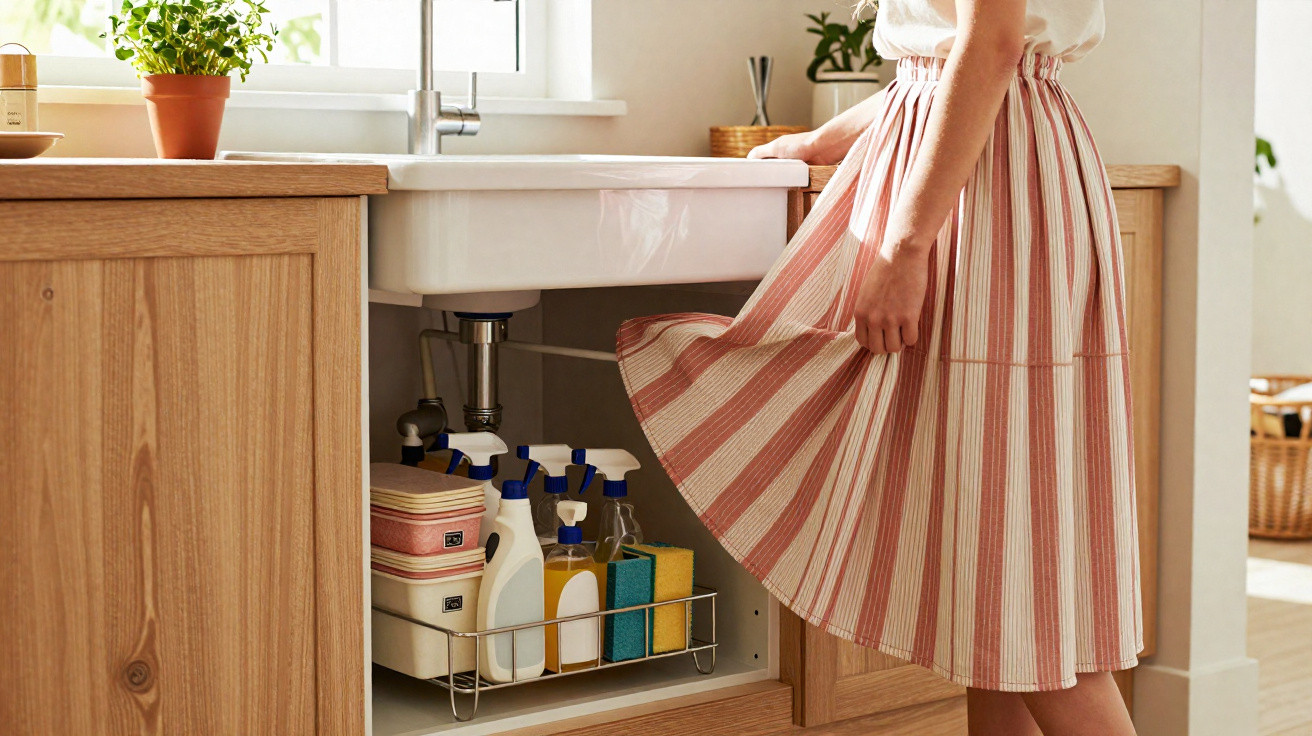
In many homes, the space beneath the sink becomes a chaotic dumping ground: cleaning products, bags and sponges piled up in no particular order. Yet this exact area can be turned surprisingly easily into tidy, attractive and practical storage. A decorating trick our grandparents already knew is now back in fashion – and it fits perfectly with current kitchen trends.
Why the space under the sink is so often wasted
For many people, the cupboard beneath the sink is simply a necessary evil. Pipes, the trap and perhaps a water filter may be hidden there – it is hardly a visual highlight, and it is often a functional disaster. Everything that has no other home gets put inside. The result is endless searching for the glass cleaner or dishwasher tablets.
Most base units also have fixed doors, leaving little scope for flexible solutions. Anyone wanting to change the setup later often has to replace entire cabinet fronts. That takes money, time and patience. This is precisely where a trend gaining real momentum again in 2026 comes in.
The return of the sink skirt – a retro solution with a wow factor
A familiar feature in country kitchens is returning in a more contemporary guise: the sink skirt, meaning a fabric curtain in place of solid cupboard doors beneath the sink. Does that sound old-fashioned? Only at first. This option is now appearing repeatedly in interior magazines and across social media.
“A simple length of fabric transforms the clutter beneath the sink into neat, concealed storage while adding character to the kitchen.”
The principle is straightforward: a rod or tension wire is fitted beneath the worktop, then a curtain is hung from it to cover the entire lower section. Behind it, cleaning products, buckets, sponges and anything that does not look good on display can be kept out of sight.
Sink skirt benefits at a glance
- Quick access: There is no door to open or swing into the way – simply lift the curtain, take the product and you are done.
- Affordable option: Fabric and a rod cost far less than replacement cupboard doors.
- Flexibility: Colours and patterns can be changed in minutes.
- Easier cleaning: The curtain can simply go in the washing machine.
- Visual advantage: Fabric hides pipes and bottles while bringing warmth to the room.
This approach is especially appealing in small kitchens and rented homes. It does not require alterations to the building, the fabric can be tailored to individual taste, and it can be taken along easily when moving house.
How to plan a sink skirt properly
Before buying any fabric, it is worth checking the practical details. How wide is the opening? How deep is the base unit? Is there a plinth that will limit the curtain at the bottom? With a few simple steps, the change can be made without stress.
- Measure the width and height carefully between the worktop and the floor.
- Decide whether the curtain should reach the floor or finish at plinth height.
- Choose a suitable fixing method: a tension rod, curtain pole or tension wire.
- Pick washable fabric that suits the kitchen’s style.
- Fit the curtain so it can be pushed aside or lifted easily.
Anyone confident with a sewing machine can make the curtain themselves. Everyone else can use ready-made curtain panels or table runners, which can be adapted with minimal effort.
Order behind the curtain: organise cleverly rather than simply hiding it
Covering the area with a curtain should not mean continuing to stack things randomly behind it. This is the ideal time for a thorough reset. The basic rule is simple: every item needs a dedicated place, arranged by category.
Essential organisers for the under-sink cupboard
- Baskets and boxes: Perfect for cleaning products, sponges and dishwasher tablets.
- Pull-out baskets: These make deep cupboards usable without having to rummage around at the back.
- Shelf inserts with cut-outs: They work around the pipework beneath the sink and create an additional level.
- Hook rails: Useful for washing-up brushes, rubber gloves and microfibre cloths.
- Slim containers: Suitable for bin-bag rolls, spare sponges and replacement washing-up brush heads.
“Anyone who sorts the area beneath the sink by category can find what they need immediately, even in half-light – without lengthy searching.”
Stackable boxes placed at the side or towards the back are also practical. Keep the products used every day at the front: washing-up liquid, dishcloths and multi-purpose cleaner.
Working around pipes and bulky equipment
Pipework and the trap are the trickiest elements beneath the sink. Many people give up at this point and decide a sensible layout is impossible. However, a few straightforward solutions make it possible to account for this maze of pipes.
Adjustable shelves with cut-outs can create another level around the pipes, for example. Modular metal or plastic systems can also be adapted without blocking access to the trap. If a water filter or waste disposal unit is installed, keep its moving parts clear, but make active use of the area beside or above it.
Fabric extras: make use of pockets and side panels
Some sink skirts come with pockets sewn onto the sides. These can hold lightweight objects that are used often or need to be grabbed quickly. Typical examples include:
- Rubber gloves
- Dusting cloths
- Spare sponges
- Small brushes
This leaves more room in the cupboard itself and makes the whole area feel more structured.
Styling: turning a problem area into a focal point
The sink skirt’s greatest strength is its decorative effect. Colour and pattern can alter the feel of an entire kitchen without replacing any furniture. A simple white kitchen can gain a country-house look with checked or striped fabric. In modern kitchens, plain fabrics with a subtle texture in beige, grey or dark green work well.
| Style direction | Recommended fabrics | Typical patterns |
|---|---|---|
| Scandinavian | Linen-look fabric, cotton | Fine stripes, light natural shades |
| Country house | Cotton fabric, blended fabric | Checks, small floral prints |
| Industrial | Canvas, heavyweight cotton | Dark plains, minimalist prints |
| Modern | Smooth fabric with a slight sheen | Geometric patterns, colour blocking |
For anyone who does not want to commit to one look, the curtain can be treated like an outfit for the kitchen: a light, fresh pattern in spring and warmer colours in autumn. Because it is so easy to swap, the room feels regularly “refreshed” without any need to replace furniture.
Hygiene, safety and common mistakes
Strong cleaning products are often kept beneath the sink. They should always be stored out of reach of children and pets. A fabric curtain must not lead to safety being overlooked. Child locks or lockable boxes remain sensible for particular products.
It is also worth checking the care label on the fabric. Synthetic materials dry quickly, while cotton looks more natural but may absorb moisture more readily. Where there is a slightly damp area around the pipework, make sure the curtain is not left constantly against wet surfaces. Washing it regularly helps prevent odours.
One common mistake is choosing a curtain that is too long or too short. If it drags on the floor, it is more likely to pick up moisture and dust. If it ends well above the plinth, the arrangement can look unfinished. Ideally, the fabric should lightly touch the floor or stop just above it.
Making more of small spaces: ideas for the bathroom and utility room
The sink skirt is not limited to the kitchen. A curtain can also create storage and conceal visually busy areas beneath an open bathroom basin or under a worktop in a utility room. Cleaning equipment, toilet roll and laundry detergent can all be made less visually intrusive.
This is particularly useful in rented homes without built-in storage, creating a kind of “mini cupboard” that can disappear without trace when it is time to move out. A simple hook or tension rod will usually be enough to secure it.
Anyone who tries this approach soon realises that the space beneath the sink does not have to be unavoidable clutter; it is an overlooked area. With fabric, a few organising aids and a little planning, the problem zone becomes a practical, visually calm corner – while also making a small style statement for 2026.

Comments
No comments yet. Be the first to comment!
Leave a Comment