
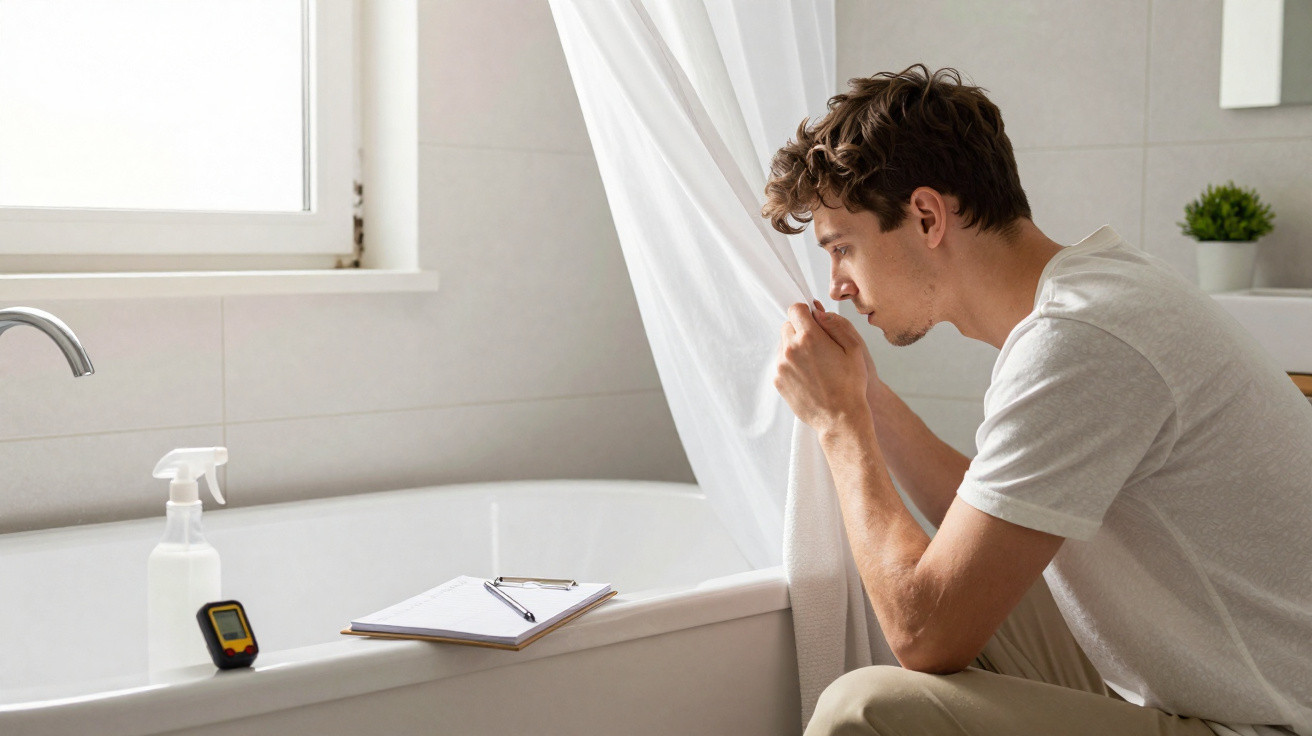
Something smells ‘odd’. Not sharply unpleasant like rubbish, not clearly like a drain – more like a dull, slightly musty film hanging in the air. You clean, open the windows and perhaps light a scented candle. Yet the smell remains. Or it returns whenever the air becomes humid. Along with it comes that nagging thought: am I breathing in something harmful? Mould does not always appear as obvious black marks on a wall. It often starts out of sight – while your nose has already sounded the alarm. We tend to call it an ‘old building smell’ or blame it on a damp day. But it could be more than that.
When the bathroom smells ‘tired’: the hidden clue in the air
Anyone who showers last in the evening will know that dense, steamy feeling: the mirror has misted over and the tiles gleam. In many bathrooms, a distinctive odour mixes with the steam at precisely that point. It does not smell fresh or clean; rather, it is as though the room itself has endured too many wet days. Some describe it as ‘wet laundry left in the washing machine for too long’. Others call it ‘a light version of an old cellar’. There is often more truth in this smell than we would like. The bathroom may look clean, but its air tells a different story.
One example from a block of flats in Munich is particularly memorable. A family complained of constant headaches, scratchy throats in the morning and a recurring cough in their youngest child. There was nothing visible in the bathroom. The grout was white, the ceiling newly painted and the shower enclosure new. There was only that faint, dull smell after every shower, which no room fragrance could cover up. For weeks, they initially suspected pollen, stress or a wave of colds. Only when a professional arrived and opened the ventilation unit did the real culprit become visible: extensive mould growth behind the panelling, which had been quietly spreading for months. Their noses had raised the warning early on. No one really wanted to believe them.
Smells are often the first indication because spores may already be in the air long before they develop into dark patches. Mould thrives in damp, poorly ventilated corners – and bathrooms provide exactly that: warm air, condensation, tight recesses, silicone seals and voids behind tiles. If organic material or dust collects there, the fungus has a buffet. While we stand under a hot shower feeling relaxed, spores can be released and enter our airways with every breath. Our nose registers something as ‘unusual’ – while our mind calls it routine. That is where the problem begins.
What hidden mould in the bathroom really smells like
The most common description of mould odour in a bathroom is ‘musty’. But musty is a broad term. Pay closer attention: does it resemble damp cardboard that has been stored in a cellar? Old books in a poorly ventilated library? Or a damp sponge that was rinsed out too late? A bathroom affected by mould often has a heavy, slightly sweet and decaying note in the air, particularly after showering. The odour lingers in towels, settles into shower curtains and returns whenever humidity rises. That characteristic cellar-like undertone is a familiar hidden classic.
We all know the situation: you leave a hotel bathroom and think, ‘Wow, it smells rather strange in here’, then put it down to the local water or cleaning products. In truth, bathrooms like these are often small practical lessons in hidden mould. One common pattern is that everything smells stronger after a shower, yet the odour remains even after 30 minutes with the window ajar. Or it is there first thing in the morning, although nobody has used the bathroom for hours. That very consistency is a strong sign. There may be clean limescale remover and fresh soap, yet the room still seems olfactorily tired, almost slightly unwell.
Behind that odour lies a straightforward fact: mould fungi produce volatile organic compounds, known as MVOCs. These compounds are what we perceive as the ‘musty mould smell’. They arise as the fungus grows and breaks down materials. In other words, if your bathroom smells, the fungus is already active. Not every type of mould has an equally strong odour, and some people notice it more readily than others. People who smoke, use lots of fragrance sprays or clean with heavily perfumed products can mask these signals. Let us be honest: nobody deliberately investigates their bathroom with their nose every day. Yet sometimes, doing precisely that would be healthier.
The bathroom smell checklist: test your bathroom in 5 minutes
A simple smell test does not require a laboratory, only a little attention. Before going to bed, close the bathroom door, air the room briefly and then leave it undisturbed. Do not use scented candles or air fresheners, and do not leave cleaning products open. The following morning, open the door and deliberately take one deep breath. What is the air like in that first instant? Is it neutral and slightly fresh, or does a heavy, dull note immediately push forward? Repeat the test after a hot shower: close the door, wait five minutes, then smell the room again. The pattern across these two moments can tell you a great deal.
When dealing with a mould smell, many people make the same mistake: they tackle the odour first, rather than its cause. Air fresheners, fragranced toilet blocks, sprays, scented candles and essential oils merely layer perfume over a biological problem. If your bathroom smells of ‘summer mango splash’, you may eventually stop noticing the damp note altogether. Then a minor mould issue can gradually become a genuine health risk. Another classic error is repeatedly cleaning the same visible areas while overlooking grout, silicone edges, the underside of the shower mat, the shower hose or the wall behind the towel radiator. These are precisely the places where the source of the smell often hides.
An indoor hygiene expert once told me a sentence that has stayed with me:
“The nose is often the best early-warning sensor – it speaks up long before mould growth becomes visible.”
If you repeatedly notice a suspicious note during the smell test, it is worth systematically checking typical mould hotspots:
- Grout and silicone edges around the shower and bath
- The reverse sides of shower curtains and bath mats
- Ceiling corners, especially above the shower
- Ventilation shafts, filters and extractor-system covers
- Areas behind furniture or laundry baskets against external walls
The sooner you take it seriously, the smaller the problem will remain – and the more freely you can breathe again.
What a bathroom smell can reveal about health
Anyone who has consciously used their nose around their own bathroom soon notices that the smell changes with everyday life. After days of doing lots of laundry, leaving windows on the latch throughout winter or taking several hot baths in succession, the air becomes heavier. This is no coincidence, but a small status report from the indoor air. If you regularly leave the bathroom in the morning with a slightly blocked nose, if your eyes sometimes sting or your throat feels scratchy, the smell may have been signalling mould spores for some time. Not dramatically, but persistently. That is how many things begin.
Many people live for years with a ‘typical bathroom smell’ without connecting it to tiredness, headaches or irritated sinuses. Mould spores do not affect everyone in the same way. Children, older people, people with asthma and those with allergies often react more sensitively. A slightly musty bathroom may merely be annoying for one person, while for another it may trigger a constant runny nose. There is one uncomfortable but accurate point: the air does not stop at the bathroom door. Each time we open it, we distribute whatever is floating in the air throughout the rest of the home. The bathroom is often the smallest room, but it has the most intense air story.
As you read this, you may be thinking of one very specific scene: that corner above the shower that always looks ‘slightly grey’. The towel that never smells truly fresh. The extractor fan whose grille has been dusty for months. These are all small pieces of a puzzle. And somewhere between them is your nose, quietly reporting for weeks or months: ‘Something is not right here.’
| Key point | Detail | Value for the reader |
|---|---|---|
| Smell as an early warning sign | A musty, ‘cellar-like’ odour that becomes stronger after showering or overnight | The reader recognises that an unfamiliar bathroom smell can be the first sign of hidden mould |
| Simple smell checks | Set the bathroom to ‘neutral’ in the evening, then deliberately smell it in the morning and after a hot shower | A practical method for getting an initial sense of air quality without measuring equipment |
| Typical mould hotspots | Grout, silicone, shower curtain, ventilation and ceiling corners | The reader knows exactly where to look if the smell seems suspicious |
FAQ:
- Does every case of mould growth in the bathroom smell the same? No. Some mould types have a very intense musty smell, while others are weaker or almost neutral. The overall impression is also altered by the mix of cleaning products, soaps and room fragrances.
- Can my bathroom smell of mould even if I cannot see anything? Yes, and that is actually common. Mould often grows behind panelling, in grout, beneath silicone or inside ventilation shafts – places that are barely noticed in day-to-day life.
- At what point is a bathroom smell a health concern? A noticeable musty, damp-cellar-like odour that remains despite cleaning and airing should be taken seriously, especially if symptoms such as coughing, headaches or irritated mucous membranes occur at the same time.
- Is it enough to use fragrance sprays if my bathroom smells odd? No. Fragrance sprays, candles and blocks only conceal the smell, not its cause. Anyone who uses them continually will usually notice potential mould growth later than necessary.
- When should I call in a professional? Professional help is sensible if the smell is strong, mould patches appear, you have health complaints or you suspect hidden growth behind walls or panelling. In rented homes, an expert report can be particularly helpful in clarifying the next steps.




Comments
No comments yet. Be the first to comment!
Leave a Comment