
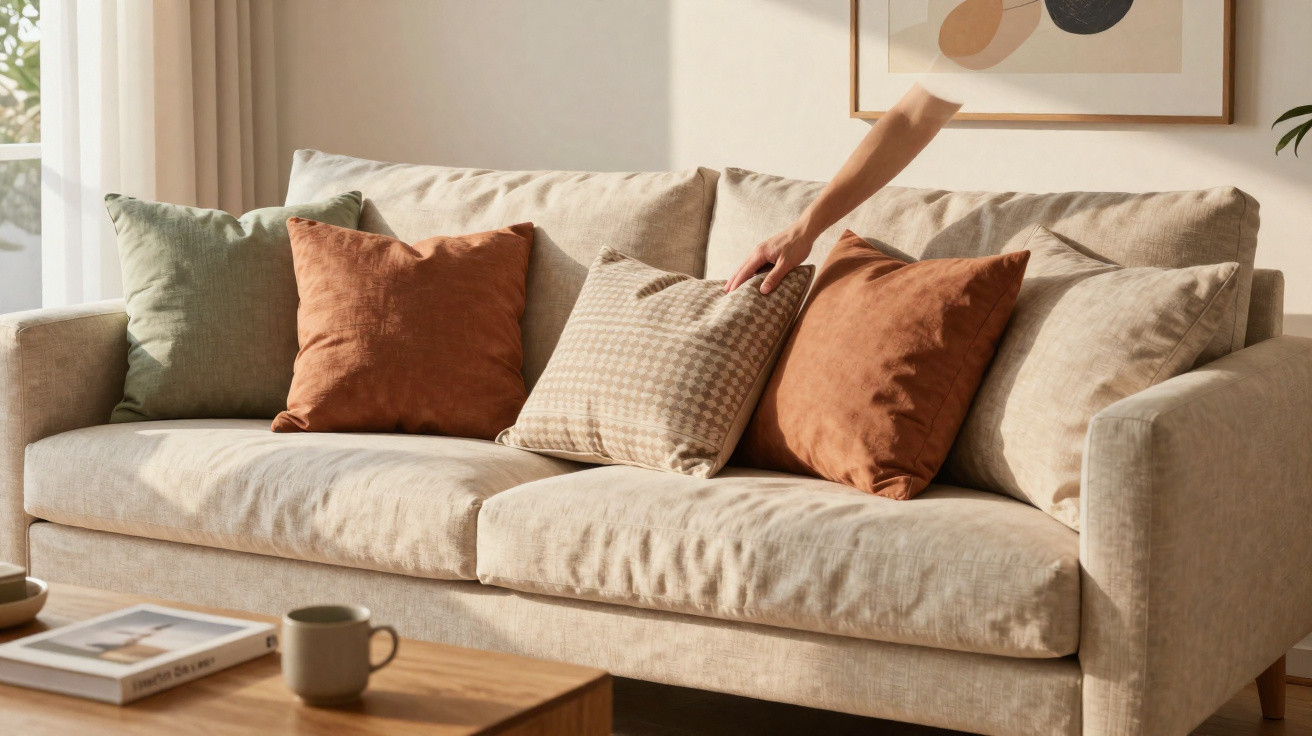
On a Saturday morning, the living room can suddenly feel oddly flat. The sofa is clean, daylight is coming in nicely, the coffee table has not moved… yet something feels wrong. More often than not, the cushions let the whole look down: they are too small, too neatly lined up, or left in place as if the children had abandoned a long-forgotten battle. We all know that moment before guests arrive when we straighten a cushion, feeling as though we ought to redecorate the entire room.
The good news is that you do not need to replace the sofa or rush out to buy ten accessories. The number of cushions, their scale and the way they work together can completely shift the atmosphere, turning a slightly cold living room into a corner where you want to curl up with a coffee. One principle comes up repeatedly among interior designers: choose an odd number. It sounds straightforward, but it makes a considerable difference.
Why interior designers nearly always use an odd number of cushions
On a sofa, three cushions catch the eye differently from two or four. They introduce a gentle sense of movement and a lived-in quality that strict symmetry cannot achieve. Two matching cushions, one at either end, can look very elegant in a traditional interior; at times, though, they can also suggest that nobody ever sits there. With three pieces, the eye moves naturally between the shapes, textures and colours.
In a Paris flat visited recently, a fairly ordinary beige sofa looked almost new once three cushions had been added: two large ecru squares, followed by a tobacco-brown rectangular design placed in front. The budget was far from extravagant, at around €90 for the three covers and their inserts. Even so, the overall effect resembled a carefully styled shop display. What made the difference was neither the brand nor the price, but that slightly off-centre balance.
The odd-number rule works because our eyes instinctively look for a focal point. With three cushions, the middle one acts as an anchor, even when it is not positioned precisely in the centre of the sofa. With five, you can arrange two groups and place one statement piece between them. Controlled asymmetry is not disorder: it simply makes a home feel lived in. That is something overly perfect photographs sometimes forget.
The right cushion size depends first on the sofa’s depth
Before selecting a colour, consider the proportions. On a compact two-seater sofa, a 45 x 45 cm square cushion is often the safest choice: it adds comfort without swallowing up the seat. On a large corner sofa or a deep design, 50 x 50 cm, or even 60 x 60 cm, is more in keeping with the scale. A tiny cushion against a generously sized backrest looks shy, almost accidental.
A very simple approach is to measure the backrest height and the width of one seat before shopping. If the backrest is low, avoid piling up cushions that are too tall and prevent you from leaning back; if the sofa is deep, be bold enough to choose a larger size that can genuinely support your back. Let us be honest: hardly anyone does this every day. Yet spending five minutes with a tape measure prevents frustrating returns and cushion covers ending up at the back of a cupboard.
Mixing sizes creates the sought-after depth, provided the hierarchy remains clear. A large square establishes the base, a smaller or rectangular cushion brings the arrangement to life, and a contrasting texture supplies the finishing touch.
“A cushion should look as though it has found its place naturally, not as if it has been punished in a corner of the sofa.”
- Two-seater sofa: three cushions measuring 40 to 45 cm, or two squares and one rectangle.
- Three-seater sofa: three to five cushions measuring 45 to 55 cm, depending on its depth.
- Corner sofa: five or more cushions, arranged in small groups rather than a single line.
Three, five or seven: finding the right rhythm without crowding the living room
Three is the right number for most everyday sofas. It leaves room to sit down, encourages relaxation and does not make it seem as though you must move the décor before watching a film. On a fairly long three-seater sofa, five cushions create a more generous arrangement: two large ones at the ends, two medium-sized options, then one smaller, more expressive piece. It is that little unexpected addition that makes the composition feel less predictable.
A common mistake is buying every cushion in the same size, texture and shade. The result is tidy, but lacks dimension. It is better to begin with a calm foundation - natural linen, warm beige, soft grey or ecru - then add a texture such as corduroy velvet or bouclé wool. A subtle stripe, botanical pattern or terracotta shade can then hold its own without becoming tiring to look at.
It is also worth considering how the sofa is used in real life. Large, soft cushions are wonderful in the evening, but they become cumbersome when the whole family gathers there; fringes are delightful until the cat decides they are its new toy. Choose removable covers, especially in a home with children or pets. And do not aim for perfection: a slightly crumpled cushion often tells a warmer story than a frozen-looking living room.
The odd-number rule does not require anyone to count every detail as though styling a shop window. Instead, it offers a guide when your eye hesitates in front of a bare sofa, a basket full of covers or an inspiration image saved late at night. Three cushions may be enough to give a small living room breathing space; five can lend presence to a large corner sofa; seven only become worthwhile if the sofa can accommodate them without compromising comfort.
You can recognise the right choice through a very practical feeling: you want to sit down without moving everything first. Cushions should work with everyday movements, support your neck during a nap, hold an open book or disappear behind someone recounting their day. Successful decoration is not always immediately noticeable. It simply makes a room easier to live in, almost quietly.
Before making your next purchase, try one very simple thing: remove one cushion, shift the other two, then look at the sofa from the room’s entrance. That distance often reveals what is missing, or what is already excessive. A deeper colour, a more generous size, an unexpected third element: the living room can take on a different mood without changing any furniture. And everyone will have an opinion about the famous cushion that, in their view, absolutely must stay.
| Key point | Detail | Added value for the reader |
|---|---|---|
| The odd number | Three or five cushions create a more flexible visual rhythm than an overly symmetrical arrangement. | A sofa instantly feels more lively and welcoming. |
| The appropriate size | 45 x 45 cm often suits smaller sofas; 50 to 60 cm works better with deep seating. | The cushions properly support the body without overwhelming the furniture. |
| The considered mix | Combining a large square, a rectangular format and a contrasting texture prevents a catalogue-like look. | The décor gains depth without requiring an excessive budget. |



Comments
No comments yet. Be the first to comment!
Leave a Comment