
Whenever a new pair of shoes comes home, its box either goes straight into the bin or takes up space at the back of a cupboard with no clear purpose. Yet the sturdy cardboard used for these boxes has precisely the strength and dimensions needed for organising drawers, shelves and wardrobes. Guided by Japanese organising principles, a shoe box can become a bespoke divider, shoe holder and storage solution that no shop can sell in the exact size required for your space.
Why a shoe box is the organiser you already have at home
Shoe boxes are made from corrugated or solid cardboard of substantial thickness - a material designed to bear the weight of footwear during transport and storage. That built-in strength makes them ideal organisers: they retain their shape over time and do not crush when stacked. Unlike milk cartons, which need cutting and reshaping, a shoe box already has a rectangular form that fits naturally into drawers, shelves and wardrobe compartments.
Japanese organising philosophy - made widely known through Marie Kondo’s KonMari method - promotes this kind of practical reuse: making functional use of what is already at home, avoiding needless spending and cutting the amount thrown away. Keeping a shoe box is not hoarding a useless object; it means having a free organiser ready whenever you need it.
- Drawer dividers for underwear and socks: cut the lid and base to the required height to create sections that separate categories and stop everything becoming mixed together.
- Organising and protecting less frequently worn shoes: storing each pair in its own box, labelled on the outside, allows boxes to be stacked without damaging the leather or soles.
- Vertical support for folded T-shirts: boxes placed upright inside a drawer prevent stacks of T-shirts from falling over when an item is removed from the middle.
- A compartment for rolled accessories: individually rolled scarves, belts, ties and neck scarves remain tidy and visible in a lidless box on a shelf.
- No-cost, genuine reuse: the box that would otherwise be discarded can serve as an organiser for months or years before eventually being recycled.
Idea 1: drawer dividers for underwear, socks and accessories
The underwear drawer is one of the areas most likely to become messy again soon after it has been organised, because everything fits together and there are no natural divisions. Use the lid and base of a shoe box as compartments within the drawer. Trim down the sides of the lid to the necessary height, then arrange the boxes side by side to fill the drawer’s full width. Assign each compartment to one category: socks on one side, pants or knickers on another, and smaller accessories in a third area.
The result is a drawer in which every item has its designated place, making it far easier to keep in order than an open space shared by everything. Once each item has its own spot, putting it back in the right place after washing takes no effort - the habit develops naturally because the system is intuitive.
Idea 2: store and stack shoes with protection and visible labels
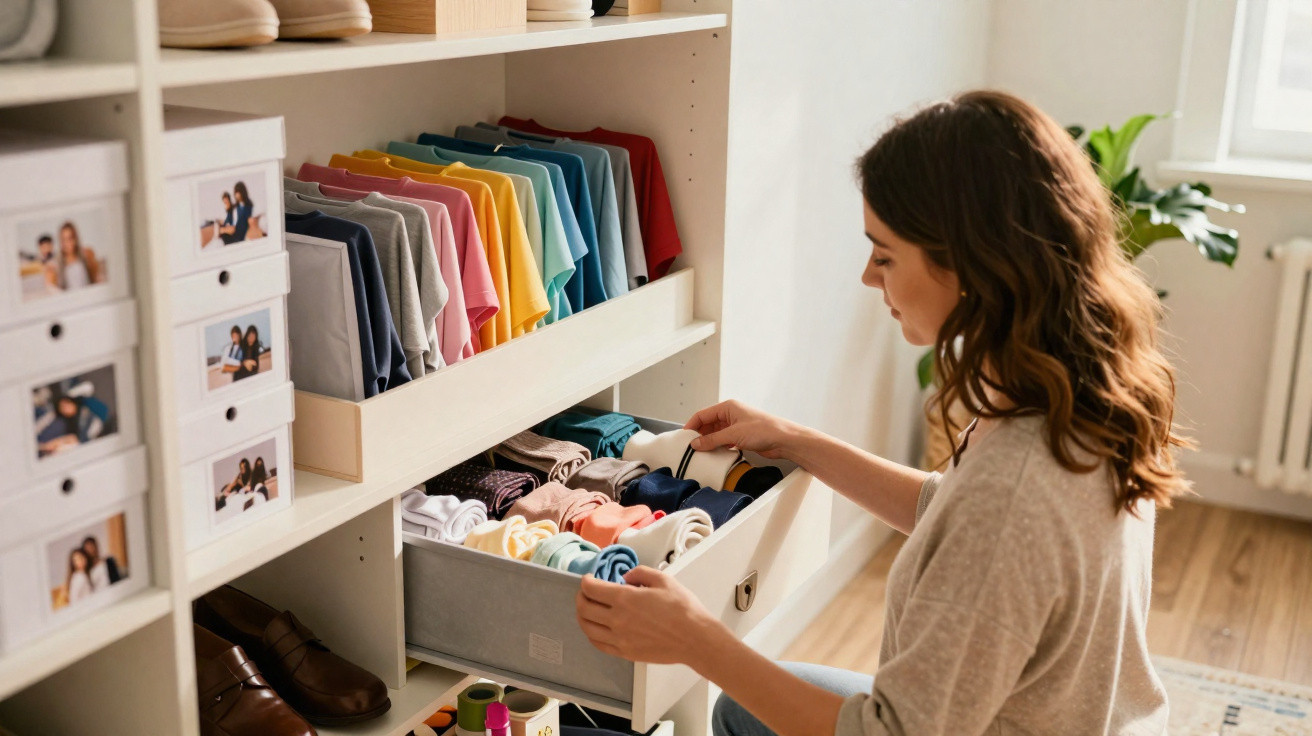
Shoes left unprotected on open shelves gather dust, can lose their shape and, when piled on top of one another without support, can damage each other’s leather. Keeping every pair in its own box solves all three issues at once. To make the system practical without opening each box to see what it contains, stick a photograph of the shoes to the front or write a simple description using a permanent marker.
How to use Japanese visibility principles in the wardrobe
The principle that makes any small wardrobe functional
The KonMari method recommends that everything should be visible at a glance, without having to rummage through piles or open several boxes to find what you want. For shoes, this means placing labelled boxes with their opening facing forwards, so the label or photograph remains in view. For clothes, it means folding garments vertically - like books on a shelf - rather than stacking them horizontally.
Very high shelves should hold less frequently used items - clothes for another season, blankets and suitcases - while items used every day should occupy eye-level storage. This frequency-based arrangement, combined with the visibility provided by labelled boxes, removes time spent searching for belongings and greatly reduces the chance of buying something already in the wardrobe but hidden from sight.
Stacked shoe boxes are considerably more stable than shoes piled directly on top of one another. External labels give immediate access to any pair without having to move another box. In particularly small wardrobes, shoe boxes with removable lids can be stacked four or five high without the risk of toppling over.
Idea 3: vertical T-shirt support that stops piles from falling over
Storing T-shirts in horizontal piles inside drawers creates an unavoidable structural problem: take out an item from the middle and those above collapse, leaving the drawer messy within seconds. The Japanese solution is to fold T-shirts into compact rectangles and store them upright, like files in a filing cabinet. Positioned vertically inside the drawer, shoe boxes act as dividers between groups of vertically folded T-shirts.
With this arrangement, every T-shirt is visible as soon as the drawer is opened, so there is no need to disturb anything to find a particular one. Removing any T-shirt does not affect the others because each is supported independently. If you have shallow drawers, cut a shoe box horizontally in half to lower its height; it will then act solely as a vertical organising guide without taking up unnecessary room.
How to customise shoe boxes for a smarter finish
The main aesthetic objection to this method is the original branding and colours on shoe boxes. The simplest answer is to cover them in self-adhesive vinyl in your preferred colour, kraft paper or fabric fixed in place with hot glue. Spending an afternoon covering the boxes in the same finish completely changes the appearance of the wardrobe - the collection looks coordinated and similar to products bought from an organising shop, while costing nothing beyond the covering material.
Keeping the order you have created requires only one habit: return each item to its compartment after use. With the boxes correctly positioned and labelled, this becomes easy because every item’s place is clear and accessible. Organisation that takes effort to maintain is eventually abandoned - an effective system is one that creates zero friction when keeping it in place. Share this with anyone struggling with a cluttered wardrobe and unsure where to begin organising.

Comments
No comments yet. Be the first to comment!
Leave a Comment