
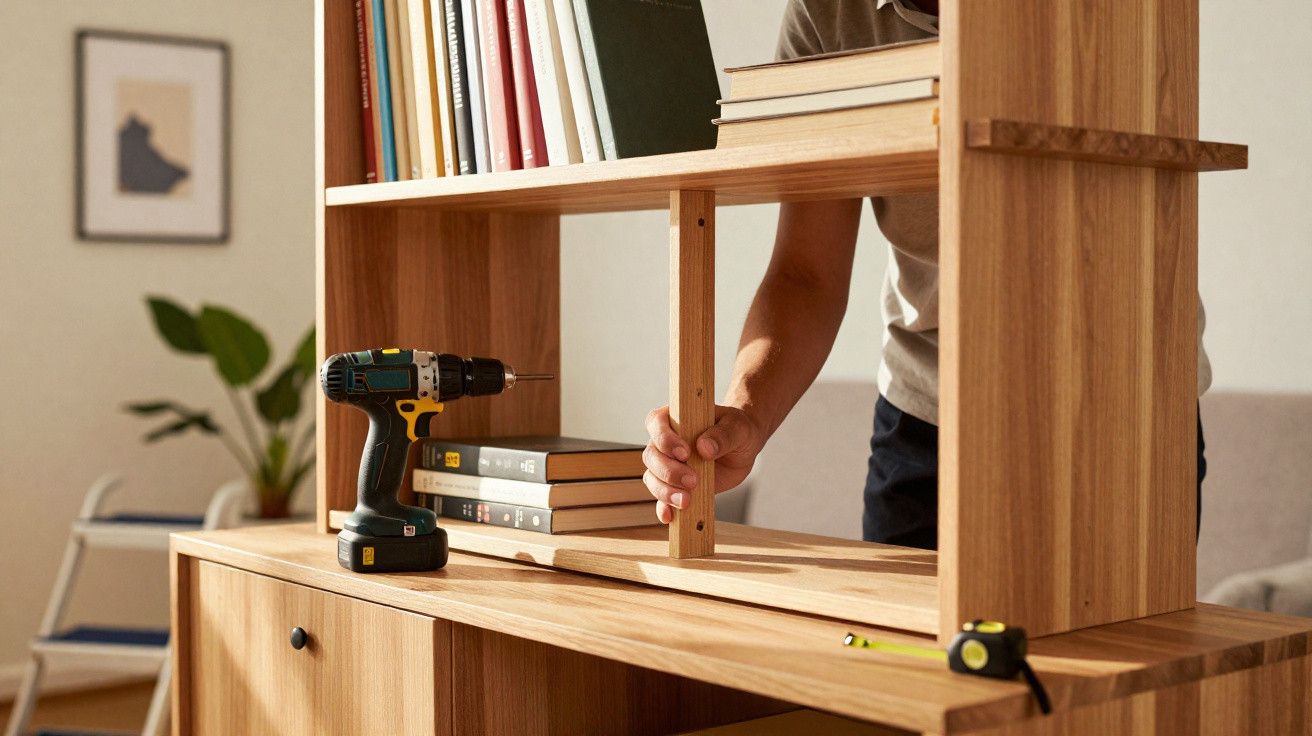
On a quiet Saturday morning, everything can seem perfectly settled until a book starts to slip sideways, an ornament leans alarmingly and the shelf appears to bow gently towards the wall. We have all had that moment of discreetly removing a few items, hoping nobody will spot the curve forming in the middle. Yet a sagging shelf does not necessarily mean cheap furniture or a poor decorating decision. More often, it is simply under strain it was never designed to take. Timber moves, brackets wear and weight builds up unnoticed. The issue then returns, sometimes in exactly the same place, like a bad habit. The good news is that the answer is surprisingly straightforward.
It is not always weight that makes a shelf bend
A shelf almost never sags overnight. It begins with a slight dip, barely noticeable and often hidden by novels, files or rows of crockery. Then one day, light from the side exposes the hollow you would rather ignore. Blaming the objects on the shelf is the natural reaction, and it is not entirely wrong. However, even a sensibly loaded board can warp when it is too long, too thin or insufficiently supported. The difference often comes down to a few millimetres of thickness and a few centimetres between fixing points.
Take a typical bookcase: an 80-centimetre chipboard shelf, 16 millimetres thick, filled with paperbacks and hardback books. On paper, that sounds unremarkable. In practice, one row of books can quickly weigh more than 20 kilograms, particularly once photo albums and dictionaries join the mix. Almost all the stress is then concentrated in the centre of the board. That is where it bends. Once the distortion has set in, it will not always straighten again, even after some of the weight has been removed. The furniture retains the memory of what it has been made to carry.
There is also a common misunderstanding between a wall-mounted shelf and one fitted inside a piece of furniture. The former relies heavily on its brackets and the type of wall, while the latter is mainly held by side shelf pins. In both cases, the weak point is usually the middle: the unsupported section where the material must cope on its own. MDF, melamine-faced board and chipboard are practical and affordable, but they do not cope well with long spans. Solid wood performs better depending on the species, although it is not indestructible. A sturdy shelf is not merely thick; it is properly supported.
The simple trick: add support where the shelf gives way
The most effective solution is to shorten the distance between support points. In practical terms, this often means fitting a central support beneath the shelf: a discreet bracket secured to the wall, a vertical support block inside a cabinet or a small divider positioned halfway along. This reinforcement halves the span, with an immediate effect. An 80-centimetre board supported in the middle no longer behaves like one long, fragile beam. Instead, it becomes two much stronger sections, without having to replace the entire piece of furniture.
Many people immediately swap a sagging shelf for a new board that looks better or is slightly thicker. That is understandable: the aim is to solve the problem quickly and restore a tidy-looking home. But if the supports remain unchanged, the replacement shelf may follow the same path within a few months. Let us be honest: nobody truly weighs their books before putting them away. It is therefore wiser to allow a small margin than to rely on perfect restraint. An extra bracket costs little, takes less than an hour to fit and prevents another disappointment.
Before drilling, inspect the precise point where the board starts to dip, then make sure your chosen support suits both the wall and the furniture. A fixing in plasterboard must not be treated in the same way as one in brick, and an ordinary screw is no substitute for an appropriate wall plug.
“A shelf rarely holds because of the board alone: it holds because it is prevented from having to span empty space.”
- Put the heaviest items close to uprights or brackets.
- Add a central support as soon as a shelf exceeds roughly 60 to 80 centimetres.
- Select a thicker board when storing books, vinyl records or crockery.
- Check the screws once or twice a year, particularly in a damp room.
Longer-lasting furniture starts with more realistic storage
A shelf does more than display attractive items. It collects the things that do not always have an obvious home: paperwork, keepsakes, stacks of magazines, gifts, board games and boxes marked “sort later”. That is exactly what makes it vulnerable. Adding central support and spreading the load more evenly does not turn your living room into a woodworking workshop. It simply gives the furniture a fair chance to perform the job assigned to it. Heavy items should sit against the supports, while lighter ones belong in the centre: this small detail changes everything.
There is also a matter of perspective. A bowing shelf often reflects a lived-in home, rather than a DIY failure. It shows that you read, collect things and keep belongings that matter to you. But it can also serve as a useful warning: reinforce it before anything breaks, particularly above a desk, sofa or bed. A straight shelf is nearly as calming as a tidy room. And when the reinforcement is well selected, no one really notices it except you, whenever you finally look at that perfectly stable line.
| Key point | Detail | Benefit for the reader |
|---|---|---|
| Span matters | A long shelf is more likely to bend in the middle, even when it appears thick. | Understand why a shelf warps without blaming weight alone. |
| Central reinforcement changes everything | A bracket, support block or divider greatly reduces the unsupported section. | Get a simple, low-cost and lasting solution. |
| Storage protects the furniture | Heavy objects should stay close to supports and uprights. | Prevent the problem from returning after a few weeks. |





Comments
No comments yet. Be the first to comment!
Leave a Comment