
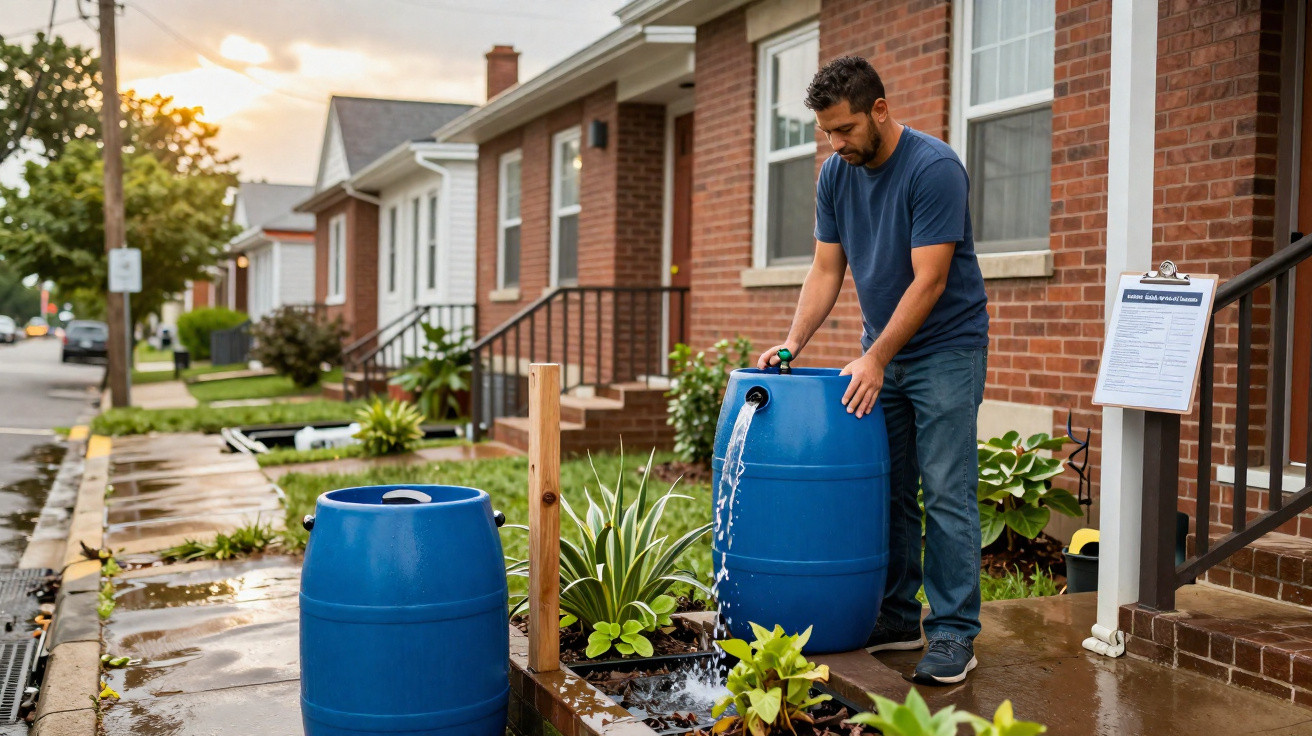
Most people view rain barrels, low-flow toilets and water-saving plumbing as tools for conserving water and cutting utility bills. Urban flood planners, however, have seldom considered them major pieces of infrastructure.
New research indicates that, if sufficient households make these modest changes, their combined effect can substantially curb urban flooding and sewer overflows – even as climate change delivers more intense rainfall and higher sea levels.
Where urban flooding starts
The research focused on Cramer Hill, a residential area of Camden, New Jersey, situated beside the Delaware River.
The neighbourhood has about 9,400 residents across approximately 3.4 square kilometres, with much of the area falling within the state’s designated coastal hazard zone.
Tidal water enters the drainage network, while storms cause sewers to back up. When flooding occurs in the neighbourhood, the water appearing on streets contains more than rainwater.
Camden, along with Philadelphia and numerous older cities on the US East Coast, relies on a combined sewer system. A single pipe transports both sewage and stormwater to the treatment works.
During severe storms, those pipes exceed capacity and discharge overflow into the river. Together, the two cities release roughly 61 billion litres of this mixture annually, despite decades of compliance efforts under federal regulations.
How household measures affect Cramer Hill flooding
Dr Amanda Carneiro Marques, an assistant professor at Drexel University’s College of Engineering, headed the research team.
Using rainfall and tidal data from 2014, the researchers created a hydraulic model of Cramer Hill at block level and tested 16 combinations of household interventions.
They assessed outdoor approaches – rain barrels and cisterns – separately from indoor measures, such as greywater reuse, in which water from sinks is used to flush toilets, and water-efficient fittings.
The scenarios included varying barrel capacities, uptake rates and combinations of measures. The team monitored each one at five outfalls where the sewer system discharges into the Delaware River.
Before this study, these strategies had not been modelled together at this degree of detail. Previous research had examined outdoor and indoor solutions independently and on a smaller scale.
When neighbourhood-wide adoption takes hold
In the model, combined sewer overflows fell by as much as 11 percent when 75 percent of households adopted the complete package: rain barrels, efficient fixtures and greywater reuse.
Floodwater volumes declined by as much as 13 percent. These reductions resulted from changes within individual homes rather than additional tunnels or greater treatment capacity.
“This finding is an important and encouraging piece of information for municipalities that are facing similar challenges,” said Marques.
“Although broad adoption of these measures can be challenging to achieve, confirmation of their effectiveness may help make the case.”
Testing the measures under climate pressure
A benefit in 2014 conditions is one matter; the key issue was whether household measures would remain effective as climate conditions became more severe.
The team reran its model with more demanding inputs: rainfall 10, 20 and 30 percent above present levels, combined with sea-level rises of 0.3 metres, 0.9 metres and 1.8 metres.
Greater rainfall produced more overflow, as expected. Rising seas restricted drainage and increased surface flooding, seemingly because water levels rose against sewer outlets. Both impacts became stronger as the parameters rose.
The household package produced the unexpected result. Even in these more severe conditions, the interventions continued to reduce overflow and flood volumes by 11 to 13 percent. Durability at that level had not previously been measured on this scale.
Small household changes quickly accumulate
Co-author Fernanda Cruz Rios, Ph.D., characterised the method as circular water: retaining rainwater on site and sending sink water to toilets rather than into the sewer.
Reducing the amount of water sent down drains lowers demand on the municipal water supply, cuts the energy required to treat wastewater and places less pressure on sewer pipes during storms. A single rain barrel cannot achieve this, but several thousand can.
“While those may seem like small steps at the individual level, we found that if they are widely adopted, they can have a significant collective impact,” said Cruz Rios.
Both cities issue utility reports recording the scale of the issue. The new model can incorporate thousands of household decisions alongside larger infrastructure interventions.
Including households in flood planning
For municipal stormwater planners, the model is the study’s most useful outcome. Camden, Philadelphia and similar cities have based drainage plans on centralised solutions – larger pipes, public green infrastructure and upstream diversions.
Measures at household level have generally remained outside these models. There had been no robust estimate of their contribution.
The study provides such an estimate. It enables planners to compare decentralised schemes – rebates, subsidised rain barrels and plumbing retrofits – with the cost of a new tunnel or treatment upgrade.
The combined sewer system, a 19th-century design that still serves millions of Americans, has long faced pressure. As storms become more intense, that pressure is likely to continue. The question is which measures can work alongside it.
Why further testing is necessary
Cramer Hill is one drainage system in one city, assessed using data from a single baseline year.
Further testing in other locations will be needed to establish whether the 11 to 13 percent reductions apply to differing pipe configurations, land gradients or drainage systems.
The 75 percent household uptake that delivered the greatest results is also an optimistic assumption, as most voluntary rebate programmes achieve much lower participation.
Making conservation part of flood protection
A practical combination of household water measures, adopted by most homes on a block, can reduce both sewer overflow and flooding by double-digit percentages.
The advantage also persists through several decades of projected climate stress. Neither result had been firmly demonstrated before this paper.
This could alter the calculation around incentive schemes. Traditionally, rebates for rain barrels and water-efficient fixtures have been regarded as conservation policy.
The study also frames them as flood policy – a component of a wider resilience strategy rather than a minor addition.
“No single intervention can fully address the intertwined challenges of combined sewer overflow and flooding,” said Marques.






Comments
No comments yet. Be the first to comment!
Leave a Comment