
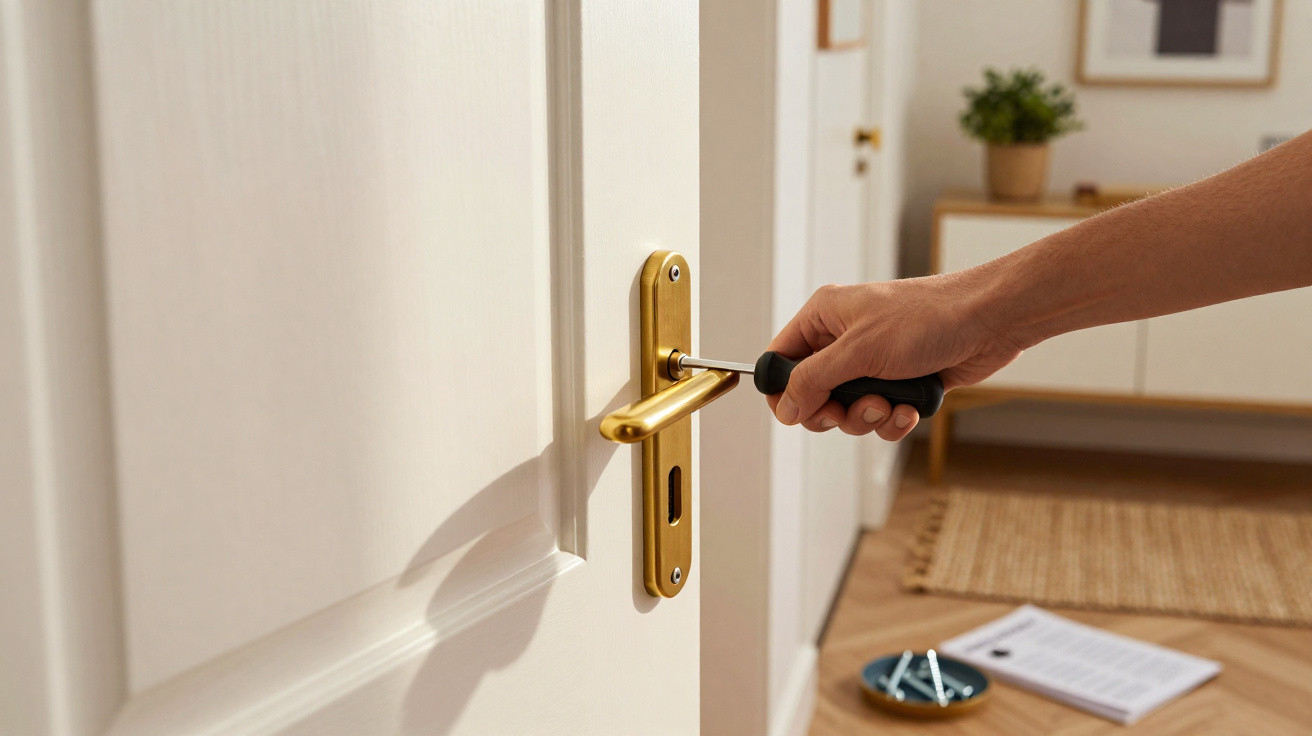
Sometimes, it takes only an everyday action for irritation to build: you press down the toilet door handle, it wobbles in every direction, then almost stays in your hand. This little routine has been going on for weeks. You tighten it quickly, forget about it, then do it all again. In a home, a loose handle can seem like a minor detail. Until the day it jams the bedroom door, traps a child inside, or leaves a guest pulling at it with a slightly embarrassed look. An unstable handle always makes it feel as though the entire door might eventually give way.
We all know the moment: you find a screwdriver that is too small in a drawer, beside a flat battery and the instructions for a piece of furniture that were never opened. You tighten one screw, the handle stays firm for two days, then starts moving around its spindle again. The issue is not always down to your DIY skills: a handle is subjected to hundreds of movements, light knocks and twists that gradually wear out its hidden components. What looks insignificant often has a very straightforward cause.
Why a door handle almost always starts to wobble
A handle never stays completely still for long. Every use puts pressure on its metal spindle, fixing screws and the rose that conceals the mechanism. In a household of four, an internal door may be operated several dozen times a day, particularly the toilet or kitchen door. The screws gradually loosen without any dramatic warning. They vibrate, develop play, and the handle then begins to sag. The most familiar sign? It no longer springs properly back to a horizontal position after being pressed down.
For Marc, who owns an older flat in Lyon, the bathroom handle dropped every two months. Unable to find his Allen key, he had got into the habit of tightening it with a coin. The real problem was a tiny grub screw beneath the handle, which had never been tightened in the correct position against the spindle. Once it was repositioned, the issue disappeared. This small screw, often so discreet that it is virtually invisible, is nevertheless the true locking point on many modern handles.
The looseness can also originate with the door itself. Timber shifts with humidity, screws grip less securely in a hollow-core panel, and a slightly dropped door forces the handle to work against the strike plate. Each time it is opened, the mechanism is put under unusual strain. The handle is not necessarily weak: sometimes the whole alignment is wearing out. Let us be honest: nobody checks whether a door is level every day. Yet a few millimetres are enough to keep this irritating movement going.
The method that stops you tightening the same door handle every month
Start by identifying the fixing type, rather than randomly pulling off the rose. On many recent models, there is a small hex socket screw beneath the lever; a 2.5 or 3 mm Allen key will tighten it. For handles with a rose, you may need to unclip the decorative cover to reach the two through-bolts. Tighten them gradually while keeping the handle perfectly horizontal. The aim is not to overtighten: excessive force can damage the thread or distort a zamak component, a widely used but fairly fragile alloy.
Before replacing the cover, test the door around ten times. The handle should press down freely, return by itself and not move the entire backplate with it. If it catches, inspect the latch bolt: it should enter the strike plate without needing to lift, push or pull the door. Many people tighten the screws when the door is already rubbing. They are doing nothing wrong, as it is a logical instinct, but the fault soon returns. A stable handle starts with a properly aligned door.
If a screw repeatedly comes loose, a drop of low-strength threadlocker can make a genuine difference, provided you choose a removable formula. Avoid superglue: when the time comes to replace the spring or remove the handle, you will seriously regret it.
“A wobbly handle does not need replacing straight away: in most cases, you simply need to find the fixing that has developed play,” notes a locksmith experienced in household repairs.
- Check the small screw underneath the handle.
- Tighten the through-bolts behind the rose.
- Check the alignment between the latch bolt and the strike plate.
- Use removable threadlocker if the play returns.
- Replace damaged screws before they begin spinning freely.
The hidden details that keep a door handle secure for longer
The quality of the hardware matters more than people might think. Budget handles sometimes have weak springs, short screws or backplates that are too thin to withstand repeated use. This does not mean you need to buy luxury fittings for every internal door. A handle with through-bolts, a decent return spring and a rigid metal rose will generally last far better than a model secured with two small screws in soft timber. The lowest price soon becomes expensive when you have to do the job all over again.
The door material also deserves some consideration. In a hollow-core door, screws can eventually spin freely if they have been overtightened or removed several times. A suitable wall plug, a slightly longer screw or a wider fixing plate can then save the whole assembly. With an old solid-timber door, the issue is more likely to be an enlarged hole. A small repair using a wooden dowel and wood glue can often restore a sound fixing without changing the entire lock.
There is also one sign that is often overlooked: noise. A handle that snaps sharply, squeaks or returns slowly frequently indicates a tired spring or a dirty mechanism. A little dry lubricant, such as graphite or PTFE, can help without attracting all the dust from the hallway. Avoid soaking it in general-purpose oil: it can seem to fix the problem immediately, then becomes sticky. A quiet door is often a door under less strain.
A small repair that changes the feel of a home
Repairing a handle is not merely about removing mechanical play. It restores that simple action requiring no thought: opening your bedroom in low light, closing the bathroom without having to lift the door, or welcoming someone without hoping they will not notice the wobbly lever. In older homes and newer builds alike, such details have a strange way of affecting everyday life. They either create an impression of neglect or provide the reassuring feeling of a well-maintained home.
Next time a handle starts to wobble, take two minutes to investigate before it becomes a real problem. Look beneath the lever, behind the rose, then at the strike plate. You may discover a tiny screw, a door that has been rubbing for months, or a spring that simply needs a little attention. And if the repair works first time, it is almost worth sharing: the best household tips are often the ones that prevent a small crisis at the worst possible moment.
| Key point | Detail | Benefit for the reader |
|---|---|---|
| Grub screw | It often locks the handle onto its metal spindle. | Identifying the right screw prevents unnecessary tightening. |
| Door alignment | A latch bolt rubbing against the strike plate puts strain on the whole mechanism. | The handle remains stable for longer. |
| Removable threadlocker | A small drop limits recurring play in the screws. | The repair lasts without preventing future removal. |






Comments
No comments yet. Be the first to comment!
Leave a Comment