
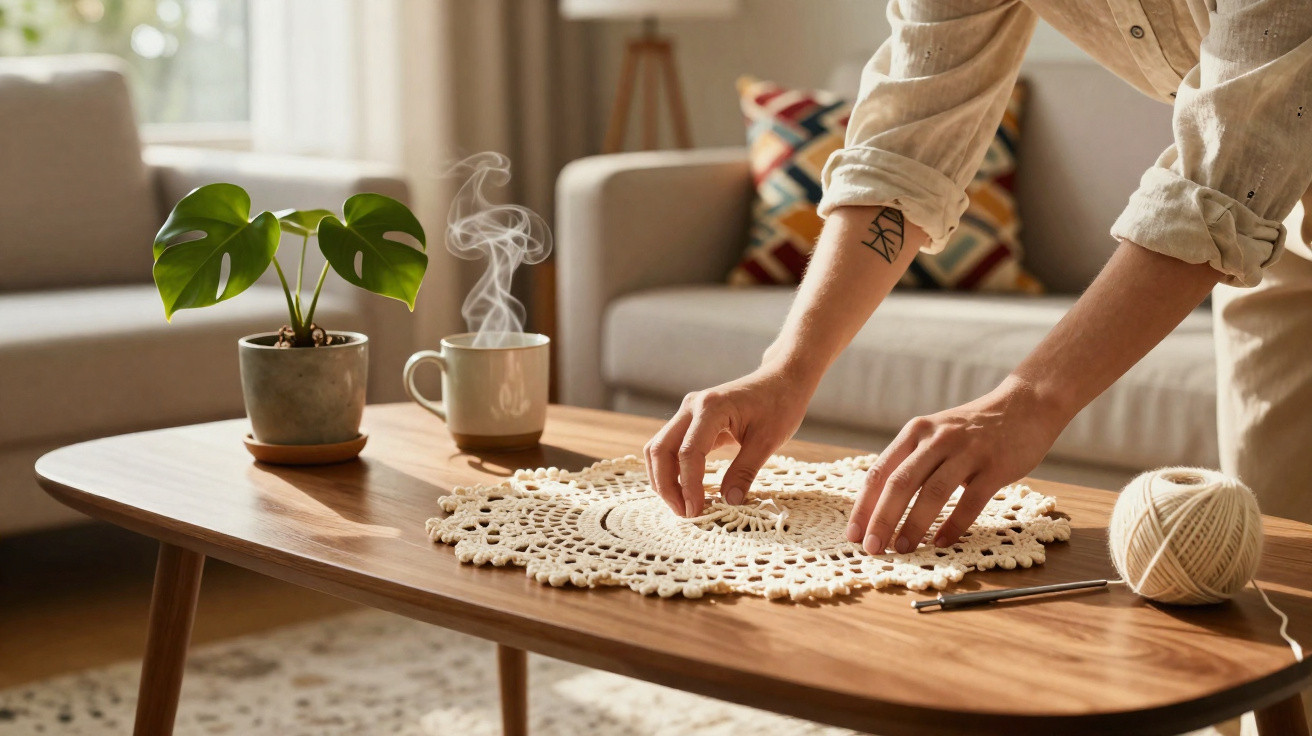
At my grandparents’ house, there was always a small white doily beneath the crystal vase, another draped over the sofa arm and sometimes a third under the landline telephone. You barely noticed them, until the day you clear out a house, open a drawer and come across these meticulously crocheted cotton squares. Today, surprisingly, the objects once filed under “old knick-knacks” are returning to coffee tables, walls and even clothing. Young decorators are hunting them down, dyeing them and framing them. The doily itself has not changed shape, but the way we see it has. And that small shift says a great deal.
The crochet doily: a slightly kitsch memory that has become desirable
We all know that unexpected return of a childhood object: the scent of furniture polish on a cabinet, a floral teacup or an overly heavy curtain. The doily belongs to that same world. Once linked with dark sitting rooms and varnished furniture, it now appears on raw timber tables, minimalist consoles and clay-coloured walls. Its appeal lies precisely in this contrast: it introduces a soft, almost delicate touch to interiors that are often highly sleek. A little imperfection gives a room space to breathe.
On second-hand platforms, bundles of old doilies can sometimes be bought for only a few pounds, while certain finely made or coloured handmade pieces are listed at between £15 and £40. In Lille, 29-year-old Clara collected a stack from her grandmother before turning them into small framed pieces for her hallway. “I thought I was doing it only so I would not throw them away,” she says. Her friends then began asking where she had found them. This is often how trends emerge: through a simple gesture, rather than from a catalogue.
This revival reflects a wider desire for homes that feel less perfect and less copy-and-paste. After years of beige décor, identical furniture and carefully calculated shelving, objects carrying a history are reclaiming their place. Crochet suggests time, patience and the work of hands. It also offers reassurance: at a time of fast purchases, keeping a textile made 50 years ago feels almost radical. Emotional vintage appeals because it does not try to look brand-new at any cost.
How to use crochet doilies without turning your sitting room into a family museum
The simplest rule is to start on a small scale. Place a round doily beneath a ceramic lamp, on a bedside table or in the middle of a tray holding a candle and two books. The contrast works especially well with contemporary materials: black metal, smoked glass, pale wood, travertine or polished concrete. If white feels too restrained, a textile dye bath can turn it sage green, tobacco brown or muted blue. One well-positioned doily is often enough to alter the mood.
The common mistake is bringing out the whole collection at once, alongside figurines, gilded vases and the matching tablecloth. Even with a fond intention, the result can quickly feel heavy. Let us be honest: nobody really does that every day. It is better to treat the doily as decorative punctuation rather than the room’s main subject. Against a white wall, three differently sized examples framed in pale wood make a surprisingly current graphic arrangement. You simply need to leave air around them.
Before displaying them, check the condition of the thread and wash them gently by hand in lukewarm water with mild soap. Yellowed pieces can sometimes regain a lovely brightness after a careful soak, followed by flat drying.
“An old object becomes modern when you dare to give it a new function without erasing its history.”
A few straightforward ideas can make taking the first step easier:
- slip a small doily beneath a sculptural vase;
- stretch one in an embroidery hoop to decorate a wall;
- sew one onto a plain cushion or tote bag;
- use one as a table centrepiece for a summer dinner.
This small square of thread may say more than our taste for retro style
The unexpected popularity of crochet doilies reveals something about our relationship with inherited objects. They are not immaculate: some bear a stain, a pulled thread or the faint scent of an old wardrobe. Yet these flaws are often what make them endearing. In décor designed for photographs and fast-moving trends, they introduce a more intimate presence. You are not simply placing a doily on a table: you are letting in an anecdote, a hand and sometimes the memory of someone who is no longer there.
The trend may also encourage us to view what lies dormant in family cupboards differently. Rather than buying everything new to “give character” to an interior, sometimes all it takes is opening an old cardboard box. Embroidery, a mismatched dinner service or a slightly yellowed doily can become the detail that stops a room looking like every other one. The most personal décor is not always expensive; it is often what you know how to talk about over coffee.
You do not need to love country style, or recreate your grandparents’ sitting room, to appreciate these pieces. Some will use them humorously, others nostalgically, and others still for their graphic beauty. Crochet accommodates all these interpretations without taking offence. So, the next time a relative offers you an old doily and says, “take it, it might come in handy”, you may feel like saying yes. Above all, you may want to ask who made it.
| Key point | Detail | Added value for the reader |
|---|---|---|
| The return of crochet | The doily appeals through its handcrafted, emotional and distinctive character. | Adds texture to décor that feels overly sleek. |
| Using it well | A single piece paired with modern materials is often enough. | Avoids an overloaded or dated effect. |
| Inheritance | Old textiles hold a family story and memory. | Creates a personal interior without multiplying new purchases. |


Comments
No comments yet. Be the first to comment!
Leave a Comment