
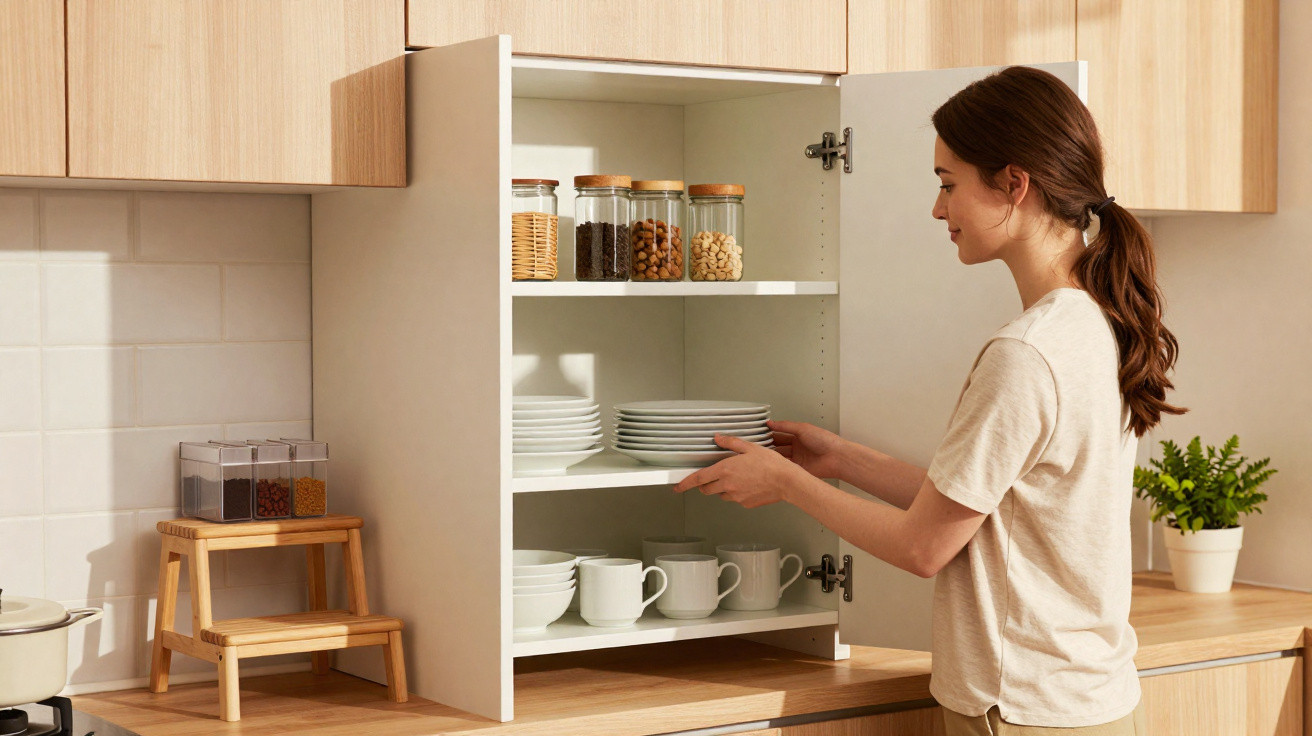
One evening, while hunting for a packet of pasta behind three cereal boxes, it suddenly becomes clear that the issue is not always the size of the home. It is how the available space is used. In small flats, every cupboard quickly turns into a tense game of Tetris: things are stacked up, forgotten, then bought again even though they were already hidden at the back. Sometimes that feeling of being hemmed in arrives before the square metres have truly run out. Yet the most effective hack comes down to one simple idea: create a second level where there was only one. A shelf, under-sink unit, bedroom cupboard or wardrobe can almost double its useful capacity with a few well-chosen dividers. The difference is apparent from the first drawer.
The unused space is often above your belongings
We have all seen a shelf that looks full despite a sizeable gap hovering above stacks of laundry, mugs or tins. That void is hard to use because it is neither accessible nor organised, so one item ends up placed on another, then a third, until nothing can be found. The hack is to add shelf risers, stackable baskets or pull-out drawers, dividing the available height into two genuinely practical sections. It may not look impressive on paper. In everyday life, though, it is almost magical: objects stop vanishing into the back of cupboards.
In an 8 m² kitchen, a simple metal shelf placed inside a cupboard can accommodate two rows of bowls rather than just one. Plates and serving bowls can go underneath, with cups, glasses or small containers above. One reader said she had freed up the equivalent of two entire shelves by fitting four risers costing less than €30 in her cupboards. The extra room did not come from a major, ruthless declutter, but from those small unused gaps between the tops of items and the underside of the next shelf. That is often where the space we believe we do not have is waiting.
This approach works because it turns depth and height into accessible surfaces. A single stack of five jumpers uses the full height, yet requires four garments to be moved to reach the last one. Two storage levels, on the other hand, make every category visible at a glance. The home feels less cluttered because items no longer spill onto the worktop or bedroom chair. Saying that storage space is doubled remains a figure of speech: it all depends on the unit and what it contains. But on tall shelves, the improvement can genuinely approach 50%, and occasionally more.
A simple way to turn a cupboard into genuinely useful space
Start with one area rather than tackling the whole home on a Sunday morning. Measure the clear height between your items and the shelf above, then consider what you use at least once a week. If that gap is more than 15 centimetres, there is probably scope to create a second level. Metal risers work well for plates and tins; clear stackable boxes better suit dried goods; and mini drawers are highly effective beneath the sink or in the bathroom. The rule is straightforward: every level must remain visible and reachable without moving everything else.
A common mistake is buying lots of boxes before checking what is already there. They look lovely and promise a kitchen worthy of a viral video, yet they can sometimes occupy more room than the belongings they were meant to organise. Let us be honest: nobody really relabels their jars every day. It is better to choose two or three sturdy, washable and adaptable formats. Open baskets, for instance, prevent lengthy searches for a product. Closed containers are useful for food or small items, but not necessarily for every cable and tube of cream.
Before ordering a single accessory, take a photograph of your open cupboard and look at it as though you were seeing the room for the first time.
“Successful storage does not hide things more effectively: it makes them easier to take out and put back.”
To achieve that much-desired double-capacity effect, keep these guidelines in mind:
- reserve the lower level for heavy, frequently used items;
- put spare supplies or lightweight objects on the upper level;
- leave a small amount of clearance so a basket can be removed without catching on everything else.
This layout also removes a subtle mental burden: you finally know where to look.
Small spaces feel calmer when every object has a level
The most surprising benefit is not simply the volume gained. It is the calm that appears when surfaces are clear again and the cupboard no longer threatens to send everything tumbling out whenever it is opened. In a studio flat, that feeling matters enormously: the kitchen also serves as an office, the living room can become a bedroom, and the smallest item left out seems to take up twice as much space. Creating levels inside furniture makes it possible to keep more belongings without making the room look like a storage area. This is not an instruction to own less; it is a gentler way of living with what you already have. Perhaps good storage is not about hiding your life, but about giving it a little room to breathe.
| Key point | Detail | Added value for the reader |
|---|---|---|
| Create a second level | Fit a riser, stackable basket or mini drawer | Make use of empty height in cupboards |
| Keep every zone accessible | Put heavy items at the bottom and lighter ones above | Avoid unstable stacks and needless searching |
| Start small | Test the method in one unit before buying anything | Gain space without spending heavily or changing the whole home |
Comments
No comments yet. Be the first to comment!
Leave a Comment