
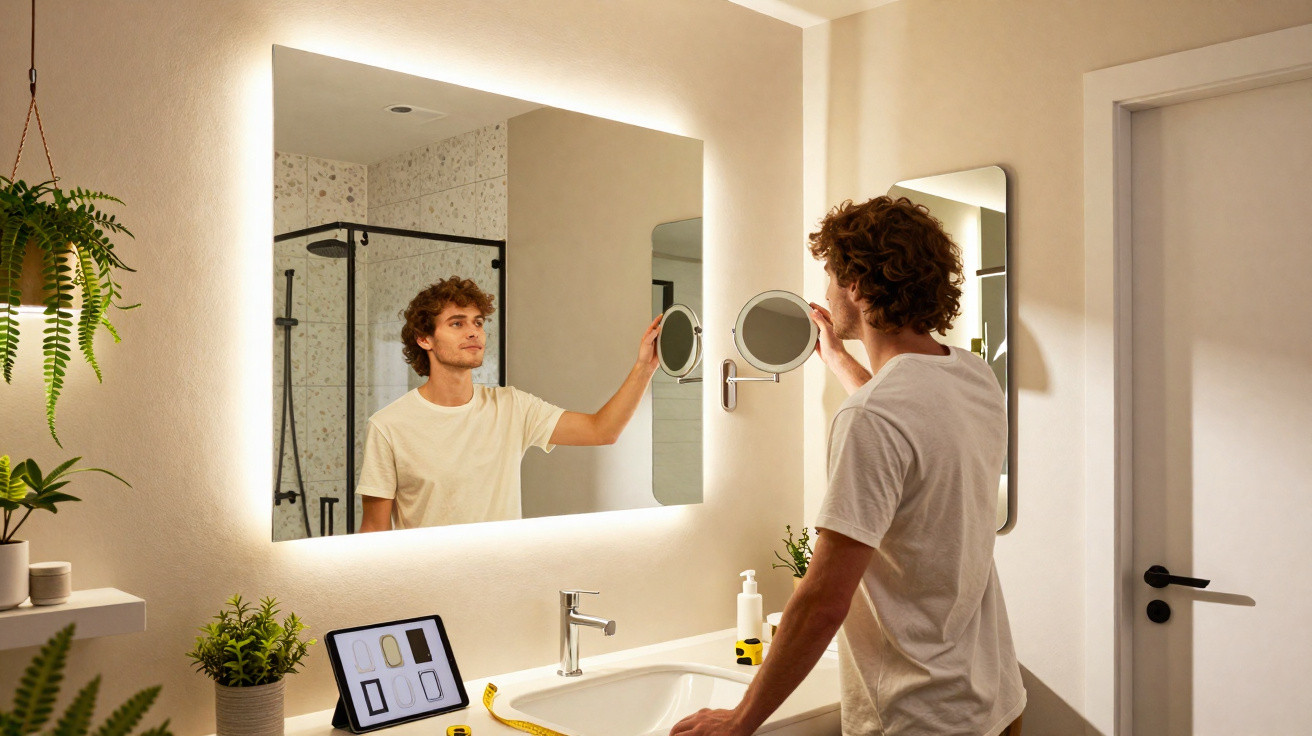
Small or poorly lit bathrooms often feel cramped, even when they are neatly arranged. In recent years, architects and interior designers have looked beyond the classic wall mirror to soften this effect. By making the mirror the focal point of the scheme, they can increase visual depth and give the room a more contemporary look without extensive renovation work.
What distinguishes a classic wall mirror from a modern bathroom mirror?
The key distinction lies in how the mirror is incorporated into the overall bathroom design. A classic wall mirror is generally a single piece positioned above the worktop, matching the width of the basin and featuring either a simple frame or none at all. A modern bathroom mirror, by contrast, often creates an uninterrupted panel, reaching the ceiling or extending along the wall in line with cabinetry and wall finishes.
Technology and scale are also important differences. Current designs frequently incorporate integrated LED lighting, indirect illuminated edges and, in some cases, an electric demister pad. Floor-to-ceiling mirrors are increasingly popular too: they visually double the height of the walls and are particularly effective in compact flats or small cloakrooms.
Watch this video from the YouTube channel Decorando Meu Apê, which discusses using organic mirrors and integrated LED lighting to give a bathroom a modern appearance:
https://www.youtube.com/watch?v=Xn72Xq6qL90
How does a large mirror make a bathroom appear bigger?
In practical terms, a larger mirrored panel acts as a visual device by reflecting walls, light fittings and finishes, creating a feeling of continuation. Placed correctly, the mirror conceals physical boundaries, distributes both daylight and artificial light, and lessens the sense of a narrow corridor, especially in long bathrooms.
To enhance this impression of space, a modern mirror is commonly paired with light-coloured finishes and clean, straight lines. Supplementary lighting, such as LED strips above or behind the glass, creates a gentle halo that elongates the vertical plane. The result is a more cohesive room that appears considerably larger.
Which solutions can replace a classic mirror without major renovation work?
Replacing a traditional mirror with a modern panel does not necessarily involve complex building work. Often, it is enough to take down the old piece, repair the fixing holes and fit a made-to-measure mirror, cut around existing sockets, wall-mounted taps and niches. This avoids making changes to plumbing or electrical installations.
Several straightforward approaches can refresh the bathroom gradually and practically, making use of the existing layout while bringing a contemporary feel to the space:
- Keep the existing worktop and fit a ceiling-height mirror across the full width of the wall.
- Replace a small mirror with two tall vertical panels, divided by a storage cabinet.
- Add LED lighting to either side of, or behind, the new mirror, using the same wiring as the existing light point.
- Make use of the area above the toilet with a mirrored strip aligned with the main panel.
How do you choose the ideal modern bathroom mirror for each bathroom size?
In cloakrooms, a large mirror often becomes the main feature, frequently running from floor to ceiling across a single wall, as there are usually fewer bulky cabinets. In medium-sized bathrooms, a continuous mirror from the edge of the worktop to the ceiling can be combined with discreet linear lighting and a compact base cabinet, leaving the upper section free for the reflective surface.
In larger bathrooms, panels are often installed on more than one surface, such as above the worktop and beside the shower enclosure, making it easier to see the full body. Whatever the size of the room, it is worth considering ease of cleaning, moisture resistance and secure fixing. Choosing polished-edge glass, suitable fittings and, where possible, anti-oxidation protection will help preserve the up-to-date appearance and the feeling of an orderly, spacious room for longer.




Comments
No comments yet. Be the first to comment!
Leave a Comment