
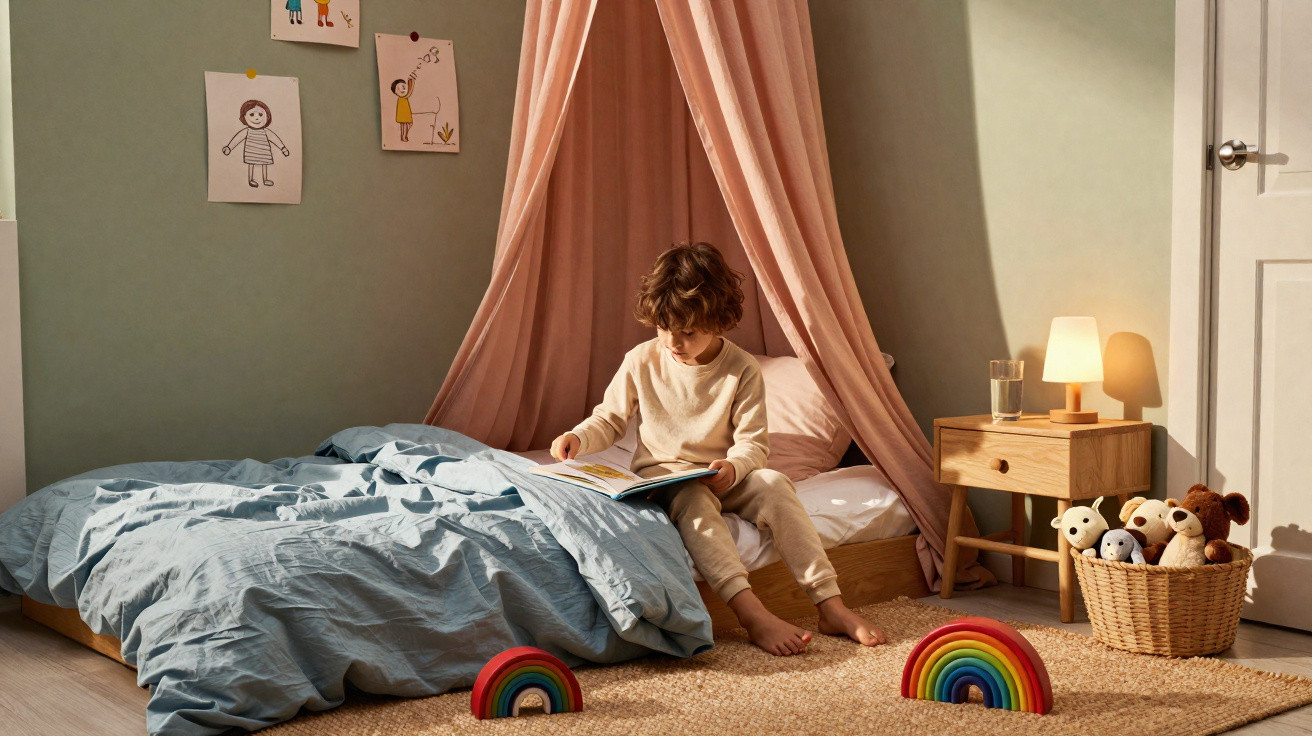
At 8.47 pm, the pyjamas are on, the night light casts a gentle glow, yet in some bedrooms the energy still seems to bounce off the walls. We all know the moment: a child asks for one more story, another glass of water, then one final check beneath the bed. Décor cannot replace routine or patience, but it can create a gentler mood when the body ought to be winding down. Colours communicate quietly too, and some seem to whisper more softly than others.
Misty blue, sage green, dusty pink and warm beige: colours that genuinely soothe
In a child’s bedroom, misty blue has the rare ability not to dominate the space. It is neither as cold as electric blue nor as gloomy as poorly judged grey; instead, it recalls the late-day light that drifts across the walls as the house begins to quieten. Colour psychology often links it with relaxation, stability and a feeling of spaciousness. For a child who is particularly sensitive to stimulation, a grey-blue wall can provide a kind of visual pause. There is nothing magical about it, simply a less hectic atmosphere.
Sage green works in a similar way, with an extra reassuring quality: it brings to mind plants, walks and leaves moving outdoors. During a decorating project involving a family from Lyon, the parents swapped a very bright apple green for a muted green. Their five-year-old daughter did not suddenly stop waking in the night, of course, but they felt bedtime became less charged. Researchers studying care environments also note that natural tones can support a sense of recovery. A bedroom is not a hospital, but the principle remains meaningful.
Dusty pink and warm beige complete this group of four with a more cocooning presence. Free from sugary pink and its sometimes overpowering associations, the former brings gentle warmth without overstimulating the eye; the latter creates the feeling of a simple, almost tactile nest. A calming colour is not the same as a dull one: it is a colour that allows the room to breathe. The real key often lies in saturation: the less strident a shade is, the less likely it is to keep a child alert. Bold colours stimulate, while powdery shades support calm.
Using calming bedroom colours without making the room look like a catalogue
The easiest approach is to pick one main colour, then use it on a single wall, in the bedding or through a large rug. Misty blue behind the bed, for instance, creates a clear cue for sleep without darkening the whole room. Sage green pairs beautifully with light wood and natural-fibre baskets. With warm beige, paint with a slight pink undertone prevents the room from feeling like a show-home. One carefully selected soft shade is better than a permanent rainbow.
A common mistake is trying to spark the imagination everywhere: colourful stickers, toys left on display, multicoloured fairy lights, patterned walls, numerous prints and cushions. It may look charming in a photograph, but it is less helpful when a child is staring at the ceiling at 10.30 pm. This does not mean stripping every bit of joy from the room, far from it. A book shelf, a framed drawing or a favourite soft toy is often enough to express their world. Let us be honest: hardly anyone puts every toy back in its place every day. Even one closed storage box can transform the evening atmosphere.
Before ordering ten tester pots, pay particular attention to the room’s light at bedtime. A beige shade may look yellow beneath an overly warm bulb, while a soft blue can appear grey in a north-facing room.
“A child’s brain does not read colour alone: it perceives a whole made up of light, noise, tidiness and emotional security.”
- Misty blue: ideal for creating a calm, cool sense of space.
- Sage green: a natural, gentle option that is easy to combine with wood.
- Dusty pink: best chosen in a matt finish, well away from flashy tones.
- Warm beige: perfect for making a cocooning bedroom without imposing gender codes.
The right approach: think about the child, not the latest trend
A bedroom designed for sleep need not resemble a silent hotel room or a perfect image pinned to social media. Above all, it should suit the child growing up in it. Some children are instantly soothed by a muted blue; others find it slightly cold and favour the softness of an old-rose wall or sandy beige instead. Day-to-day observation is more reliable than any trend: does the child play peacefully in this space, ask for their night light, or seem reassured when it is time to switch off? These details say a great deal.
You can also involve the child by deliberately limiting the choice. Offering two samples rather than a chart of fifty colours prevents overwhelm and gives their view a genuine place. This small step can turn a decorating change into a shared adventure: you paint, wait for it to dry, put the books back, then discover the room in a new way. The colour then becomes a memory as much as a backdrop. Calm is rarely created by a tin of paint alone, but it can begin with this very practical decision.
What feels soothing today may change in three years’ time, when preferences, fears or sleep habits have evolved. A neutral base with accessories that are easy to replace provides valuable flexibility: a sage green duvet cover, misty blue curtain or a few dusty pink prints can refresh the mood without starting all over again. The bedroom remains alive, just like the child who lives in it. And if bedtime remains difficult despite a soft palette, it is not a decorating failure: sometimes, it simply takes more time, one more story or a hand resting for a few minutes on a small shoulder.
| Key point | Detail | Added value for the reader |
|---|---|---|
| Choose desaturated shades | Misty blue, sage green, dusty pink and warm beige reduce the impression of visual overload. | Create an atmosphere more conducive to slowing down in the evening. |
| Observe the real light | The same paint changes depending on the room’s orientation and the bulb used. | Avoid unpleasant surprises once the wall has been painted. |
| Keep the bedroom personal | The child’s preferences and temperament matter more than a decorating trend. | Create a reassuring, lasting space that genuinely feels lived in. |

Comments
No comments yet. Be the first to comment!
Leave a Comment