
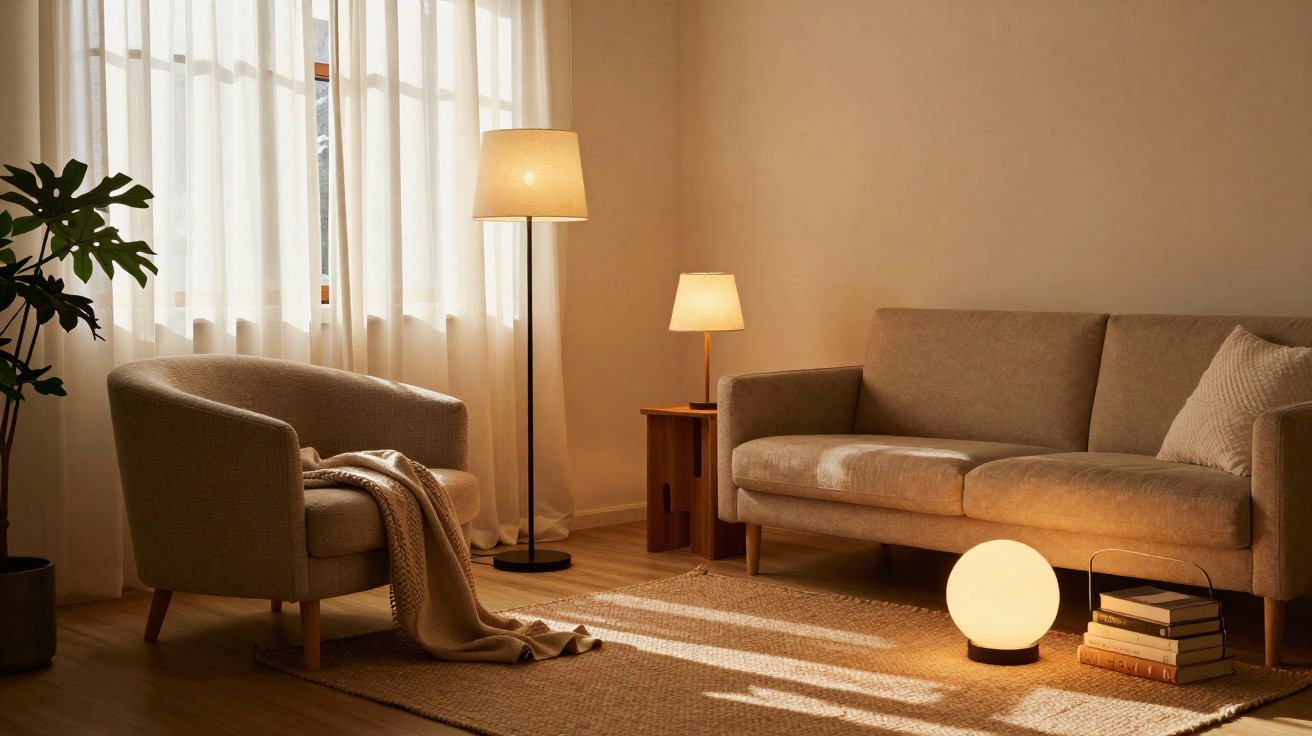
One winter evening at friends’ home, the living room seemed to have changed even though nobody had moved the sofa, rug or curtains. The ceiling light was off. Instead, a lamp beside the armchair, another tucked behind the sofa and a small light on the low cabinet created soft, almost intimate pockets of light. We all know that feeling: a tidy room can still seem cold and slightly empty, like a waiting room. It is not always about expensive furniture. Often, the lighting is telling the wrong story. Interior designers now rely on three low lamps to alter the atmosphere, with a striking result from the very first evening. One small detail can change everything.
A ceiling light illuminates a room; low lamps bring it to life
For years, the ceiling light has been the automatic choice: walk in, press the switch and the entire room lights up at once. It is practical, certainly, but seldom flattering. Light falling from above flattens texture, makes walls appear more uniform and can give a living room the slightly showroom-like feel nobody really wants after a long day. With three low-positioned light sources, the eye travels differently. It lingers on a book, a vase, the corner of a sofa or a plant. The room does not feel smaller; it simply feels more lived in.
In a 28 m² Paris flat, an interior designer replaced a central chandelier with a slim reading lamp by the sofa, a table lamp on a console table and a small illuminated globe on the floor beside a bookcase. The owner changed neither the paintwork nor the furniture, spending around €180. Yet guests were already asking whether the living room had been redecorated. This reaction is common because the eye does not judge watts: it remembers the overall impression. Well-positioned light can make previously noticeable flaws fade into the background.
This method is based on a straightforward principle: a living room does not need evenly distributed lighting. It needs distinct zones. A reading light for settling down, ambient light for conversation, and decorative lighting to add depth to a wall or object. In the evening, a living room is not used in the same way as an office. Shadows then become useful, even reassuring. They create the depth that a ceiling light often removes, especially when fitted with an overly powerful cool-white bulb.
The three-lamp rule for warming up a living room without redecorating
The easiest approach is to spread three lamps across different heights. Start with a floor lamp beside an armchair or at one end of the sofa, then add a table lamp on an occasional piece of furniture and finish with a small low lamp on the floor or a shelf. The aim is not to flood the room with light, but to establish three points of visual relief. Choose warm-white bulbs, at around 2,700 kelvins, to avoid the bluish light that quickly makes faces and beige walls look washed out.
A common mistake is buying three matching lamps and lining them up as though they were in a shop display. They can complement one another without being copies. A very slim black reading lamp, a cream ceramic lamp and a small amber-glass model will look more natural than a perfectly coordinated trio. Let us be honest: nobody genuinely rearranges their lighting every day. Positions must therefore remain practical, with cables kept out of walkways and switches easy to find without fumbling in the dark.
To prevent an overloaded effect, interior designers advise giving each light source a clear purpose rather than adding luminous objects with no particular intention.
“A lamp should not merely provide light: it should make you want to stay in the corner it reveals.”
A few simple guidelines can help achieve the right balance:
- position the reading lamp beside a seat, never behind it;
- aim a gentle light towards a wall, curtain or bookcase;
- choose a lampshade that conceals the exposed bulb;
- keep the ceiling light for special occasions or cleaning.
A softer atmosphere, even in an imperfect living room
The most appealing part of this trend is that it does not require a magazine-worthy interior. A slightly worn sofa, a second-hand coffee table or characterless white walls can all gain presence when light is placed in the right spot. Three low lamps do more than transform the décor: they change the pace of the evening. You first switch on the one in the reading corner, then the lamp by the sofa, and the living room seems to suggest it is time to slow down. This small ritual is very tangible, far removed from impossible-to-follow decorating dictates.
Some people will favour golden light, while others will prefer more neutral lighting to maintain a contemporary feel. The key is to assess the room at the time it is actually used, often after 19:00, when the windows turn into mirrors. The warmth of a living room does not always come from an on-trend colour or a new sofa. Sometimes it lies in a discreet bulb, the shadow of foliage on the wall, or a corner that was never used and eventually becomes somewhere to sit. The best arrangement will be the one that makes you want to come home a little earlier.
| Key point | Detail | Added value for the reader |
|---|---|---|
| Three light sources | A floor lamp, a table lamp and a low light | Create depth without replacing furniture |
| Warm-white bulbs | Around 2,700 kelvins for a soft atmosphere | Avoid an overly cold, clinical effect |
| Zoned lighting | Reading, conversation, decoration | Make the living room more welcoming every day |



Comments
No comments yet. Be the first to comment!
Leave a Comment