

Sometimes all it takes is a slightly gloomy evening, a living room that feels smaller than usual and a lamp tucked into a corner to realise that lighting changes everything. You switch on the ceiling light, wince at its flat glare that washes out the colours, then end up looking at a screen rather than the room itself. Yet a 15-minute DIY job can completely alter that feeling: fitting an LED strip behind a piece of furniture, where it cannot be seen directly. Instead of hitting you in the face, the light runs across the wall and suddenly gives the space more depth. It is subtle, almost magical. Once you have tried it, it is hard to go back.
Hidden lighting that changes the mood without changing the room
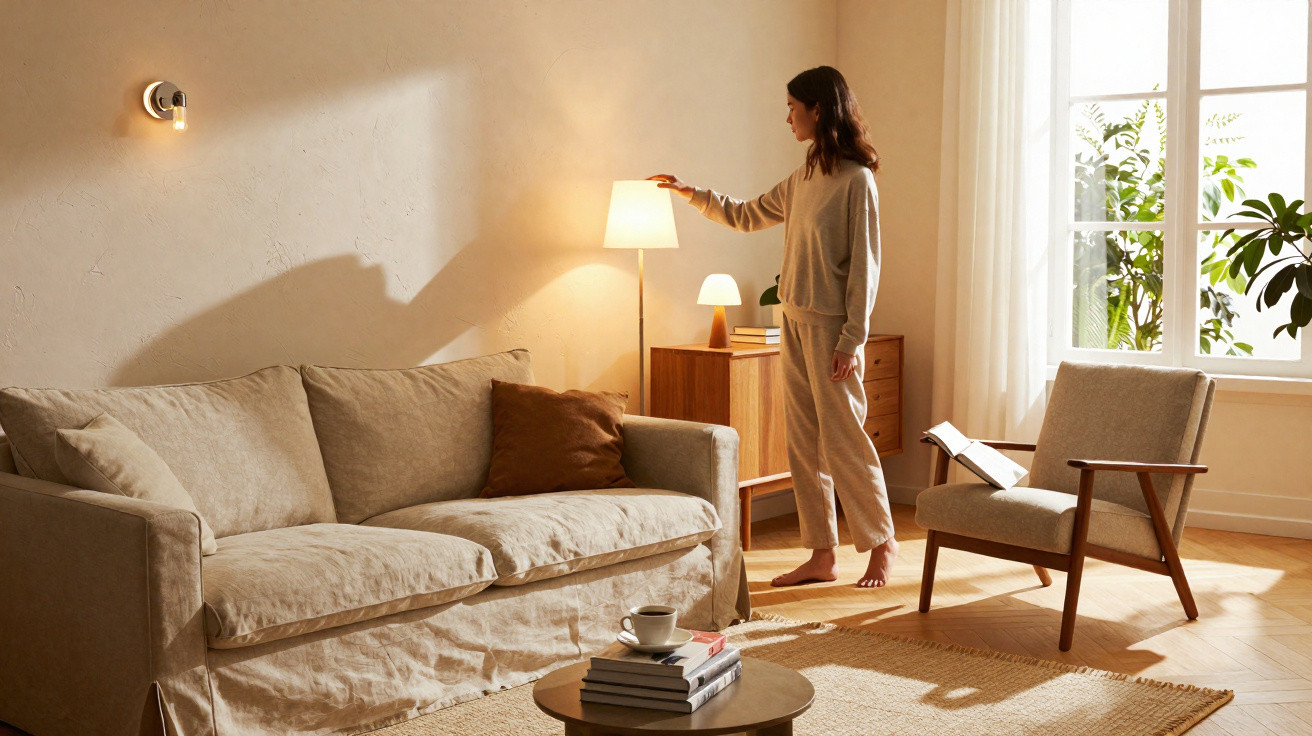
We have all known a room that is clean, tidy and sometimes even nicely decorated, yet still seems to lack warmth. The issue is not always the sofa, curtains or wall colour; often, it is the single ceiling fitting that lights everything in exactly the same way. An LED strip fixed behind a television, headboard, sideboard or mirror creates a soft glow instead. The wall becomes a luminous surface, corners soften slightly and the room immediately feels less harsh. The furniture stays where it is, but what it says in the evening changes.
For Léa, in a fairly typical Parisian one-bedroom flat, the experiment began behind a low unit in the living room. She bought a 2-metre warm LED strip with a self-adhesive backing and USB plug for less than €20. Fifteen minutes later, the effect was striking: her white wall appeared to have gained a few centimetres of depth. Her partner even asked whether she had repainted it. It is the kind of detail that makes you smile because it shows that the eye reads a space long before looking for an explanation. Indirect lighting can make a room feel wider without moving a single item of furniture.
This DIY project relies on a very straightforward principle: rather than directing light straight at your eyes, it bounces it off a surface. The wall then spreads the illumination more softly and evenly. Shadows remain, but become less severe. It also avoids the “waiting room” effect created by some overly powerful white bulbs. Indirect lighting draws less attention to itself while improving the overall atmosphere. It suits a conversation, a late meal or a film, without making you feel as though you are living under office strip lights.
The 15-minute DIY project requiring hardly any tools
Start by choosing the spot where the glow will have the greatest impact: behind the television if you often watch films, beneath the lip of a sideboard to make a bulky piece look lighter, or behind a headboard to replace an overly bright bedside lamp. Wipe the area with a dry cloth, unroll the LED strip and stick it a few centimetres in from the edge rather than right on it. That small gap keeps the individual light points out of sight and produces a softer finish. Plug it in, test it and adjust it. If your strip has a remote control or app, begin with a warm white setting of around 2,700 kelvins.
The most common mistake is choosing bluish light because it looks dramatic on the packaging. In a real living room, that shade can quickly create a cold, almost artificial mood, particularly with white or grey walls. Let us be honest: hardly anyone changes their LED colour every day to match their mood. A warm tone that you can live with on a rainy Sunday and a tiring Tuesday evening is the better choice. Also avoid applying the strip to a dusty surface or behind an appliance that becomes very hot. The job is simple, but a little common sense prevents unwelcome surprises.
To keep the result pleasant, focus less on power than on the feeling you want to create. An LED strip that is too bright does not make a cosy space; it simply becomes a second light source demanding attention.
“The best light is the light you only notice when it goes out,” an interior designer often says.
A few guidelines can help you choose without getting lost among the dozens of available options:
- opt for a warm colour temperature between 2,400 and 3,000 kelvins;
- choose a dimmable strip so that you can lower the brightness in the evening;
- always keep the LEDs outside your direct line of sight;
- use a suitable, accessible power supply, with no cable trapped beneath a rug.
Successful lighting does not try to impress at any cost: it simply makes you want to stay in the room.
This subtle glow also changes how we use our homes in the evening
Once the strip is fitted, its decorative impact is not necessarily the most surprising thing. What stands out is how the room becomes usable again. You can leave the ceiling light off, read a few pages with a supplementary lamp, talk without being dazzled or eat dinner without feeling as though you are under kitchen lighting. This approach does not replace task lighting for cooking, DIY or working, but it provides a gentler alternative for quieter hours. It also encourages you to see your home differently: an empty wall can become a glowing backdrop, an ordinary piece of furniture gains presence and the evening feels less abrupt.
| Key point | Detail | Added value for the reader |
|---|---|---|
| Discreet placement | Install the LED strip behind furniture, a screen, a mirror or a headboard | Create a luminous glow without seeing the diodes directly |
| Warm tone | Choose a colour temperature between 2,400 and 3,000 kelvins | Achieve a more restful, welcoming atmosphere in the evening |
| Adjustable brightness | Select a dimmable model with a remote control or app | Adapt the light for a film, meal, reading session or quiet moment |




Comments
No comments yet. Be the first to comment!
Leave a Comment