
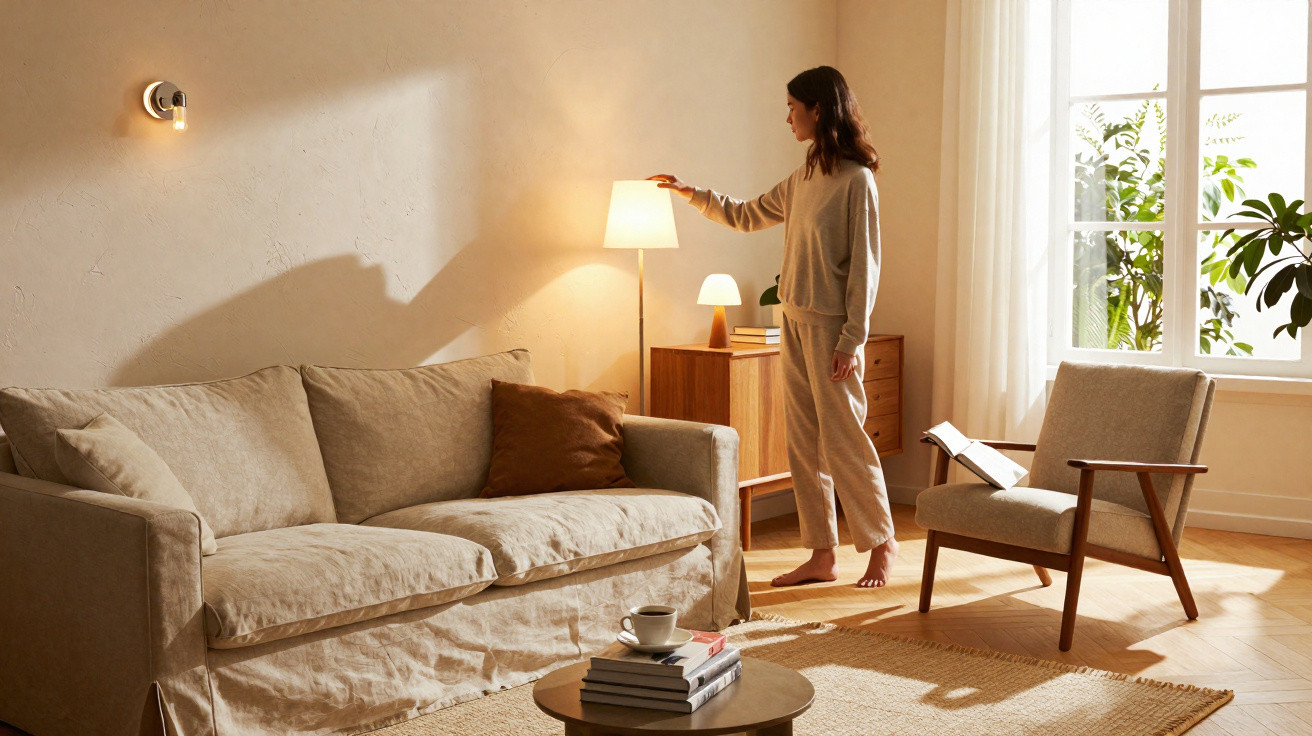
In many living rooms, a single ceiling light overwhelms the whole space. A straightforward interior-design rule offers a radically different approach.
For years, one central ceiling fitting was seen as enough, yet its shortcomings become clear when the aim is to create a warm atmosphere. The decorating website cited by the original source says that a “three-light rule” can transform a living room without major work or an excessive budget. Widely used by interior designers, this approach works just as well in Germany, where the media outlet is based, as it does in France.
Why a single ceiling light does not work in a living room
A central ceiling light remains the default choice in many homes. It provides strong illumination from the middle of the room and appears practical, but this option soon proves limited in a living room.
- Light that is too harsh: the bulb, often cool or overly white, flattens the room’s features.
- Strong shadows: faces are not shown to their best advantage and corners remain dark.
- An “office” feel: the room resembles a workspace more than an area for relaxation.
The source outlet explains that interior designers first try to avoid this uniform lighting, which creates a “clinical” impression. In a living room, people watch television, talk, read and entertain friends. None of these activities requires the same brightness or direction of light.
A well-designed living room does not rely solely on one general light source: it combines several points of light at different heights to give the space structure.
This observation is the basis for the well-known rule: replace the single ceiling light with three complementary fittings.
The three-light rule: how it transforms a living room
According to the article, the “three-light rule” involves using several light sources in the living room to create an adaptable atmosphere. It is not a rigid rule, but a simple principle: rather than placing all the emphasis on one ceiling light, install at least three carefully selected lights.
An ambient light to replace an overpowering ceiling fitting
The first light source forms the foundation. It can retain the role of the ceiling light, but should do so more gently:
- a ceiling fitting with dimmable bulbs;
- a lower pendant light above the coffee table or dining area;
- or a large arched floor lamp providing indirect general illumination.
The decorating outlet stresses the value of subdued, preferably warm lighting that does not dominate the other lamps. The aim is no longer to “flood” the room with light, but to establish a pleasant illuminated backdrop.
A task light for specific activities
The second fitting is intended for a particular use: reading on the sofa, working on a laptop or doing homework at a side table. This will generally be:
- a reading lamp beside the sofa;
- a table lamp on a sideboard or occasional table;
- a small adjustable floor lamp.
The featured decorating website points out that this lamp should provide more focused light without becoming harsh. It keeps the overall atmosphere soft while ensuring that the task at hand remains clearly visible.
With a targeted light source close to the sofa, the room immediately feels more welcoming and less impersonal.
A third light source to add depth
The third fitting has a more decorative purpose. It is used to draw attention to an element of the living room:
- a bookcase;
- a painting, print or photograph;
- a large plant;
- a music corner or antique piece of furniture.
The source outlet mentions, for example, discreet fairy lights, a wall light or a lamp positioned behind a plant to create a glow. This light source does not replace the other two: it complements them and brings depth to the room.
How to apply the three-light rule in a French living room
For readers in France, this rule is easy to adapt whatever the type of home. Whether it is a Haussmann-style living room, a lounge in a newly built house or a small studio flat, the principle remains unchanged: combine several lamps to vary the lighting.
- Assess the existing living room: where are the dark areas and where do activities take place?
- Identify the current general light source and make it less harsh with a warmer bulb, dimmer switch or lampshade.
- Add a reading lamp near the most frequently used sofa or armchair.
- Position a third lamp to highlight an often-overlooked area, such as beside a plant or low cabinet.
In France, lamps are widely available from major retailers, DIY shops and specialist stores. The three-light rule does not require a large budget: an existing lamp can be combined with an affordable reading light and a small decorative lamp.
Three well-positioned points of light are often enough to transform a living room without changing a single item of furniture.
What type of light should each fitting provide?
Beyond the number of lamps, light quality is crucial. The decorating article highlights the benefit of choosing bulbs with an appropriate colour temperature.
| Use | Recommended type of light |
|---|---|
| Ambient fitting | Warm, subdued light, potentially with a dimmer |
| Reading lamp or task light | Neutral white light that is comfortable for the eyes |
| Decorative fitting | Soft light, sometimes coloured or indirect |
In practical terms, this often means selecting warm LED bulbs of around 2700 to 3000 kelvins for ambient lighting, while using a more neutral white for reading. Interior designers avoid overly white lighting similar to office illumination, as it tires the eyes and makes the room feel colder.
The situation in France: habits and recommendations
In France, advice from interior architects and furniture retailers largely aligns with the three-light rule. Although they do not necessarily use this wording, they often refer to “ambient lighting”, “task lighting” and “decorative lighting”.
French professionals generally recommend:
- using more floor lamps and table lamps rather than adding ceiling spotlights;
- avoiding one very powerful source in the centre of the room;
- fitting dimmers to adjust brightness in the evening;
- combining direct and indirect lighting, where light reflects off a wall or ceiling.
For tenants, the three-light solution offers a particular benefit: it requires no electrical work. Lamps plug into existing sockets without altering the installation. French interior designers see it as a simple way to personalise a standard home without incurring substantial costs.
Common mistakes to avoid with three lights
Following the rule does not mean placing three lamps at random. As the original article and the advice of many interior designers point out, several mistakes occur repeatedly.
- Positioning every lamp in the same place, such as grouping them around the sofa.
- Choosing three bulbs with very different colour tones, resulting in an inconsistent atmosphere.
- Forgetting about available sockets and relying on numerous unsightly extension leads.
- Ignoring height: three low lamps create a compressed effect, while three high lamps lack warmth.
A well-considered arrangement varies both heights and brightness: a high pendant or floor lamp, a medium-height table lamp and a lower or indirect source. The three points of light should work together and lead the eye around the room.
A cumulative effect on visual comfort and atmosphere
Beyond appearance, this method improves everyday comfort. Better-distributed lighting reduces eye strain when watching television or reading. It also lessens overly strong contrasts between the screen and complete darkness, which are common in living rooms lit only by the television or with the ceiling light switched off.
The three-light rule also provides welcome flexibility: the same combination is not needed for drinks with friends, a film night or a reading session. Users can create their preferred atmosphere by switching on one light source rather than another, without changing furniture or décor.
By dividing the lighting, every use of the living room has its ideal light without sacrificing comfort or conviviality.
For a French reader, just as for the occupants highlighted by the original foreign media outlet, moving from one ceiling light to three well-planned fittings is a quick and simple intervention. Often more effective than replacing a sofa or repainting, this change profoundly alters the perception of the living room and the way it is used every day.

Comments
No comments yet. Be the first to comment!
Leave a Comment