
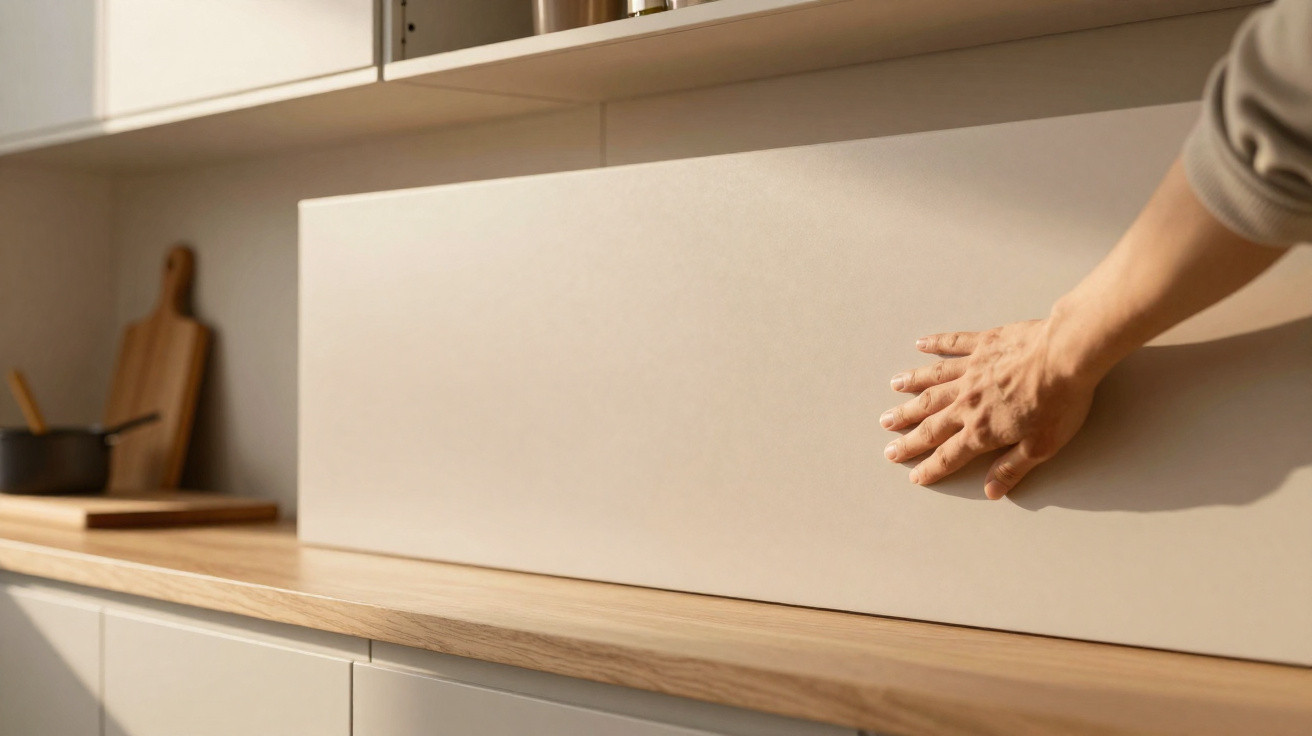
A kitchen appointment often begins with a very simple gesture. In the showroom, a customer places her hand behind the hob, taps the large matt surface with her fingernail, then turns to the kitchen designer: “Is that tiling?” The sound is dull, almost muted, nothing like the hollow little click of a stick-on splashback hurriedly fitted one Saturday afternoon. She is not simply looking for an attractive colour. She wants a kitchen that can cope with sauce splashes, pans moved too quickly and those fingerprints that always appear just before guests arrive. Behind the hob, professionals are changing their approach: rather than using a basic self-adhesive covering, they now favour solid panels, often matched to the worktop. The first clue is right there beneath your fingertips.
The matt sound that reveals the new splashback
We all know that moment of hesitation in front of a kitchen wall: marble effect, soft concrete, pale wood, deep black… everything looks appealing under showroom lighting. Yet the difference becomes obvious when you touch it. Kitchen designers are increasingly fitting splashbacks in compact laminate, ceramic or the same material as the worktop, all with a dense surface that does not sound hollow. When tapped, they produce a fuller, deeper sound, like an element genuinely built into the kitchen. It may seem a minor detail, but it immediately conveys sturdiness. The room feels as though it has been designed as one cohesive whole.
Decorative laminate panels are still widely used in homes, especially when renovating quickly without removing existing wall tiles. For new kitchen projects, however, the trend is towards a splashback panel coordinated with the worktop: the same mineral veining runs along the horizontal surface before continuing up the wall. A kitchen measuring 8 m² can therefore appear more spacious, as the eye is no longer interrupted by a border or a sequence of grout lines. Large-format tiles, sintered ceramic and toughened glass also retain their followers. What do they have in common? They are installed as lasting materials, rather than as a decorative layer simply stuck on top.
This shift addresses a very practical reality: the area behind a hob is exposed to intense daily use. Steam gets in, oil splatters and tomato sauce can reach surprisingly unlikely places. A good-quality self-adhesive splashback can provide a useful quick fix or transform a tired wall, but depending on its composition, it is less able to withstand lifting edges, repeated cleaning and heat. Rigid panels provide a more stable surface that is often easier to wipe down. The decision is not solely about appearance. It is about how the kitchen will be used on a Tuesday evening, when nobody wants to spend twenty minutes scrubbing.
Before choosing a splashback, look at what happens behind the hob
The easiest approach is to begin with the cooking appliance rather than the colour of the cabinets. An induction hob does not place the same demands on the wall as a gas hob, where flames and rising heat require greater care. Ask the kitchen designer about the distance recommended by the hob manufacturer and the specifications of the chosen material. Compact laminate can suit many layouts, provided the installation guidance is followed. For gas, toughened glass, ceramic or certain mineral materials are often considered with greater confidence. The right panel is one that does not require you to watch every pan.
A common mistake is selecting a finish before considering the practical details. A very matt splashback looks superb in a catalogue, but some dark finishes show limescale splashes more readily, especially near a sink. Conversely, glossy glass is quick to clean but may reflect daylight from a window or LEDs beneath wall cabinets. Let us be honest: hardly anyone carries out a methodical deep clean of every mark after every meal. It is better to choose a material that suits your real life: rushed breakfasts, children cooking and dishes simmering without perfect supervision.
When requesting a quote, ask what installation includes: cuts around sockets, seals, finishing trims, edge protection and the visit after the worktop has been installed. The advertised price of a panel may appear modest, then rise once these details-although they make all the difference in everyday use-are added.
“A successful splashback should not draw attention through its flaws: it should make you forget there is a wall to clean behind the hob.”
- Tap the surface: a solid sound often indicates a rigid panel that has been properly fitted, although it does not by itself guarantee the quality of the material.
- Check compatibility with your type of hob and the manufacturer's guidance.
- Ask for a sample to view at home, morning and evening, beside a real light source.
- Check for neat seals around sockets and along the worktop.
The splashback becomes a genuine part of the kitchen
This development reflects a broader change in our homes. The kitchen is no longer merely a functional space hidden behind doors; it has become the room where shopping is set down, coffee is made while standing up and friends continue chatting even after dinner has ended. In such a closely observed space, the splashback no longer wants to play a supporting role. It extends the worktop, softens a composition of colourful cabinets or adds mineral texture to very smooth fronts. Kitchen designers understand this: one large continuous surface instantly creates a bespoke impression, even in a fairly simple layout.
This does not mean declaring self-adhesive splashbacks outdated. They remain a clever option for a rented home, a tight budget or an express renovation, provided a product suited to heat and humidity is chosen. But for a kitchen designed to last, compact panels, ceramic, glass or engineered stone bring a different presence. You notice it to the touch, in the quietness of the material and in how easily a splash disappears. The next time you visit a kitchen, do not just look at the wall behind the hob. Put your hand on it. That small tap can start a very useful conversation about what you are really buying.
| Key point | Detail | Added value for the reader |
|---|---|---|
| The tap test | A rigid surface that has been properly fitted generally produces a fuller sound than a thin decorative film. | Quickly identify the difference between a lightweight covering and a splashback designed as a durable element. |
| The type of hob | Induction, ceramic and gas hobs do not place the same heat-related demands on the wall. | Avoid choosing an attractive option that conflicts with safety or installation requirements. |
| Real everyday life | Finish, seals, limescale marks and cleaning matter just as much as the chosen colour. | Choose a splashback that looks good on installation day and remains pleasant to live with for years. |


Comments
No comments yet. Be the first to comment!
Leave a Comment