
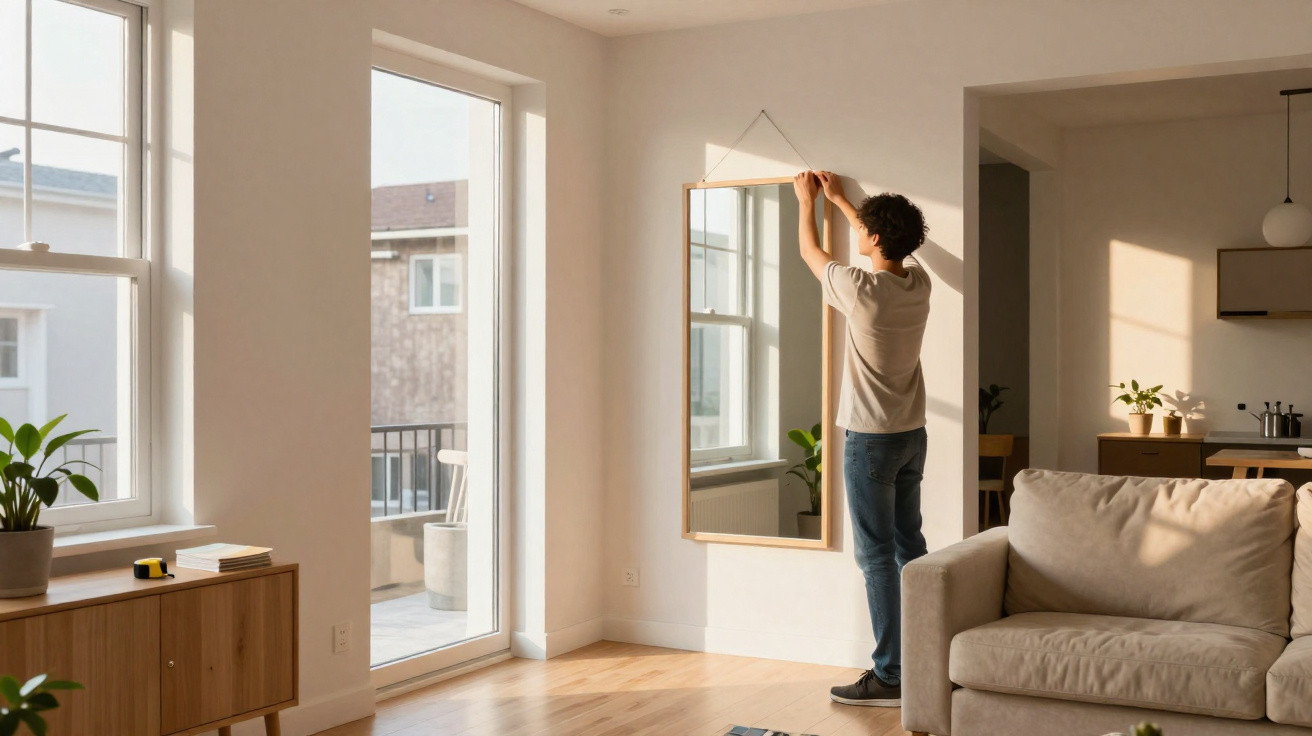
In a poorly lit flat, a single well-positioned mirror can transform the atmosphere, according to a specialist interiors website.
An article published by the online interior design outlet outlines how placing mirrors with precision can make a dark room noticeably brighter, without renovation work or a substantial budget. Drawing on interior designers’ usual methods, the site identifies the strategic places for a mirror to make the most of every ray of light, whether you live in the UK or elsewhere.
Why a mirror can genuinely brighten a dark room
A mirror does not create light; it reflects it. This straightforward principle is highlighted by the designers interviewed by the publication. In a room with limited daylight, every light source matters: a window, glazed door, table lamp, pendant light or wall light. Positioned correctly, a mirror catches this light and sends it across the rest of the space.
The impression of a room being “twice as bright” comes from the eye seeing both the direct light source and its amplified reflection in the mirror.
Professionals point out that the result is not purely visual. A room that looks brighter also feels larger, airier and more pleasant to live in. Conversely, poorly distributed light that is confined to one corner heightens the feeling of a cramped space.
The outlet highlights an observation shared by many interior designers: mirrors are poorly positioned in a great many homes. Hung too high, facing a dark wall or tucked into an alcove, they add almost nothing to the overall brightness. This is why knowing the placement that genuinely makes a difference is useful.
The “go-to” mirror placement designers use to double brightness
According to the professionals quoted by the site, one instinct recurs almost every time they work on an overly dark room: they position a large mirror opposite a natural light source, as perpendicular to the incoming light as possible.
The mirror then acts as a second virtual window, sending light towards the back of the room instead of allowing it to fade near the outside wall.
In practical terms, for a living room or bedroom, the publication says designers often favour:
- a large mirror hung opposite a window, on the facing wall or slightly offset;
- or a mirror placed at 90° to the window, on the adjoining wall, to reflect light towards the middle of the room.
This arrangement multiplies light reflections without creating direct glare. The mirror should remain within the path of incoming light, without dividing the room or obstructing movement.
Mirror placement mistakes interior designers avoid
The experts cited by the outlet identify several common mistakes that substantially reduce a mirror’s effectiveness:
- Positioning it opposite a dark wall, an imposing bookcase or a large dark piece of furniture: the mirror then reflects mostly shadow.
- Hanging it too high: the reflected light benefits neither the worktop, sofa nor table, instead being lost near the ceiling.
- Squeezing it into a corridor or alcove with no light source opposite: in that case, its role is limited to decoration.
- Aiming it towards an unappealing exterior view, such as a blank wall or a very dark courtyard, which can undermine the desired brightening effect.
The designers interviewed by the publication also stress one point: a small, highly decorative mirror will never have the same effect on light as a large, simple mirror covering a substantial section of wall.
Living areas, corridors and kitchens: where mirror placement matters most
Based on the experience of the interior designers it consulted, the site describes several typical home layouts in which placing a mirror opposite or beside a window significantly changes the perception of light.
A living room facing a courtyard or north
In a living room with little sunshine, often north-facing or overlooking a dark courtyard, the aim is to make maximum use of the window, even where the available daylight is limited. According to the article, designers advise:
- fitting a large mirror to the wall opposite the window, behind the sofa or coffee table;
- or placing it on the clearest side wall, at seated eye level.
The mirror then reflects the opening and every subtle change in outdoor light. At certain times of day, the result is immediately apparent: the back of the living room, previously dull, receives softer and more even reflected light.
A narrow dining room or eating area
For a dining room wedged between the kitchen and living room, or a widened corridor used as an eating area, the publication reports that designers often select a long horizontal mirror. Resting against the wall or hung at table height, it reflects the pendant light, candles or a sideboard lamp.
This position makes the room feel more generous and enhances the warmth of evening lighting. The reflected fitting creates a kind of duplicate light source without increasing the bulbs’ wattage.
A windowless corridor and entrance hall
In particularly dark corridors, the designers quoted by the outlet recommend a pairing: a mirror aligned with the front door or an adjoining glazed door, and a wall light or pendant fitting installed directly opposite it. The mirror reflects artificial light as though it were an additional opening.
In an entrance hall without a window, positioning a mirror to capture light from the neighbouring living room or kitchen helps illuminate the route through the space, while also providing a practical place to check your appearance before leaving.
Which mirror types best enhance brightness
The outlet also examines the part played by a mirror’s size, frame and finish in the final effect. Not every mirror is equally effective at boosting light.
| Mirror type | Effect on light |
|---|---|
| Full-length mirror | Maximises reflections; ideal for visually enlarging and brightening a living room or bedroom. |
| Horizontal strip mirror | Spreads light at eye level; suited to dining rooms and corridors. |
| Mirror with a thick, dark frame | Reduced brightening effect, as the frame absorbs part of the visual impact. |
| Bevelled or antiqued mirror | Produces more diffused light; creates a soft atmosphere but a less pronounced impression of brightness. |
The designers consulted generally opt for slim, pale or metallic frames that do not overpower the reflection. A large frameless mirror standing on the floor and tilted slightly can also be a good compromise for anyone who does not want to drill into the walls.
What professionals recommend in the UK
In the UK, interior architects and designers apply the same principle: use every window to multiply reflections. Advice shared by many British professionals aligns with that reported by the overseas publication.
Opposite or at a right angle to the window, a mirror becomes a tool for “redistributing” light around the room.
British specialists also emphasise that mirrors and artificial lighting should work together. Whether in a Victorian flat or a more recently built house, they often recommend:
- combining a large mirror with a central pendant light and supplementary lamps;
- avoiding very dark walls opposite the mirror, as they partly cancel out the brightening effect;
- adjusting the colour temperature of bulbs to prevent an overly cool reflection that is unflattering in the evening.
In the UK, these recommendations apply equally to compact urban homes, where every centimetre counts, and to larger houses with rooms running through from front to back. The principle remains unchanged: the bigger the reflective surface and the better it captures light, the more noticeable the improvement in brightness.
How to combine mirrors, light colours and storage
For a UK reader looking to improve the brightness of their home, mirror placement is only one part of the solution. Many designers note that the colours of walls, curtains and furniture have a major influence on the outcome.
Pale walls, lightweight curtains and simply designed furniture reflect more light than very dark shades or heavy materials. The mirror can then amplify this potential. Conversely, if the room is cluttered with numerous objects and tall pieces of furniture, the reflection may multiply shadowy areas and create an impression of disorder.
A well-positioned mirror works better in an uncluttered room with clear routes through it, where light sources remain visible.
A gradual approach can be taken: start by clearing the area around the window, choose lighter curtains, then install a first mirror opposite the light. If the result is still insufficient, a second, smaller mirror can be added in a dark corner, angled towards a lamp or wall light.
A simple step, with limits to bear in mind
Finally, the designers cited by the source publication remind readers that a mirror is not a substitute for sunshine. It improves what is already there, but it cannot turn a completely windowless room into a living space flooded with light. In a deeply shaded ground-floor home or one facing due north, this measure needs to be supported by well-planned artificial lighting.
For a UK reader, however, this type of improvement remains an accessible option: no planning permission, no major work, just a little assessment and secure fixing. By placing a large mirror opposite or perpendicular to the window, as the designers describe in the article, the feeling of brightness can genuinely change, making a room that was previously neglected far more pleasant to use every day.



Comments
No comments yet. Be the first to comment!
Leave a Comment