
The earliest warning is almost never spectacular.
It may be a barely visible dark ring around the doormat, a slightly yielding spot near the hall, or a faded stain that only becomes apparent when low winter sunshine catches the floor from the wrong direction. It seems innocuous, almost expected: the kind of everyday wear any home gathers over the years.
But then one rainy week leads into the next. Boots accumulate by the entrance, trainers end up in a damp pile, the dog flings meltwater across the rug, and the hallway begins to feel close and heavy. There is a smell that is not quite clean. The boards by the door no longer sound properly firm beneath your feet. By mid-January, the beige carpet looks worn out, as though it has endured three winters at once.
It can all begin with the way footwear comes through the front door - and with one small routine that barely anyone mentions.
The hidden harm winter shoes do indoors
Step into a British hallway in January and the weather is obvious within seconds. There are muddy football boots from a Sunday league game, Chelsea boots marked with salt from the commute, and school shoes shedding sparkling grit like rather miserable confetti. Every pair creates a small wet mark, followed by another, then another.
At first, the floor makes no complaint. It simply takes in the melted sleet, road salt, stubborn mud and car-park de-icer. This mixture works its way into timber grain, settles among carpet fibres and remains there - quietly worsening.
From above, it can appear to be ordinary daily life. Below the surface, however, the countdown to damage has already started.
Consider Sophie, who lives in a 1930s semi-detached house in Leeds. She valued her original floorboards even more than her new kitchen. During one particularly wet winter, her children began leaving their football boots “just inside the door, Mum, only for a minute”. That minute stretched into entire evenings. By March, a long, dark mark had formed across the entrance like a pale river in reverse.
When a flooring specialist eventually inspected it, he was frank. Repeatedly pooled water beneath wet shoes had caused the boards to cup and begin rotting. Replacing that relatively small section cost more than Sophie had set aside for her annual holiday. “It was from such a boring habit,” she told me. “We weren’t smashing things, just… walking in.”
Insurance figures in the UK quietly support accounts such as hers. Winter is reported by insurers as a busy season for water-related household damage, and although major leaks make the news, gradual damp from routine daily behaviour forms a large, largely unseen category. Shoes may be small, but their effect is persistent.
Water does not need to cause a flood to do lasting harm. A modest amount repeated every day is entirely sufficient. Damp soles left on timber make the fibres expand and shrink as they dry, over and over. This movement produces tiny fractures in protective finishes, allowing grime and salt to penetrate further. Carpet fares no better: backing material deteriorates, underlay can remain wet for hours, and subtle musty smells gradually develop.
Treat every shoe as a sponge on the move. Each can bring in a few tablespoons of slush, rainwater or watery mud. On a hectic school morning, several cups of moisture may reach your floors before 8:30am. If it is left in place, it will not simply dry away tidily. Instead, it is absorbed, held in place, drawn beneath skirting boards or forced into fibres by the next person walking over it.
The science is hardly glamorous, but it is straightforward: winter damp plus time brings swelling, staining, warping and the worrying softness underfoot that no one wants beside their front door.
The simple winter shoe habit that protects your floors
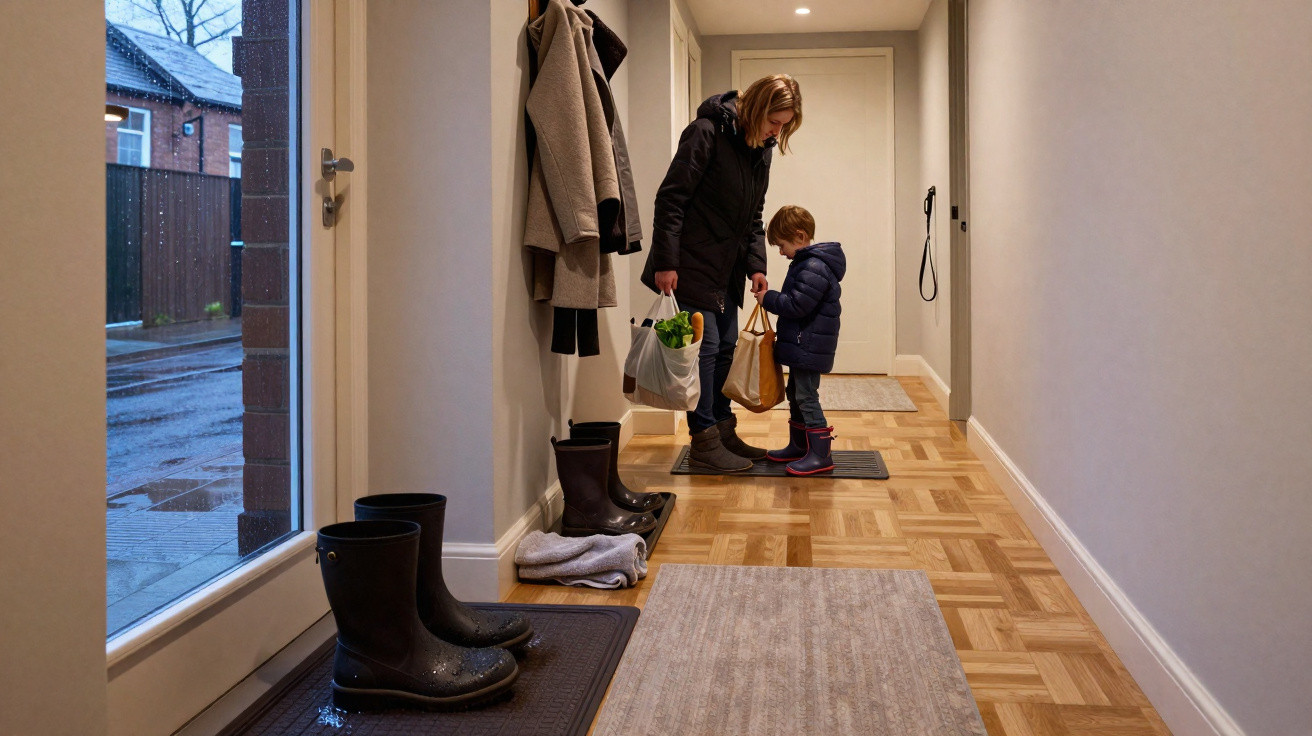
The routine is this: every wet shoe should pause on a dedicated “landing strip” and dry there completely before reaching your actual floor or carpet. Not for five minutes - until it is fully dry.
That landing strip might be a deep tray, a lipped boot mat, or a durable washable rug used alongside a separate drying mat. The item itself matters less than the rule: wet footwear never sits directly on floorboards or carpet. Shoes come in, drip, dry, and only then go elsewhere.
It may sound almost embarrassingly simple. Still, households that maintain this routine tend to have far fewer threshold stains, less fraying at the edges of hall carpets and almost none of those unexplained dark patches that seem to “appear overnight” near the door.
Many people assume they are already doing it, broadly speaking. “We’ve got a mat, so we’re fine.” That is often exactly where the issue begins. A thin, flat doormat that takes in water without holding it merely passes the moisture to the surface below. Water seeps underneath and stays hidden there. Eventually, it leaves a mark as distinct as a watermark on headed paper.
A proper landing strip should be selected for winter conditions rather than summer ones. Look for raised sides that hold water in, a rubber or robust plastic base, or dense pile that can be washed and dried thoroughly. Then comes the practical behaviour: shoes should not be moved early simply because they “look dry”. They remain where they are until the soles genuinely feel dry.
This is the ordinary, unphotogenic side of looking after a home - and it can prevent hundreds of pounds’ worth of repairs that never need to happen.
Let’s be honest: hardly anyone manages this perfectly every day. People arrive carrying shopping, children are bickering, and a dog lead is wrapped around their wrists. Footwear is kicked off “just for now”, ending up partly on the good rug or leaning against the skirting board.
That does not make you lazy; it means you are busy. Dark winter evenings leave everyone tired, and a flawlessly managed hallway can feel somewhere between an unrealistic fantasy and a source of guilt. The routine therefore needs to fit real life rather than compete with it.
One helpful approach is to create visible zones. Put a boot tray or substantial mat in a dark, forgiving shade for the “wet zone”, then position a paler, softer runner or small rug after it for the “dry zone”. The change in colour guides people without repeated reminders. Children tend to understand it quickly too: wet, muddy shoes go on the dark area, while dry feet continue to the lighter one.
Capacity is another practical consideration. If your household produces more footwear than the landing strip can accommodate, the system soon fails. Additional stackable shoe storage or a second tray placed just beside the first can take the overflow, meaning no one has to choose between following the rule and getting inside promptly on a freezing evening.
“The floors that last are rarely the ones with the fanciest finish,” says Manchester-based floor fitter Paul Jenkins. “They’re the ones in homes where people manage the boring stuff - like where wet shoes live - almost without thinking about it.”
A short checklist can make that principle easier to follow every day.
- Set up one dedicated wet zone at the main entrance, using a tray, deep mat or both.
- Ensure it is large enough for the busiest evening of shoes in your household.
- Leave a towel or old microfibre cloth there for quickly wiping soles.
- Tip out any collected water from trays and hang mats up to dry at least once a week.
- Use the same arrangement at any other entrance you regularly use.
None of this is particularly glamorous, but it can be unexpectedly rewarding. By late February, you may notice that the floor looks different: fewer random grey curves, no soft squelch around the doormat, and carpets that still smell gently clean when the heating comes on.
Give your winter floors time to breathe
Our homes take on the season along with us. Wet umbrellas, steamed windows and heavy coats thrown over chairs all convey the same message: winter has moved inside. Floors and carpets absorb more of that seasonal story than we tend to recognise. Each squelching boot print and puddle of thawing slush places another small demand on them.
Allowing shoes to stop on a landing strip is not so much about “being tidy” as it is about letting floors breathe. Time spent drying is time spent recovering. When water is not pressed into the grain or trapped beneath fibres every evening, materials can recover rather than prematurely sag and age.
Once the practice becomes established, you may notice other subtle changes too. Hallways can seem calmer and less cluttered. After several wet days, the area by the door loses its damp-smelling edge. Visitors often follow the arrangement instinctively, copying what they see without needing to be told.
We have all had the experience of spotting a new, unattractive floor mark and wondering, “When did that happen?” Slow-building moisture is deceptive in that way. It works silently, often under socks, rather than arriving with a dramatic storm. A small, almost dull habit involving your shoes is one of the few ways to pause this particular sort of deterioration.
You may not get it right every time. On some evenings, boots will still end up half on and half off the tray. On certain mornings, you will forget to empty it. That is fine. Home-saving routines do not need to be perfect to work; they simply need to happen most of the time, quietly stopping water before it gets the better of you.
| Key point | Detail | Benefit for the reader |
|---|---|---|
| Create a shoe “landing strip” | Use a tray or lipped mat where every wet shoe stops and dries completely | Dramatically reduces staining, swelling and odours in wooden floors and carpets |
| Use visual zones | Pair a dark area for damp footwear with a light area for dry feet | Makes the routine intuitive for adults, children and guests without constant reminders |
| Maintain the system | Empty water, dry mats and match the set-up size to the number of shoes | Prevents moisture from getting beneath the mat and quietly damaging the floor |
Frequently asked questions:
- Do I really need a special boot tray, or will any mat do? Any mat is preferable to none, but trays and mats with raised edges are most effective in winter because they hold pooled water rather than allowing it to seep underneath and remain on wood or carpet.
- How often should I dry or clean the shoe mat area? During a wet winter, try to inspect it briefly every couple of days and dry it properly at least once a week, particularly if you can detect damp beneath it.
- Is this habit still useful if I have cheap laminate floors? Yes. Laminate can be especially prone to lifting and swelling at the edges when moisture repeatedly reaches the same areas near doorways.
- What about small flats with almost no hallway space? Make use of height: a narrow tray with a slim shoe rack above it can still form a compact landing strip that keeps damp away from your main floor space.
- Do guests really follow this kind of system without feeling awkward? Most people will, provided the arrangement is clear - a visible tray, shoes gathered together and perhaps a small bench or hook nearby - allowing them to copy it without asking.

Comments
No comments yet. Be the first to comment!
Leave a Comment