
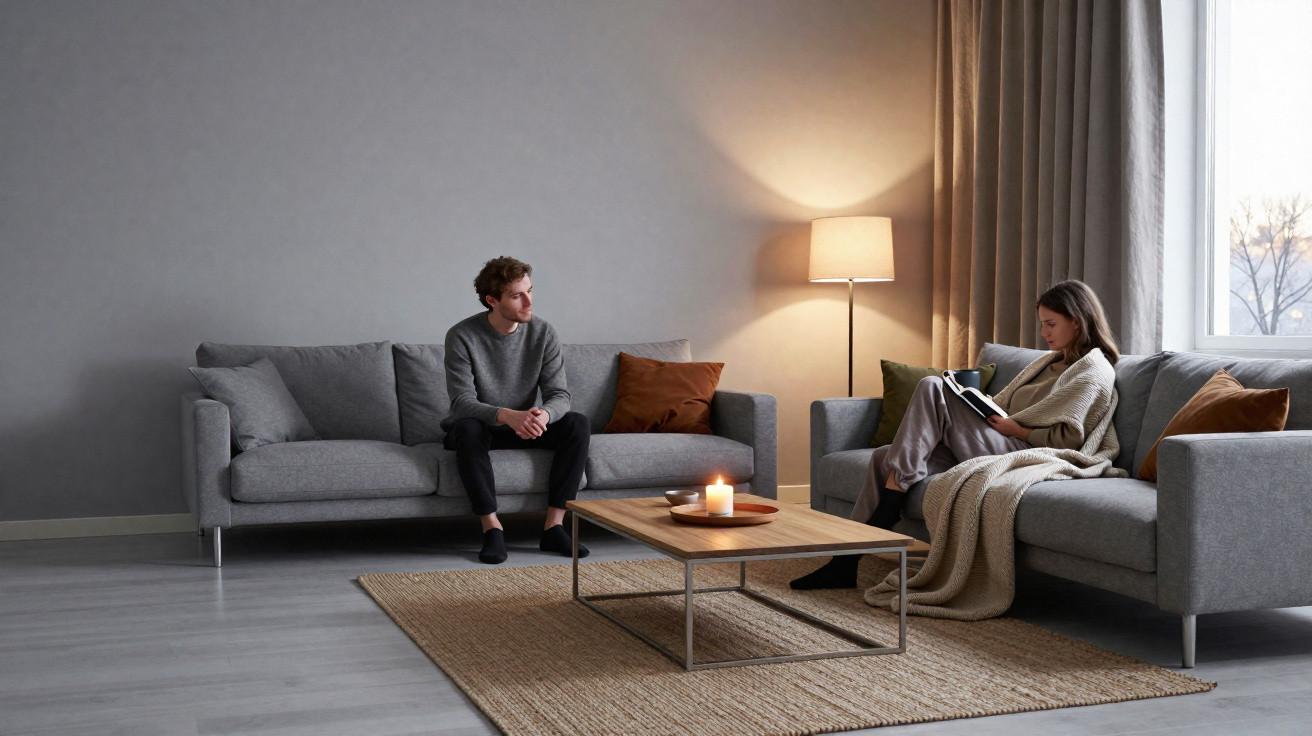
Winter ought to make a living room feel warm and welcoming, but some supposedly stylish decisions can quietly strip that comfort away.
As daylight hours shorten and the sofa takes centre stage in home life, one extremely popular colour trend can undermine the atmosphere, making cosy nights feel closer to a waiting room than a comforting sanctuary.
Why a fashionable colour can quietly spoil your living room
How a “safe” shade became the mood-killer of modern interiors
For the past ten years, one tone has taken over Pinterest boards, show homes and Instagram reels: cold, flat, cement-style grey. Designers promoted it as adaptable. Estate agents described it as neutral. Landlords covered entire properties in it. As a result, many living rooms now have an oddly lifeless quality.
In theory, cool grey seems like a sensible choice. It conceals small imperfections, works with nearly anything and appears crisp in property photographs. Yet, once the weather turns colder and daylight weakens, that same grey absorbs warmth, casts shadows over faces and gives social occasions an unexpectedly formal feel.
Cold, blue-leaning grey doesn’t just look cool – it makes people behave differently, sit differently, and stay for less time.
Colour psychologists have cautioned for years that cooler hues, particularly greys with blue undertones, are processed by the brain as remote and impersonal. You may be able to use them successfully in a bedroom or corridor. In a living room, the emotional centre of the home, that neutral backdrop can begin to feel unwelcoming.
Why your “magazine look” resembles a hotel lobby
Look through current interiors content and the formula remains familiar: grey walls, a grey sofa, a white media unit, a metal coffee table and perhaps a pale-blue cushion for contrast. It may look stylish at first, but the effect changes once real people settle into the room.
Conversations can remain surface-level. Visitors perch instead of sinking into the seating. Children may choose rugs in other rooms for play. You may not point directly to the colour, but the space never completely puts people at ease.
When style wins over comfort, the room might photograph well but fails the only test that matters: do people feel welcome here?
Design researchers refer to “perceived temperature”: when a room is decorated in cooler colours, people can judge the air as several degrees colder than it actually is. This is especially relevant during the darker months in the UK and US, where living rooms often already contend with limited light and damp conditions.
What cold grey really does to your guests
The quiet social impact of a chilly palette
In social psychology studies, participants describe photographs of grey-led rooms as more “formal”, “professional” and “reserved” than rooms featuring warmer shades. That can be useful in an office. In a living room on a Sunday afternoon, however, it can communicate conflicting messages.
Friends might hold back from putting their feet up. Parents could feel anxious about children leaving fingerprints behind. Feeling as though you need to act as if you are in a showroom, rather than at home, may shorten a visit without anybody fully understanding the reason.
- Body language changes: people sit more upright, sprawl less on the sofa and spend more time perched on the edge of chairs.
- Staying time shrinks: guests are less inclined to remain for “one more drink” if the room feels sterile.
- Noise levels drop: laughter and lively conversation may not come as naturally in spaces that recall offices or clinics.
This does not mean grey is inherently bad. The issue arises when one cold tone takes over every element: the walls, sofa, rug, curtains and even the artwork frames. With no warmth for the eye to settle on, the room lacks an anchor that signals, “you can relax here”.
The spaces most affected by cold grey
Certain rooms are particularly vulnerable when saturated in this icy shade:
- North-facing living rooms: with little natural light to begin with, blue-based grey can make them appear dull and gloomy. Complexions look sallow, while even candlelight struggles to create warmth.
- Open-plan kitchen–living areas: grey cabinets, grey island stools and a grey sofa can turn the entire area into one uninterrupted, hard-looking surface.
- Small city flats: often selected to “make it look bigger”, cold grey can remove personality and leave renters feeling like short-term guests in their own homes.
The more hours you spend in a room, the more punishing an all-grey, cold scheme becomes during winter.
How to make a grey living room warmer without repainting everything
Moving from clinical to cocooning with a few key changes
Most people cannot, or simply do not wish to, repaint every wall tomorrow. Fortunately, they do not need to. The quickest improvements come from the items placed alongside the grey.
Designers describe this as “warming the grey”: counteracting its chill with colours and textures that soften the effect. It is rather like adjusting the room’s emotional thermostat.
Here are some practical changes to consider:
| Cold element | Simple warmer swap |
|---|---|
| Metallic coffee table | Wooden table with rounded edges or a woven ottoman |
| Thin, white curtains | Thicker oatmeal or sand-toned curtains in textured fabric |
| Grey-on-grey cushions | Rust, caramel, saffron or olive cushions in velvet or boucle |
| Cool white bulbs | Warm white bulbs (around 2700K) with fabric shades |
| Glossy prints | Art with warm landscapes, people or organic shapes in matte frames |
Just one substantial, tactile feature - a tobacco-coloured chunky-knit throw, a large jute rug or a wooden sideboard - can interrupt the “rental grey” atmosphere and bring in a more human quality.
Colour families that can save a cold living room
Warm colours do not all mean vivid orange. Plenty sit within soft, easy-to-live-with ranges that complement existing grey rather than competing with it.
For a typical living room in the UK or US with cool grey walls, colour consultants commonly recommend:
- Earthy neutrals: mushroom, beige with a pink or brown undertone, and soft taupe.
- Soft terracotta and clay: muted brick, paprika and clay pink instead of bubble-gum shades.
- Spice tones: cumin, nutmeg, burnt sugar and warm mustard.
- Greens with warmth: olive, sage and eucalyptus rather than icy mint.
The goal isn’t to turn your living room into a colour explosion, but to give grey something warm to lean on.
Even a slim painted band can transform the atmosphere. Some interior stylists suggest applying a clay or caramel shade to only the lower half of a grey wall, producing a “colour-dipped” look that gives the room a grounded feel without requiring a complete refurbishment.
Lighting, texture and layout: the hidden partners in a cold room
Why light temperature matters as much as wall colour
Many homes combine cold grey walls with cool white lighting, commonly marked as 4000K or above. Together, these choices intensify blue undertones and create severe shadows on faces.
Changing to 2700K bulbs, or “warm white” lighting, can feel like adding a flattering filter. Skin tones appear healthier, fabrics look more luxurious and the entire room seems more inviting, even when nothing else is altered.
Using layers of light also makes a difference:
- A floor lamp positioned behind the sofa provides gentle backlighting.
- Table lamps on side tables draw guests into areas designed for conversation.
- Low, warm lighting near the television stops the room becoming dark during films.
How surfaces shape emotional temperature
A living room dominated by hard, reflective surfaces - glass, high-gloss metal and polished tiles - reinforces a showroom-like atmosphere. Warmth often comes through friction: objects and finishes that feel a little irregular, matte or tactile.
Consider introducing:
- Textured throws in wool, chenille or heavyweight cotton.
- Rugs with a visible weave instead of flat synthetic styles.
- Unvarnished or lightly oiled timber in place of high-gloss finishes.
- Ceramics with a handmade appearance rather than uniform glass vases.
Texture is the quiet rival of colour: even in a grey room, rougher, softer surfaces make people feel held rather than displayed.
Planning a realistic warm-up for your own living room
A straightforward weekend audit to try
A useful way to find out whether your living room has fallen into the “cold grey trap” is to sit in it at three points in the day - morning, late afternoon and late evening - and briefly note how the space feels.
Ask yourself:
- Am I reaching for a blanket because I am cold, or because the room appears bare?
- Where does my gaze go: towards an inviting focal point or an empty wall?
- Would a friend feel at ease curling up here with their socks off?
If your truthful answers tend towards “no”, a full redecoration is unnecessary. Begin with a single corner: replace the lamp, introduce a warm-coloured cushion, or add a wooden tray holding a candle and book. Pay attention to how that small zone changes the way you use the room.
You can then decide whether the walls need to be softened later, perhaps by moving from cold grey to a greige or clay-toned neutral when you next repaint.
When grey still works - and how to use it more effectively
Grey is not forbidden in interiors. When used thoughtfully, it can settle a busy room and offset more striking shades. The problem begins when it becomes the automatic choice for every wall in every room.
Designers who continue to use grey well generally follow a few unspoken principles: choose a warmer version with more beige than blue, restrict it to one or two surfaces, and always combine it with something that has emotional significance - a family gallery wall, a vintage armchair or shelves filled with battered paperbacks.
For renters living with grey walls, accessories are the main toolkit. Treat every addition as a balance against the chill: a patterned wool rug from a second-hand website, a large plant in a terracotta pot or a worn leather footstool that encourages people to linger a little longer than intended.



Comments
No comments yet. Be the first to comment!
Leave a Comment