
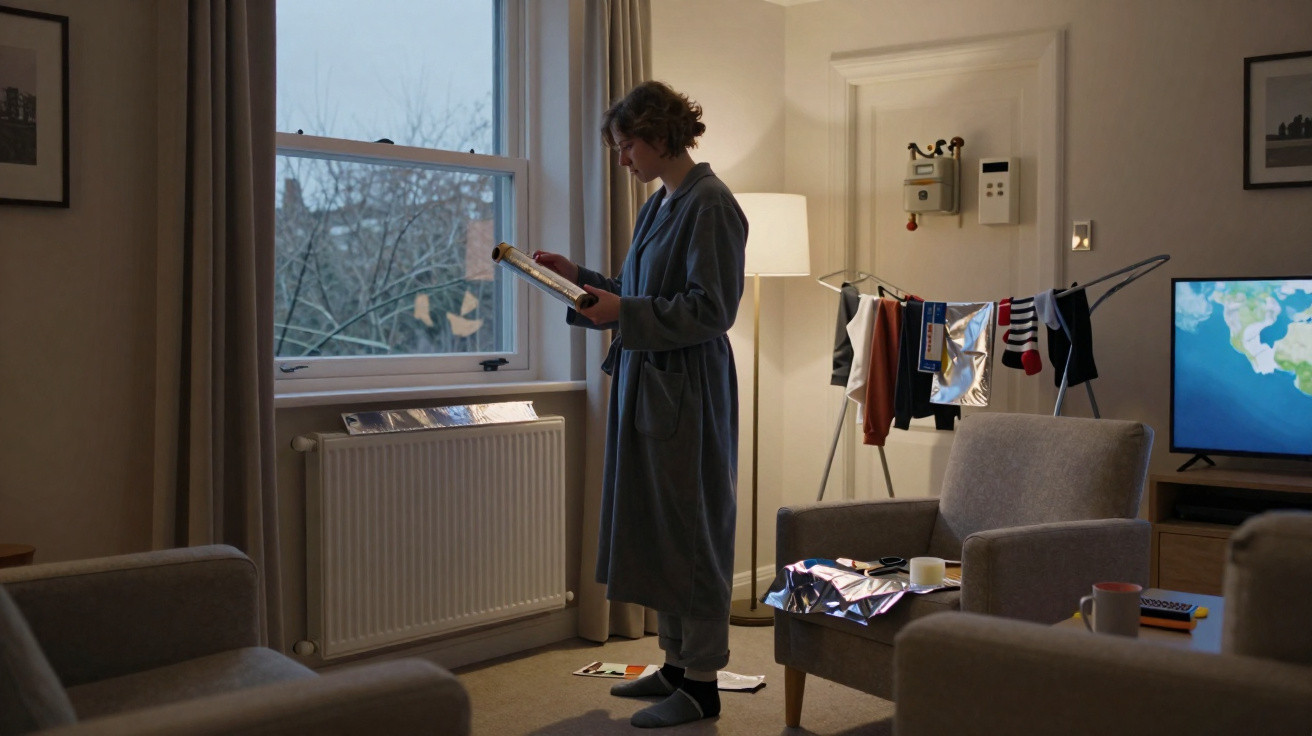
Every winter, as soon as the first truly cold night arrives, someone somewhere in Britain stands in the hall, watches the gas meter race round and says: “There has to be a cheaper way than this.” That person might be you. Perhaps you have already searched “how to stop heat loss radiator” on your phone at midnight, wrapped in a dressing gown that definitely did not seem this flimsy last year. Before long, your social feeds fill with energy-saving tips, and one suggestion appears again and again: put foil behind the radiators. It is easy. It is shiny. It is hard to resist.
There is something reassuringly Blue Peter and make-do-and-mend about the prospect: a roll of foil, some tape and the satisfying feeling that you have beaten your energy bill. But between TikTok advice and your nan’s tips from 1983, electricians and heating professionals are quietly raising an eyebrow. Their view of the foil trick is not quite the answer the internet is hoping for.
The kitchen-table conversation that starts it all
Bring the subject up at a family meal and the same tale usually follows. “My dad used to do that, swear by it,” somebody will say, often while adding more gravy and grumbling about gas prices. For many households, foil behind radiators is not so much a new trick as a handed-down custom, sitting alongside “bleed them every October” and “put on a jumper first”. It belongs somewhere between folk knowledge and the pages of a 1979 DIY magazine.
Most of us have experienced the jolt of opening a bill and feeling honestly alarmed by the figure on it. In that mildly frantic state, anything quick, inexpensive and not entirely ridiculous becomes appealing. Foil seems to tick every box. It crackles as you pull it from the roll, you can see it being fixed to the wall, and it gives the impression that you are taking action. That small feeling of control matters when every other cost is eye-wateringly high.
When I asked electricians what they genuinely made of it, their responses were remarkably alike: a faint sigh, a knowing smile, then a balanced reply rather than the clickbait “useless myth!” I had expected. The reality sits in a grey area, which, frankly, is not where anyone wants to be on a freezing Tuesday evening.
What electricians really say when you mention the foil trick
Electricians may not be the first trade you associate with radiators, but they are often called when “a bit of DIY” creates unexpected consequences. When I asked a Sheffield electrician, who spends winter moving between draughty terraces, about foil, he was direct: “Proper radiator reflector panels? Fine. Bacofoil flapping on the wall? That’s when people start ringing me.” He had already attended one flat where sagging foil reached a spur outlet and melted in part.
Most electricians are not against the principle – their concern is the way people apply it. The reflective concept is reasonable: some radiator heat is lost into the wall, particularly an uninsulated external wall, and reflecting some of that energy into the room can slightly improve comfort. The trouble begins when that principle becomes “just tape some cooking foil back there, job done”. At that point, every tradesperson nearby starts looking a little uneasy.
Several electricians used almost identical wording: “It’s not evil, it’s just limited.” You may recover a few per cent of heat that would otherwise be lost, and a particularly cold wall may feel slightly different when you stand in front of it. However, no professional suggests that it can turn a poorly insulated house into a cosy fortress. As one London electrician said over instant coffee, “If foil behind your rads is your big energy-saving move, you’ve already lost the game.”
Where it can help just a little
There is a limited situation in which electricians will shrug and say, “Yeah, fair enough.” Picture an older property with single-skin external walls, radiators fitted directly to them and no prospect of proper insulation in the near future. In that scenario, a purpose-made foil panel, trimmed to fit and securely installed, can move things slightly in the right direction. It is not a miracle solution, but modest gains can build up during a long winter.
The understated advice from electricians is simple: choose suitable material and install it correctly. They wince at loosely hanging foil, crumpled into odd forms and drooping too close to electrical cables or plastic pipes. This is when a seemingly harmless tip can turn into an unplanned call-out, often opened with: “So… my wall’s gone a bit brown behind the radiator.”
The safety question everyone skims past
Foil appears harmless, even homely, until you consider its composition: it is a thin sheet of highly conductive metal. That is the detail that catches an electrician’s attention. If foil touches an exposed live component – a damaged cable, loose socket back box or even a poorly isolated junction behind a radiator in an older home – it can conduct electricity, causing a short circuit or serious shock. Is this likely? No. Can it occur? Occasionally, yes, and that is enough for those who deal with the results.
A Manchester electrician described a rented property where a student had taken the full Blue Peter approach and covered the entire wall behind a radiator in foil, extending it up to a spur supplying a towel rail. The adhesive gave way, the foil fell and the metal touched the fitting. Nobody was injured, but the scorch mark was striking and the landlord was far from amused. “It looked like someone had tried to roast the plaster,” he said, shaking his head.
There are also the quieter problems that never make headlines but still frustrate professionals. Foil packed tightly around wiring and pipework may hold heat in places where it is unwanted, while also making later electrical work more awkward and costly. Electricians describe stripping away layers of improvised DIY “insulation”, like peeling a shiny onion, before they can reach the task they were hired to complete. They’re not against people trying to save money; they’re just tired of crawling through half-baked fixes to do it.
The flammability myth – and what’s actually risky
Many assume that foil itself is a fire hazard. That is not strictly true: aluminium foil will not simply ignite behind a radiator. Electricians are more concerned about the materials used to attach it. Inexpensive tape, ageing wallpaper paste and cardboard backing can deteriorate or shift, and in the worst circumstances may smoulder if pushed against a badly wired fitting or an exceptionally hot pipe. The problem is not the reflective surface but what is supporting it.
Therefore, when electricians say “I wouldn’t do it,” they are often considering the wider setting: untidy walls, ageing wiring and an overloaded extension lead hidden just out of view. By itself, a neat reflective panel behind a radiator is not their greatest concern. Their alarm rises when it becomes one more small hazard in a worn-out property.
The psychology of the quick fix
What became clear while hearing these accounts was how emotional the foil argument really is. In theory, it concerns heat transfer and surface emissivity. In everyday life, it is about people feeling helpless in the face of bills and grabbing at anything that might make the figures seem less punishing. Covering walls in foil can look, oddly enough, like armour: a thin, crinkled defence against a system that appears stacked against you.
Electricians understand that feeling as well. Many live in the same draughty homes and pay the same alarming bills. A Bristol electrician told me, “I get why people do it. My own mum asked me to put foil up at hers. I said no, then spent my Saturday fixing her loft hatch and sealing her windows instead.” When you get past the initial grumbling, that mixture of professional caution and personal sympathy is often clear.
People also tend to place too much value on things they can see. Visibility makes a solution feel trustworthy. A reflective panel seems more tangible than loft insulation that cannot be seen, or a minor adjustment to boiler flow temperature. It is rather like the exercise gadgets collecting dust beneath beds across the country: the more eye-catching they are, the more they appear to promise, even when the real benefit is modest at best. Honestly, nobody gets excited about sealing gaps behind skirting boards, although it may have a greater effect than a strip of foil.
What the electricians would actually do instead
At one point, while talking to an experienced electrician from Leeds, he laughed and said, “If I could ban one thing, it wouldn’t be foil, it’d be false hope.” His opinion, shared by others, was that pursuing small, awkward tricks can draw attention away from bigger, less glamorous improvements. Lowering the boiler flow temperature, using the programmer properly and tackling draughts around windows and doors may not look as good on Instagram as a gleaming foil-covered wall, but each can make a difference.
When asked for a straightforward priority list, most electricians name three things: safety first, efficiency second, cosmetics last. They would prefer to find a properly maintained heating system rather than a beautifully foiled wall concealing corroded valves. Bleeding radiators, ensuring the thermostat is not trapped behind a curtain and avoiding blockage of radiators with huge sofas are all ordinary practical steps that can save more energy than expected. The foil trick is like trying to jump to exam answers before doing the homework.
Some electricians also recommend affordable alternatives that do not involve fitting metal sheets behind heated surfaces. These include using heavy curtains properly by opening them during daylight and closing them at dusk, traditional draught excluders, and reflective blind material behind single-glazed windows. They are quiet, fabric-based ways to keep heat where people sit and sleep. They may lack excitement, but when a frosty morning arrives and the bedroom no longer resembles a fridge, the unglamorous options suddenly seem rather smart.
When a reflective panel does make sense
Even so, none of the electricians I spoke with took an absolute position. Most could name at least one customer for whom they had said, “If you really want to, let’s do it properly.” In practice, that meant purchasing purpose-made radiator reflector panels – slim boards with one reflective face – cutting them accurately and securing them to the wall so they could not sag or drift towards sockets and pipes. No loose edges, no wrapping material around the radiator and no experimental use of cardboard and tape from the kitchen drawer.
In these carefully selected locations – usually behind radiators on extremely cold external walls, particularly where furniture prevents warm air from circulating properly – the panels can quietly perform their limited role. They will not turn a C-rated home into an A, but they may make one area of the room feel less bitterly cold. For plenty of people, that small psychological boost is almost as worthwhile as the fractional energy saving on paper.
The quiet truth behind the shiny temptation
Enter any cold British living room this winter and you are likely to find a familiar picture: a television displaying weather maps in worrying shades of blue, a clothes airer burdened with damp laundry and someone warming their hands in front of a radiator as though beside a campfire. At that point, the thought of “recovered heat” sounds wonderfully scientific, as though physics can be outsmarted with a £2 supermarket roll. You want it to work, and you want the difference to be substantial.
The electricians’ judgement is far gentler than the arguments online. Some tidy, correctly fitted reflective backing in the right location? Fine. A house covered in kitchen foil, carelessly hanging beside cables and plastic fittings, and marketed as a transformative energy-saving answer? That is when the warning signs appear. They are not trying to stamp out DIY enthusiasm; they are weary of watching people put more faith in a shiny surface than in the sturdy, unglamorous changes that genuinely help.
So, if you are standing there this week with foil in hand, looking into the space behind the radiator and wondering what professionals would say, their response is surprisingly human: “You can, a little, in the right way – but don’t pin your winter on it.” Real comfort does not come from what glints quietly behind the metal, but from the less obvious decisions that gradually make a home more pleasant to live in. That is the part nobody films for TikTok: the steady, boring work that lets you forget, for one blissful moment, that the radiator is even switched on.




Comments
No comments yet. Be the first to comment!
Leave a Comment