
The debate invariably begins in much the same fashion.
One person gestures towards the open shelves, arranged with attractive ceramics and linen napkins, and says, “Look how airy it feels.” The other opens a nearby cupboard, exposing a jumble of mismatched mugs and plastic containers, and responds, “This is real life.” The same dispute is playing out in kitchen showrooms, on Instagram and even in family WhatsApp chats: should crockery remain on show, or should it return behind closed doors?
On a dreary Tuesday morning in a Brooklyn flat, interior designer Mia is arranging a client’s open shelves for the fourth time. The plates are lovely, the glassware is artisan-made and the spices have been transferred into identical jars. It looks flawless in photographs. Yet, two hours later, the client’s children arrive home, leave cereal boxes on the worktop and push cartoon mugs onto the “curated” shelf. Suddenly, the room resembles a student flat.
Mia sighs, snaps a fast “before” and “after” photo, then sends it to a colleague with the message: “Open shelving is a scam.” He answers with an image of immaculate white cupboards covering a wall and writes: “And this is a morgue.” The conversation has moved beyond storage alone. It concerns the gap between the way we want our homes to appear and the way we genuinely live.
Why open shelving is losing its shine
Open shelving first felt romantic because it was a form of rebellion. It meant no more weighty wall cupboards or shadowy corners: only floating boards, warm timber, handmade bowls and a café-style atmosphere at home. For a time, virtually every new Instagram kitchen featured the same precisely arranged stacks of plates and casually propped cookbooks. It seemed liberating and effortless.
Then people began living with it for real.
Dust gathered on glasses used only once a year. Cooking oil settled on pasta packets and spice jars. Visitors could see chipped plates that would normally be tucked away at the back. The idea of “minimalism” gradually became visual clutter. Rather than a design detail, open shelving turned into an everyday cleaning task. For many, that was when the appeal began to fade.
Design studios are noticing the change in client briefs. One London practice we spoke to says that more than 70% of its current kitchen projects request “mostly closed storage”, with only a small open feature. In property listings, “generous cabinet storage” is beginning to displace “open shelving” as the key selling phrase. Homeowners are reporting one straightforward benefit: when clutter vanishes behind doors, their minds feel calmer.
A couple in Chicago renovated a compact galley kitchen in 2018 with entirely open shelving. They adored the photographs and enjoyed hosting dinner parties where guests could admire the displayed wine glasses. Then came lockdown, children and countless meals cooked at home. Within three years, they had discreetly fitted doors across nearly every open section. “We felt guilty at first,” they said, “like we were betraying some cool design ideal. Then we remembered we actually live here.”
In strictly practical terms, closed cabinets win the storage battle. They keep grease off possessions, limit the visual noise that can make a room look untidy even when it is technically clean, and accommodate necessary but unattractive items: a huge water bottle, a plastic mixing bowl or the stray Tupperware lid that never fits anything yet always reappears. Designers discuss “visual calm” much as therapists discuss sleep hygiene. The fewer things your eyes need to process in a room used every day, the less exhausting it feels.
This is the point at which the debate becomes emotional. Supporters of open shelves argue that closed cabinets conceal personality and make kitchens resemble showrooms or rented flats. Advocates of closed cupboards counter that having to curate every visible mug is a tyranny in itself. Beneath all the moodboards lies an almost philosophical question: should your kitchen reveal life as it is, or life as you would like it to be?
How designers are staging the closed cabinet comeback
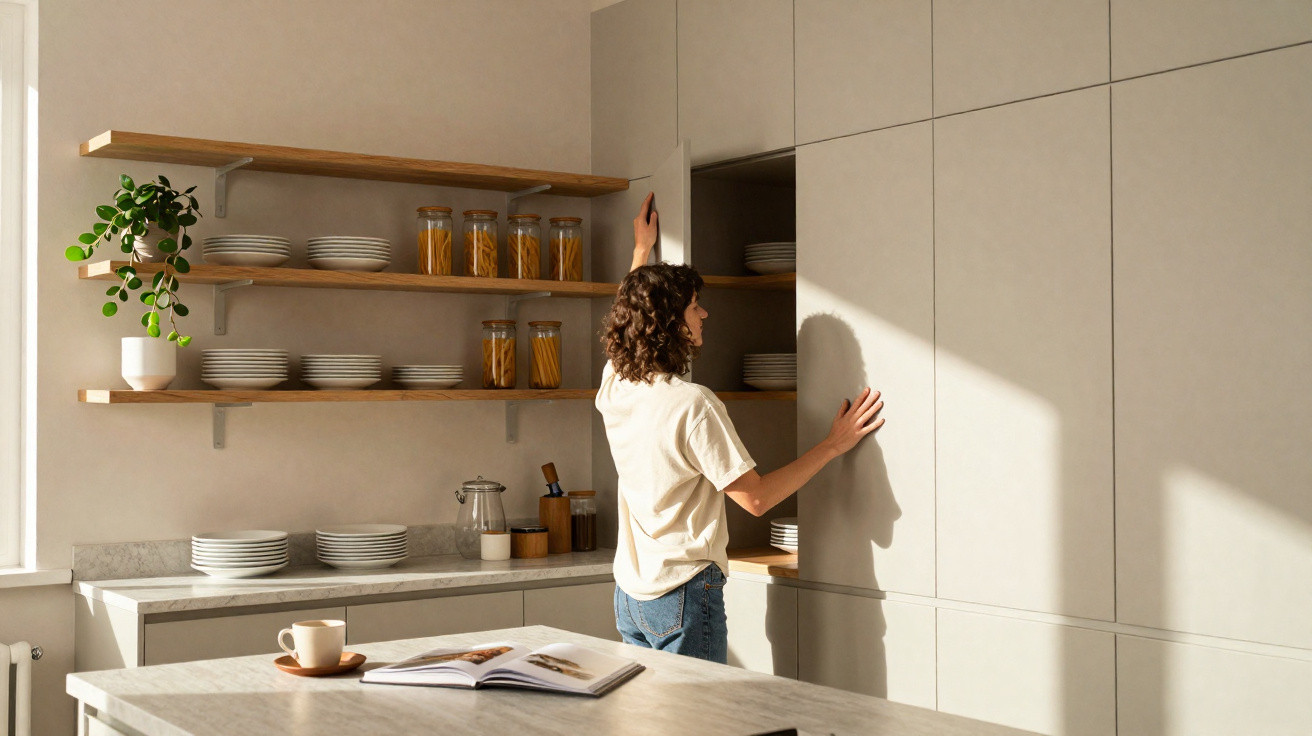
The return of closed cabinets is not a complete withdrawal. It is closer to a compromise. In new schemes, designers are forming “storage zones” using tall, full-height cupboards that absorb daily disorder, while retaining one small open area for display. Picture a stage within a working backstage: there is one styled feature, perhaps a niche for favourite bowls or a rail for attractive cups, while everything else remains out of sight.
Their key method is to zone storage according to function. Everyday plates and glasses are placed behind doors, close to the dishwasher. Open shelves move higher or onto a side wall, away from the hob and sink where grease and splashes are less likely to reach them. Some designers are replacing conventional open shelves with shallow ledges, just deep enough for artwork, one or two plants and a small stack of books. This modest adjustment changes the purpose from “storage” to “decoration”, immediately requiring far less perfection.
Many homeowners make the same mistake: using every centimetre of open shelving as storage. That is when it becomes disorderly and demanding. If you retain open shelving, approach it as you would a coffee table: use a small number of objects and leave space around them. Spend ten minutes each month editing the display. Let’s be honest: nobody really does that every day.
Another common error is fitting open shelves above a cooker or beside a fryer. It may look impressive in a 3D rendering, but then real life brings steam, oil and tomato sauce. With every sticky jar that needs wiping, resentment increases. A more forgiving approach is to use closed cabinets in the “splash zone” and reserve open displays for quiet walls away from the cooking action.
We have all had that moment when we scroll past a flawless kitchen on our phone, glance at our own worktops and immediately feel as though we are falling behind. That is why some designers are speaking more directly about the pressure open shelving has imposed on clients’ lives.
“Open shelves turned kitchens into performance spaces,” says New York designer Lena Hu. “Closed cabinets let people cook and live without constantly editing themselves for an imaginary audience.”
Her observation clearly resonates. The “cabinet revival” is not simply about doors and hinges; it is about privacy. It allows part of a home to be unphotogenic while still feeling worthwhile. To support clients, some studios now show two layouts: one that is highly open and styled, and another that is more enclosed and forgiving. Time after time, clients select the option that preserves their energy rather than merely serving their Pinterest board.
- Small kitchens frequently benefit most from closed cabinets, as reduced visual clutter can make the room seem bigger.
- Messy households with children, pets or housemates generally feel more relaxed with only a very limited amount of open display.
- Design lovers can retain one “hero” shelf while allowing the rest of the kitchen to sit quietly behind doors.
Where the real battle lies: lifestyle versus aesthetics
The most compelling aspect of this change is not the hardware but the language people use to describe it. Fans of open shelving reach for terms such as “honest”, “unfussy” and “lived-in”. Those who prefer closed cabinets speak of “sanity”, “calm” and “focus”. Browse design forums and the recurring comments are clear: one camp calls the other “sterile”, while the reply is “unrealistic” and “high maintenance”. It is two outlooks sharing one wall.
In reality, the conflict is less about shelving than it is about expectations. For a decade, social media turned kitchens into settings for personal identity: coffee rituals, sourdough starters and rainbow-coloured spice jars, all framed by open shelves asking to be admired. Such constant exposure raised expectations of how a “normal” kitchen should appear on an ordinary Tuesday. Closed cabinets quietly resist that standard. They allow your mess to remain your own.
Some designers are developing hybrid options that recognise this tension. Glass-fronted cupboards with reeded or fluted glass obscure their contents, offering depth without exposing every item. Pocket doors can slide open to reveal coffee stations and appliance garages, then disappear when visitors arrive. Retro-inspired larders conceal entire microwaves and toasters behind large, almost old-fashioned doors. It is a form of design diplomacy, saying that “you can have your pretty moments, but you don’t owe anyone a full inventory.”
So what is the future of open shelving? It is not exactly dead; it has simply been redefined. Open shelves are moving from being the default replacement for upper cabinets to becoming an accent feature with a specific role. It might be a short stretch beside a window for plants, a small niche cut into a tiled wall for favourite cups, or a solid-wood ledge in a stone splashback holding three cookbooks and one vase. Designers are no longer presenting it as a universal answer. Instead, they treat it like a strong spice: excellent in modest quantities and overwhelming when used everywhere.
The understated resolution to this supposed war may be kitchens that accept their dual existence: the side facing the camera and the side belonging only to those who cook there. As more homeowners choose cabinets that close, lock, slide and conceal, they make a quiet statement about boundaries in a hyper-visible world. Not everything needs to be displayed, including your favourite mug.
You may spot the change the next time you scroll: fewer walls of carefully styled shelving and more kitchens that initially appear almost plain. Attention shifts from objects to light, texture and the way a run of cabinetry turns a corner. It is less immediately “wow” and more quietly mature. Perhaps that is the real change: design that permits life to be slightly messy without requiring you to stage it every morning.
| Key point | Detail | Why it matters to the reader |
|---|---|---|
| Open shelving fatigue | Dirt, dust and visual clutter are driving people back towards closed cabinets | Helps you feel less guilty if your own shelves never look Instagram-ready |
| Hybrid layouts | A combination of mainly closed storage with one or two small open “stage” areas | Offers both practicality and personality without continual maintenance |
| Design as a boundary | Closed doors act as a barrier against the pressure of social-media perfection | Encourages you to design around your real habits rather than photographs alone |
FAQs
- Are open kitchen shelves really going out of style? They are not disappearing, but they are no longer the default choice. Designers are using them more sparingly, often solely as accent features.
- Do closed cabinets make a small kitchen feel cramped? Not when colour and light are used thoughtfully. Pale fronts, integrated handles and effective lighting can make a wall of cabinets seem calm rather than heavy.
- Can I keep my open shelves without constant cleaning? Positioning them away from the hob and restricting what you store on them reduces grease and dust, meaning they need cleaning less frequently.
- Is it “wrong” to have both open shelves and closed cabinets? Not at all. Many of the most attractive and functional kitchens now combine both approaches to suit the owner’s habits.
- What should I actually display if I keep one open shelf? Select objects you use regularly and enjoy seeing: a stack of everyday plates, a favourite jug, several glasses and perhaps a plant or cookbook.

Comments
No comments yet. Be the first to comment!
Leave a Comment