
Old clothes pegs often end up at the back of a drawer, yet they can still be useful in everyday household routines. With a little creative reuse, they can help organise the home, make better use of available space and feature in low-cost DIY projects that tackle daily clutter.
Why is it worth keeping these small items?
In practical terms, a clothes peg provides grip, a fastening mechanism and a compact size: three qualities that are useful for sorting cables, sealing packets and keeping notes in view. Rather than throwing away wood, springs and plastic unnecessarily, these materials can become practical accessories for a wardrobe, utility room, worktop or home office.
The principle is straightforward: repurposing what is already on hand cuts waste and produces solutions tailored to a real home, with loose wires, scattered papers and small belongings lacking a designated place. Creative reuse works particularly well because it starts with familiar items that can be assembled quickly.
How can clothes pegs become cable organisers?
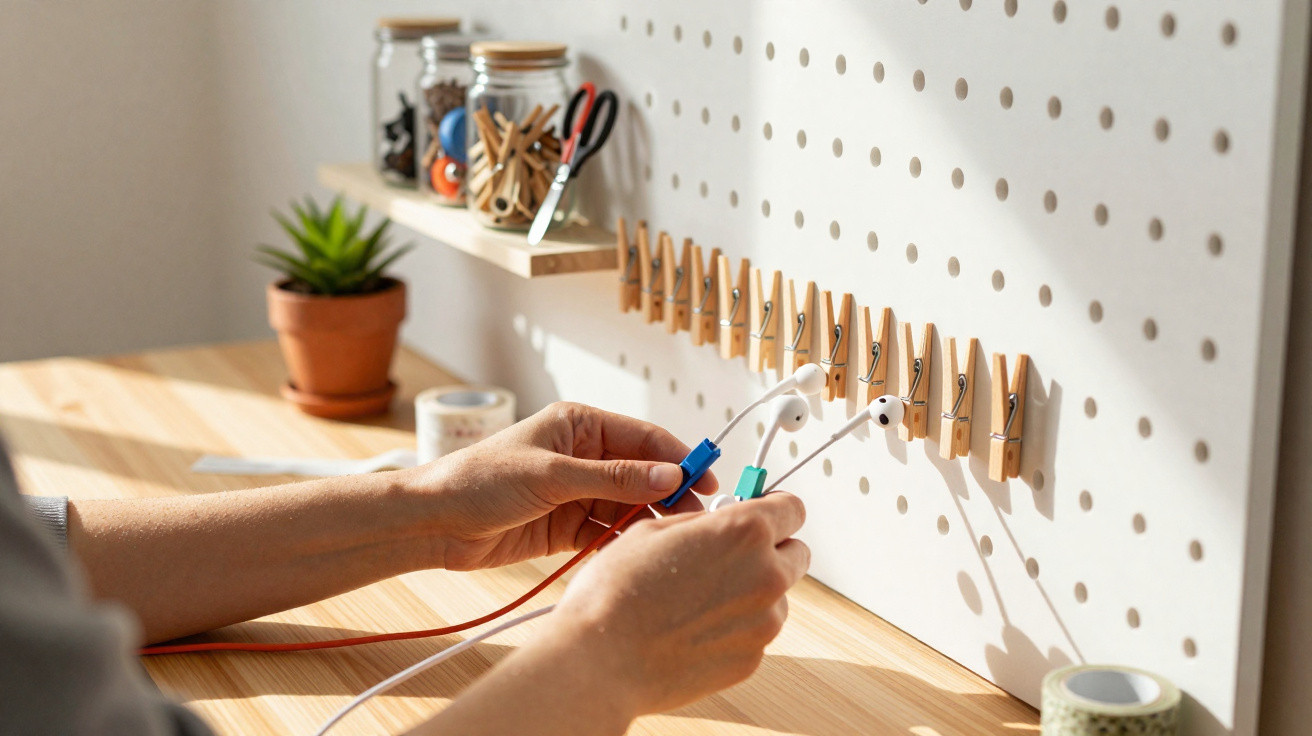
One of the most practical options is to attach each peg to the side of a desk, shelf or wooden base, where it can hold chargers, earphones and USB cables. The clip stops cables from dropping behind furniture and makes working, studying and charging devices more convenient.
For an easy assembly process, a few steps can make the result sturdier and safer:
- Sand the wood if it has splinters or signs of old wear.
- Apply strong adhesive or high-bond tape to the chosen surface.
- Group cables according to their purpose: mobile phone, laptop, lamp or printer.
- Space the clothes pegs far enough apart to prevent wires from tangling.
Where do they help most with home organisation?
Home organisation improves when every object has a visible place to rest. In the kitchen, clothes pegs can seal food packets and hold labels. In the bedroom, they can display photographs, lists and reminders. In the utility room, they work as markers for socks, cloths and small items that tend to disappear among baskets and boxes.
Using them across different areas prevents clutter from building up on worktops and keeps walkways clearer. The impact may seem minor, but it is noticeable on surfaces that collect papers, packaging, chargers, keys and post throughout the week.
Which DIY projects with clothes pegs are worth trying first?
For anyone wanting to begin with something quick, there are three simple projects that make good use of clothes pegs and require very few materials. Each one suits small flats and helps establish a storage routine without buying new organisers.
- Wall-mounted note holder: secure several clothes pegs to a wooden strip to hold bills, shopping lists and messages.
- Labelled packet sealer: paint the pegs and write the contents on them, such as rice, coffee, biscuits or pet food.
- Holder for lightweight accessories: attach necklaces, hair bands, earphones or ribbons to a narrow base inside a wardrobe.
In all three examples, the benefit comes from combining visibility with quick access. The item stays secured, does not disappear into a drawer and can be returned to the same place after use, reducing everyday mess.
How can creative reuse remain useful for longer?
The best results come when clothes pegs form part of a simple home-maintenance system. Check the condition of the spring, remove dust, discard broken pieces and move the holders around as needs change between the kitchen, office and utility room.
Creative reuse and DIY work best when there is a clear purpose behind them. When a clothes peg regularly holds a cable, label or accessory, it is no longer a leftover item but a household tool. These small adjustments, made at genuine points of use, improve home organisation by saving space, reducing build-up and making everyday life more practical.




Comments
No comments yet. Be the first to comment!
Leave a Comment