
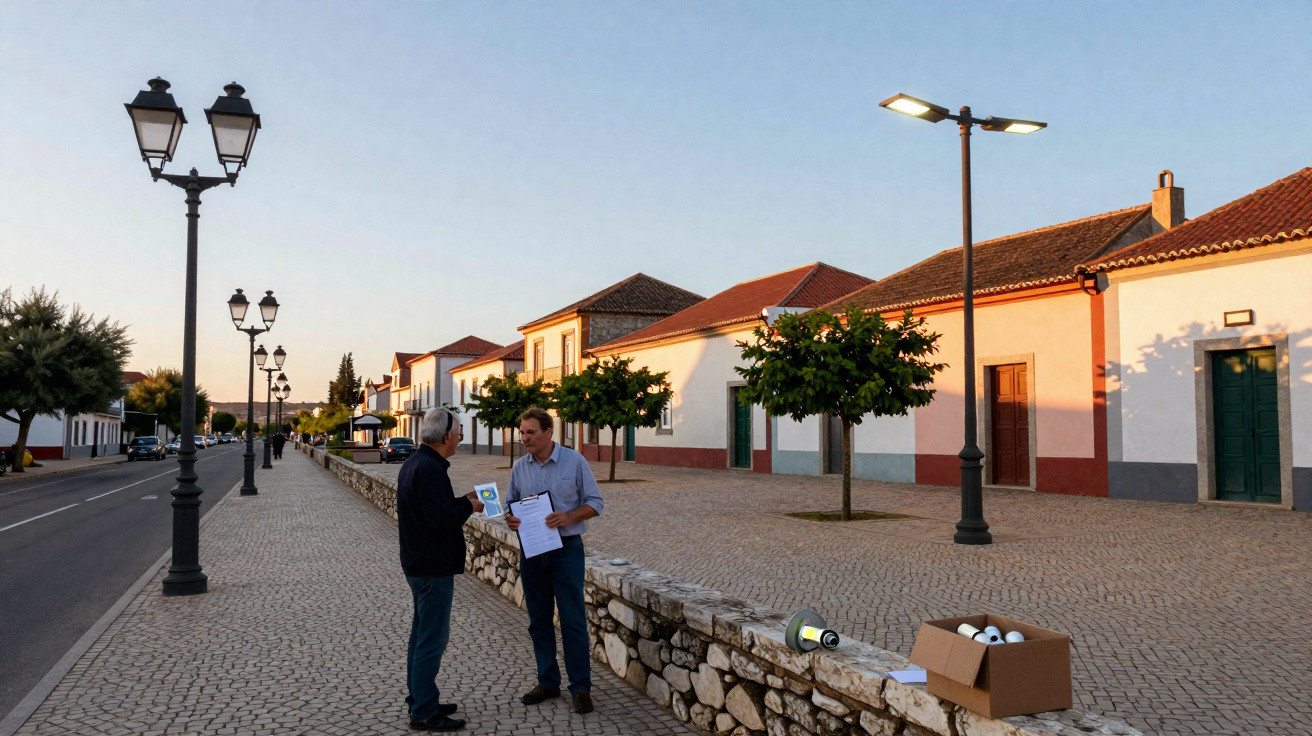
Viana do Castelo and Arcos de Valdevez switch off public street lights, but the policy remains contentious. Other local authorities are installing LED lighting to reduce their bills.
Switching off public lighting overnight as a cost-saving measure is not new among Alto Minho municipalities. However, only two now retain such restrictions, as the replacement of equipment with LED technology across their areas is cutting consumption and electricity spending. Leaving part of a municipality in darkness during the early hours is not universally accepted and, in Viana do Castelo, a public petition with nearly 500 signatures warns of potential safety risks.
LED public lighting reduces energy costs in Alto Minho
Viana do Castelo and Arcos de Valdevez both turn off public lighting at night. In the former municipality, lights are switched off between 3 am and 5 am, while brightness is reduced at certain times and in specific areas. In the latter, lights are turned off from 2 am in rural areas during summer. In winter, the lighting is switched off at midnight and comes back on at 5.30 am.
Across the region, most of the other eight municipalities - Monção, Melgaço, Vila Nova de Cerveira, Caminha, Ponte da Barca, Ponte de Lima, Paredes de Coura and Valença - have previously introduced either complete or partial cut-offs, but these have since been discontinued. This is because councils have been replacing, or are due to replace by the end of the year, lamps in the public network with LED technology. According to an E-Redes source contacted by JN, LED use, which has received total investment of more than €160 million since 2017, delivers “savings of 65 to 70% compared with the technology previously installed”.
Viana do Castelo street-lighting cut-offs face opposition
In Viana do Castelo, the overnight switch-off has proved controversial. An online petition (see box), with almost 500 signatures, calls “for an end to the nightly blackout” in the municipality, which has a population of more than 86,000.
“The petition is based on a great deal of misinformation. What we do is interrupt public lighting during a period in areas where the infrastructure does not allow the light intensity to be reduced. We maintain it across a large part of the municipality,” says mayor Luís Nobre. He stresses that “where there is three-phase infrastructure, there is no interruption to lighting, but rather a reduction in intensity, and people are not noticing it”.
The mayor says that “street lights have been replaced with LED technology, fitted with an automatic three-level reduction system (100%, 80% and 60%), with two thirds also being switched off from 10 pm”.
“In a targeted way, the overhead network is also switched off completely between 3 am and 5 am,” he says, adding that “this measure alone produces direct savings of around €600,000”. The value of the multi-year public-lighting contract running until 2028 exceeds €6.1 million.
Consumption reduced by 19%
In Arcos de Valdevez, the target is to replace the existing luminaires with LED technology by the end of this year. “Since 2021, through the work carried out, the Council has already saved 19% in terms of consumption,” a local authority source explains. The source acknowledges that “overnight cut-offs to public lighting remain in place, using criteria adapted to the reality of each area. In the urban area and at the municipality’s main tourist sites, lighting remains on throughout the night. In rural areas, during winter, it is switched off at midnight and reactivated at 5.30 am, while in summer the cut-off takes place at 2 am and the lights are not switched back on”.
Monção was among the municipalities that adopted overnight lighting cut-offs in villages more than a decade ago, but the Council eventually reversed the measure amid controversy. “I was never a supporter of that policy,” says Monção’s current mayor and leader of the Alto Minho Intermunicipal Community (CIM), António Barbosa, who was in opposition at the time.
“Our strategy was different. Rather than cutting the lights, we invested in replacements using energy systems that generate greater savings, in this particular case LED, while ensuring the safety of local people - especially when we are talking about municipalities with widely dispersed populations - so that this feeling of insecurity does not arise,” the mayor argues. “There are older people who live alone and already suffer from that. Switching off the lighting created a great deal of discomfort.”
Petition calls for impact assessment
The online petition to end the nightly blackout in Viana do Castelo argues that there are “legitimate concerns about the negative impacts” of switching off lighting during the early hours in Viana do Castelo, “particularly in terms of the population’s safety, mobility and quality of life”.
The petition’s 760 signatories argue that the absence of public lighting overnight “increases the perception of risk and insecurity; makes it harder for night workers and essential services to get around; compromises road and pedestrian safety; and negatively affects people’s wellbeing”. They therefore call for public lighting to be restored throughout the municipality or, at the very least, in urban areas and locations with heavier traffic.
They also support a public assessment of the impact of the current policy and the promotion of balanced solutions between energy efficiency and citizens’ safety. “Public lighting is not a luxury; it is an essential service and a fundamental pillar of urban safety and quality of life,” the petitioners insist in the petition addressed to the presidents of Viana do Castelo’s Municipal Council and Municipal Assembly.





Comments
No comments yet. Be the first to comment!
Leave a Comment