
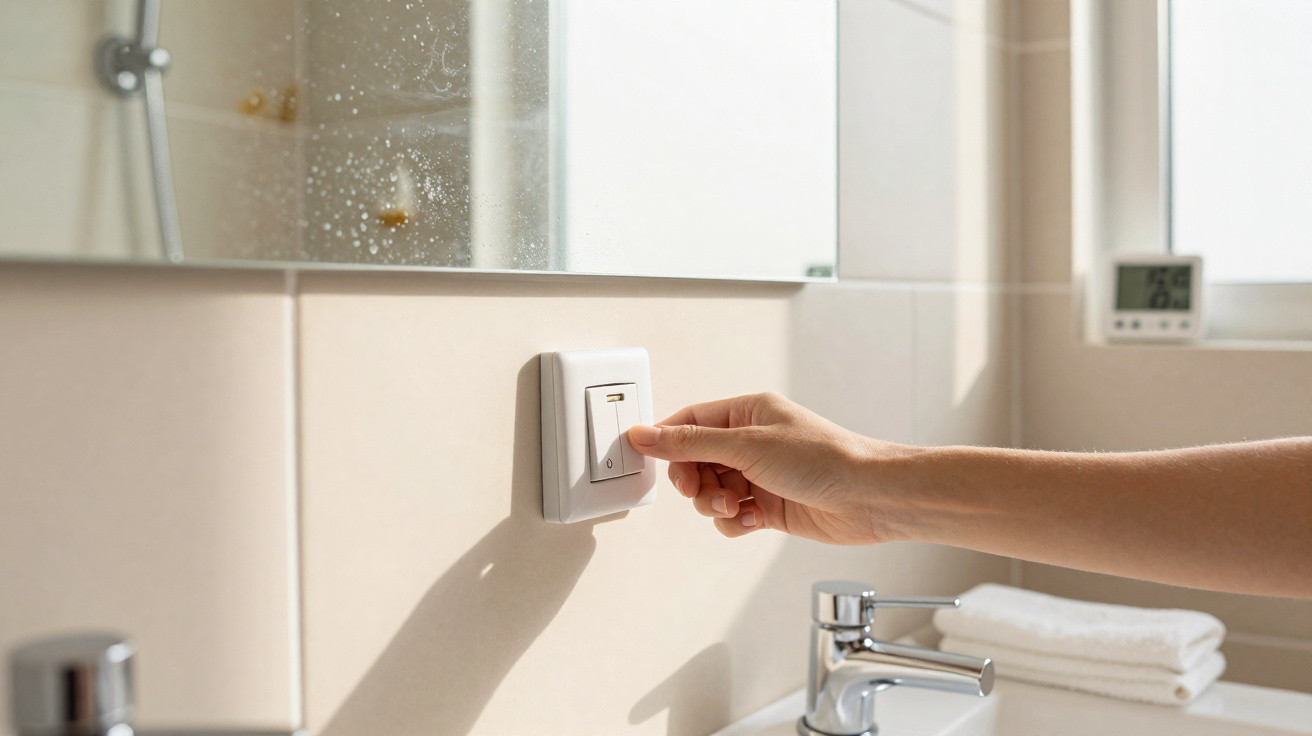
There is a familiar moment after a shower when the bathroom mirror resembles a blurred crime scene.
Droplets cover every tile. The atmosphere is thick, almost chewable. You open the window, clear the mirror with your palm and perhaps use a towel to dry the vanity. Yet, 10 minutes later, the room remains wet and carries a faintly… mushroomy smell.
A plumber once joked to me that most bathrooms are “slow-cooking their own walls.” I laughed at the time, until black specks began appearing in the grout behind my shampoo bottles. When a building inspector visited for an unrelated reason, he pointed casually to a small switch by the extractor fan that I had never registered.
“Use that properly,” he said, “and your moisture problem drops by almost half.”
I had lived there for three years without ever using it.
The small humidity switch nearly everyone overlooks
In plenty of homes, particularly new-build properties and refurbished flats, the bathroom extractor fan does more than simply switch on and off. It may have a discreet dial or switch connected to a humidity sensor: a little-known humidity control switch that determines how long the fan runs. Most people turn on the light and fan, have their shower, then carry on with the day.
This small control may sit beside the light switch or be fitted into the fan cover, often with tiny settings such as “30 / 50 / 70”. Those figures indicate relative humidity. With the right setting, the switch allows the fan to continue removing moisture long after the bathroom door has been closed. If it is set poorly, or ignored altogether, it may as well not be there.
It might sound like an insignificant technical feature. In reality, building-science research shows that a properly adjusted humidity switch can reduce lingering moisture by nearly half when compared with a basic routine of running the fan only while the room is occupied. Less residual damp means mould grows more slowly, paint is less likely to peel and wood is less likely to warp. It is a dull little detail that can quietly determine whether a bathroom grows old well or decays from within.
At a small block of flats in Portland, the building manager began seeing brown marks spreading across ceilings above showers. Residents reported musty odours in their hall cupboards, unaware that the issue began in the bathroom. A ventilation contractor inspected every flat and found the same problem throughout: each had an extractor fan with a humidity switch, but the controls had either been left at their default setting or switched off at the wall.
They carried out a straightforward comparison. Residents showered normally in two matching bathrooms. In the first, the fan operated only during the shower before being switched off. In the second, the humidity switch was adjusted to roughly 50%, and residents were instructed not to touch it. Measurements taken 30 minutes after showering found that the humidity-controlled bathroom had nearly 45% less moisture remaining in the air and on surfaces.
You will not necessarily spot that change in one day. Over months, however, it appears as cleaner grout, fewer dark patches and less condensation on the inside of windows. Residents barely had to alter their routines. The switch did the work.
The principle is simple. A hot shower fills a room with warm, moisture-laden vapour. Once that vapour meets cooler surfaces - tiles, mirrors and painted walls - it turns into water. Extractor fans are intended to expel this moist air and draw in drier air from outdoors or neighbouring rooms. A conventional on/off system only succeeds if you remember to leave the fan running for long enough.
A humidity switch gives the setup some intelligence. Rather than relying on guesswork, it tracks the actual moisture level. When humidity rises sharply, it increases the fan speed and continues operating until levels return to normal. There is no need to time it or decide whether the room is “dry enough”. Correctly used, this small control shortens the period during which surfaces remain wet - precisely the period in which mould flourishes.
Most people never adjust the setting, which explains why so many technically ventilated bathrooms still feel swamp-like for half the year.
How to use a bathroom humidity switch effectively
The key is to stop viewing the extractor fan as a light switch and instead regard it as a background assistant. Where the fan has a separate humidity dial or switch, begin by turning it on and leaving it on. If its settings are visible, choose a target between 40% and 50%. That level is sufficiently high to avoid over-drying the room while remaining low enough to limit condensation.
The more difficult part is resisting the urge to keep changing it. You can still switch the fan on when showering, but let the humidity control decide when it should stop. It may continue running for 20, 30 or even 40 minutes afterwards. That is not wasted electricity: it is moisture being removed instead of settling into the walls.
If your fan uses a combined control, such as a button labelled “AUTO” or “HUM”, choose that setting rather than permanent “ON”. In many systems, the fan runs quietly at low speed in the background before accelerating as steam fills the room. It is rather like cruise control for bathroom air.
There is a reason fogged mirrors and damp towels are so common. Ventilation is often treated as an optional job that we will get round to doing properly another time. Let’s be honest: nobody really does that every day. You leave the shower late, children are shouting and your phone is buzzing in the next room. The fan goes off with the light, leaving the moisture behind.
Using this little switch properly works because it does not depend on willpower. It asks you to remember nothing beyond “leave it alone”. The usual errors are very understandable: some people set the humidity threshold too low, so the fan never activates. Others set it so high that it responds only once the bathroom has become a sauna. Some even turn off the circuit breaker to silence a “noisy fan that won’t shut up”, without realising that it is doing precisely what it was designed to do.
When a bathroom still smells damp despite the setting, the concept is usually not at fault. More often, the fan is underpowered, dirty or venting directly into a cold loft space, where moisture simply collects rather than leaving the home.
As one building scientist said at a workshop for landlords:
“Most of the moisture damage I see in bathrooms isn’t from leaks. It’s from showers that ended an hour ago and air that never really dried out.”
Many homeowners privately assume their bathrooms are simply “like that”, as though certain rooms are fated to feel clammy. A humidity switch offers a quiet way to challenge that belief without removing tiles or purchasing expensive equipment. Try it for a few weeks, then notice not only the mirror but also the smell when you first enter the room in the morning.
- If your fan has a visible humidity dial, begin at around 50% and make gradual adjustments over several days.
- Clean the fan cover and grille once or twice yearly so it can move air at its intended rate.
- Leave the bathroom door slightly ajar after showering, allowing the fan to draw drier air from the rest of the home.
- If the fan never switches off, the setting may be too low or there may be another source of moisture in the room.
- If it hardly ever starts, the setting may be too high or dust may be blocking the sensor.
Why a small humidity switch affects how your bathroom ages
Once you notice how moisture behaves, it is difficult to ignore. You start seeing how long water droplets remain on the window, how grout in shaded areas stays wet, and how a towel on the back of the door never fully dries. That modest bathroom switch stops seeming like a random wall fitting and starts looking more like a volume control for how forcefully your home fights back against water.
This goes beyond mould marks that can be scrubbed with cleaner at the weekend. Persistently high humidity gradually strains vanity joints, distorts door frames, lifts paint and sealant, and reduces the working life of the extractor fan itself. A bathroom that reliably dries within 20–30 minutes of a shower has a very different existence from one that remains humid for hours. The price is only a few extra minutes of fan operation, directed by a control that probably came free with the house or flat.
The more openly people discuss these small pieces of home infrastructure, the more they change what others notice around them. Someone mentions their “magic humidity switch” at work, and colleagues suddenly go home to find the same dial over their sink. A tenant asks a landlord why the bathroom always smells stale, and the solution becomes a clean fan with a properly adjusted sensor rather than a scented candle.
It is a subtle chain reaction: one small switch, less moisture and fewer headaches. Once you have watched your mirror remain clear after a hot shower on a cold morning because the fan continued humming by itself, it becomes difficult not to mention it to someone else.
| Key point | Detail | Benefit for the reader |
|---|---|---|
| Finding the humidity switch | Often a small button or dial near the fan, marked with a percentage or “HUM/AUTO” | Helps you discover an existing feature in your home at no cost |
| The right setting | Aim for roughly 40–50% humidity and let automatic mode manage the running time | Reduces condensation and the long-term risk of mould |
| Useful habits | Leave the door ajar after showering, clean the fan and do not cut its power supply | Extends the bathroom’s life and improves everyday comfort |
FAQ
- How do I know if my bathroom has a humidity switch? Check around the extractor fan and lighting controls for an additional switch labelled “HUM” or “AUTO”, or a small dial numbered from 30–80. On some models, the control is concealed behind the fan grille, so carefully removing the cover may reveal it.
- What if my fan only has a simple on/off switch? You can achieve a similar result by running the fan for 20–30 minutes after every shower. If you want the same set-and-forget convenience later, a plug-in humidity sensor or smart wall switch can provide automation.
- Isn’t running the fan longer a waste of energy? Bathroom extractor fans use comparatively little electricity, while quicker drying protects far more expensive parts of the home. In many cases, additional fan use costs less than tackling mould or repainting.
- My fan is too noisy to leave on, what can I do? Excessive noise can indicate an old, undersized or dust-clogged fan. Cleaning may improve it, but if it still roars, replacement with a quieter humidity-controlled model is often the only genuine solution.
- What if I already see mould spots in my bathroom? Removing mould addresses only half the issue. You also need improved drying: use or install a humidity switch, increase airflow and inspect for hidden leaks. Unless moisture is controlled, the spots will return.






Comments
No comments yet. Be the first to comment!
Leave a Comment