
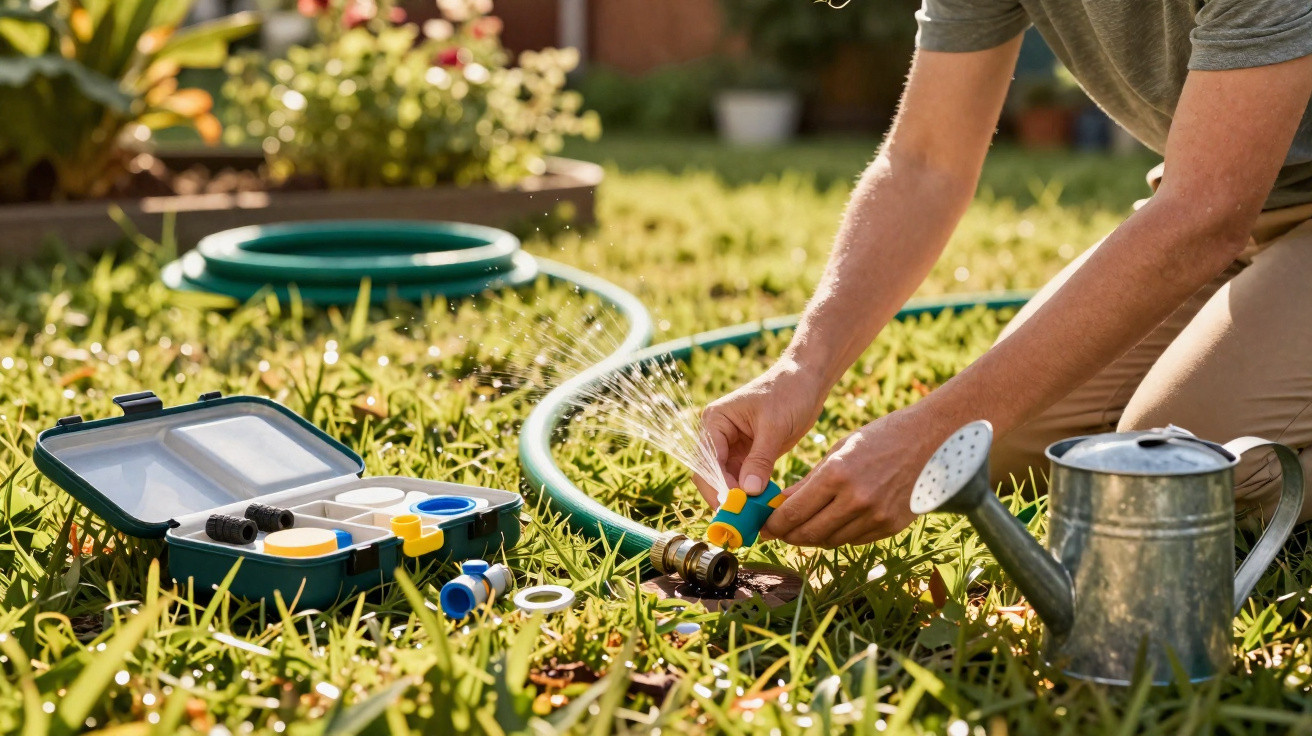
A barely visible shine on the hose, a deeper-coloured spot in the earth, a gentle hiss lost beneath the birdsong. Then the water bill turns up, or you come home from work to discover a muddy hollow where your tomatoes ought to be. A minor leak has been running unnoticed for days, perhaps even weeks.
Garden hoses seldom fail in spectacular fashion; instead, they gradually wear out. There is a split in one place, a pinhole in another, or a loose fitting that drenches your shoes rather than the roses. Many people simply bin the hose and replace it, without considering either the water being lost or the plastic sent directly to landfill. Over one summer, however, these “small” leaks can waste hundreds of litres.
If watching clean water disappear across your paving has ever made you feel a little guilty, you are far from alone. Once that narrow, sunlit jet catches your eye, it is impossible to ignore. Fortunately, ten minutes, a knife and a little determination can achieve a great deal.
Why tiny garden hose leaks matter more than you think
One sunny Saturday, I saw a neighbour watering his lawn. At first glance, it seemed idyllic: tidy rose beds, a consistent arc of water and children running barefoot after one another. Then I spotted the side of his hose, sending a fine, uninterrupted mist into the air like an unwanted miniature fountain.
Months earlier, he had wound an old piece of duct tape around it. By then, the tape was grey, sticky and peeling away in strips. Whenever he opened the tap, the leak sprang back into action, wasting water over the concrete. He merely shrugged and laughed. “It’s only a bit of water,” he said, drying his glasses on a damp T-shirt.
Yet “Only a bit” soon mounts up. Research from water boards throughout Europe indicates that one pinhole in a hose can lose tens of litres per hour when left running. Across a summer of gardening, that amounts to bathtubs full of water disappearing into gravel and paving cracks. Scale that up across a road, town or city, and those apparently harmless sprays become part of a much larger, less amusing issue.
For an individual household, a leaking hose reduces pressure at the nozzle, makes you leave the tap running for longer and gradually increases the bill. More broadly, it is one of those unnoticed habits that jars with our stated concern for the environment. There is an odd contradiction in tending a pollinator-friendly border with care while allowing a continual trickle to run into the nearby gutter.
Most hose leaks are repairable, though. Garden centres sell joiners, repair kits, replacement washers and connectors for less than the price of a takeaway coffee. A neat cut and a plastic coupler can rescue a hose and give it several more years of use. The key is recognising when to patch it, when to remove a section and when to retire it with dignity rather than force it through another leaky season.
Practical ways to repair small leaks and loose fittings
The leak is most often found at a hose end rather than halfway along its length. Click-on connectors and metal spray guns may appear robust, but one worn rubber washer in the fitting can turn them into a sprinkler aimed at your footwear. Replacing the washer normally takes less than a minute and can prevent a remarkably large amount of waste.
For damage along the hose, first identify the precise location. Let water run through it at moderate pressure and inspect its full length slowly. Tiny holes often sit underneath, giving themselves away only through a sparkling spray in sunlight or damp grass. When you find one, mark it with a peg or piece of string before shutting off the tap.
Small holes away from either end can often be sealed effectively with self-fusing silicone tape. Pull the tape tight and wind it carefully over the damaged spot, overlapping each layer. It fuses to itself to form a flexible seal that tolerates bending and coiling. For a tidier, more permanent repair, remove the damaged piece with a sharp knife and fit a hose repair joiner, securing the clamps so that both hose ends sit firmly against the connector.
Eventually, repairs can become a losing struggle. A hose left in direct sunlight for years often turns brittle. Its plastic begins cracking along the length, and sealing one hole simply transfers the pressure to another weakened area. If bending the hose reveals several pale, chalky lines, its structure has already started to break down.
In practical terms, further leaks are inevitable. You may be able to repair each one separately, but your time and patience count as well. Let’s be honest: nobody really does that every day. A hose that continually kinks and develops little leaks is less likely to be handled with care, because every watering session becomes a minor repair task.
Water pressure is another consideration. Even a “small” side leak can significantly weaken the flow from your nozzle, particularly with longer hoses or at homes where pressure is already limited. You may end up opening the tap further to achieve the same reach, quietly undoing the water-saving effort. In some cases, cutting out one central section and installing a joiner is more useful than applying five separate patches along the hose.
There is something unexpectedly satisfying about repairing a hose. It offers a small, tangible success in a world where so many problems are abstract and online. Water that was once spraying uselessly in all directions becomes, minutes later, a clean and controlled stream. That hands-on feeling of control has value: it changes you from a passive buyer of inexpensive garden equipment into someone who knows how things work and how to maintain them.
It also has a wider effect. After removing and replacing a damaged section, you begin to notice where the hose scrapes against sharp brickwork or how tightly knotting it beside the shed creates lasting kinks. You start moving it rather than pulling it roughly. You keep it off the ground during winter. These are small changes, but they can extend the life of a straightforward tool by years.
Habits and hacks to make your garden hose last much longer
One approach stands above many others: cut, join, revive. If you find a small split or a flattened, cracked portion, avoid simply covering it with tape. With a sharp blade, cut a clean, straight section from both sides of the damage. Next, push each cut end securely into a plastic or brass hose mender and tighten the fittings evenly.
This gives you two solid, clean connections rather than one fragile, covered-over section that will trouble you all summer. Using this method, many gardeners turn a single long, scarred hose into two shorter but highly useful lengths. Where an outside tap sits near the front of the house, the second piece can be useful for washing the car, while the better, more flexible length is reserved for beds and borders.
When the leak is at the tap, replacing the worn rubber O-ring inside the connector is an easy solution. Dirt, grit and a little limescale can wear through the seal much faster than expected. A replacement costs pennies and immediately stops the ring of spray that drenches the wall whenever you water pots. While doing this, remove the spray gun or nozzle and inspect its washer as well. Rinsing it beneath the tap may dislodge the grain of sand that has been preventing it from closing.
Few things damage a hose faster than leaving it full of water, kinked around a sharp corner and baking on paving slabs. Ultraviolet light breaks down plastic, while trapped water expands and contracts as temperatures change; together, these forces gradually damage the material from the inside. If you have ever picked up a hose in spring and felt it crackle in your hands, you will have encountered that slow deterioration first-hand.
We all know the temptation to arrive home tired and leave the hose wherever it lands. On a wet, windy night, draining and coiling it neatly can feel unrealistically ambitious. This is why small, simple routines work better than grand intentions. Putting it on a basic hose hook instead of leaving it on the ground, even only once or twice a week, helps prevent it being crushed by bicycles or garden furniture.
Many leaks start at the same pressure points: where the hose comes off the reel, where it is dragged around a sharp step or where a car tyre has passed over it twenty times. Follow the route it usually takes and soften those harsh edges - for example, place old carpet over a brick edge or add a smooth plastic guard to a corner - and you can add whole seasons to its life without actively “working” on it.
“Every hose tells you how it wants to be treated,” smiled one allotment keeper I met in North London. “Leave it in the sun, leave it full of water, and it sulks. Drain it, shade it and it’ll serve you for years.”
The little routines make a difference. Emptying the hose before winter prevents trapped water from freezing, expanding and splitting its walls from the inside. Keeping it out of direct sunlight - even beneath a bench or inside a shed - slows the brittle ageing that causes hairline fractures.
- After turning off the tap, let the hose run briefly to release water and pressure.
- Wind it into loose coils without sharp kinks; broad, relaxed loops are gentler than tight bends.
- Keep connectors off the ground so grit cannot wear away their seals.
Emotionally, these small care routines often reflect how we relate to the rest of our outdoor space. Where a hose is permanently tangled and leaking, beds are more likely to dry out, plants may suffer and watering becomes a chore. A hose that works smoothly and reliably draws you outside in the evening not only to “do the watering”, but also to stroll, observe and breathe. During a hot, dry week, that distinction is enormous - for your plants and your state of mind.
Sharing repairs, saving water and rethinking “cheap” tools
There is a quiet satisfaction in repairing something that others would discard. Garden hoses occupy an awkward space: “cheap enough to replace, annoying enough to ignore”. After you have fixed a few leaks and watched your water pressure return, it becomes more difficult to view them as disposable lengths of tubing.
At allotments and in communal gardens, hose-repair skills spread quickly. One person cuts away a cracked section and fits a joiner, another borrows the knife, and before long the whole row of plots is marked by green and yellow connectors like battle scars. Those repaired lengths tell a very different story from heaps of split, sun-bleached plastic at the recycling centre.
For many people, the first move is not a technical one. It is simply deciding that a leak should not be ignored. Once that glittering spray looks like both wasted water and a problem with a solution, keeping a hose repair kit in the shed feels as ordinary as storing spare light bulbs under the sink.
This is not a demand for perfection. Nobody expects you to measure flow rates or record every minute that the tap runs. It is about moving gently from “oh well, it’s leaking again” to “right, let’s sort that”. The materials are available, the repairs are straightforward, and your garden does not mind if the hose is brand new or unmistakably patchwork, provided the water reaches its intended place.
On a warm evening, as the light falls at an angle and you use a hose that finally behaves itself, you can feel the difference in your shoulders. There is no unexpected cold spray on your anorak, no irritated pulling at a stubborn kink and no guilty look towards a spraying connector. Instead, there is only the gentle, controlled sound of water meeting soil and the sense that this small part of your life is quietly in your care.
| Key point | Detail | Benefit for the reader |
|---|---|---|
| Identifying micro-leaks | Walk along the pressurised hose, looking for fine jets and damp areas | Helps target repairs accurately without wasting time |
| Cutting and joining | Remove the damaged section and fit an appropriate repair connector | Provides a durable solution that gives the hose several more years of life |
| Protecting and storing | Avoid full sun, tight bends and standing water in the hose | Lowers the likelihood of further leaks and saves water over the long term |
FAQ:
How can I tell whether a leak should be repaired or the hose replaced? Look at the number of weak areas you can identify. Repair is generally worthwhile if there are only one or two leaks and the hose remains flexible. If it is brittle, cracked in several places and creaks when bent, replacing it - while reusing sound portions as short extensions - is the more sensible option.
Which tape genuinely works on a garden hose? Self-fusing silicone tape is the strongest option for minor pinholes and hairline splits. Standard duct tape commonly peels away and leaks after becoming wet and warm. Stretch silicone tape firmly as you wrap it, overlap the layers and allow a little time for it to bond.
Is it possible to repair a leak immediately beside the connector? Yes, although cutting away a few extra centimetres and installing a completely new connector is often simpler. A leak near the end usually indicates that this section has been heavily strained and could fail again, so a fresh end fitting offers a cleaner solution.
Does a repair affect water pressure? A well-made repair - a cut-out section with a proper joiner - usually improves pressure because water no longer escapes before reaching the nozzle. Poor repairs involving loose tape or badly fitting connectors can restrict flow, so it is better to do the work carefully once than keep layering temporary fixes.
What can I do to prevent leaks developing in the first place? Store the hose in shade when it is not being used, avoid driving or repeatedly walking over it and drain it before winter. Fit smooth protectors around sharp corners and coil it in wide loops rather than tight knots. Those small habits greatly reduce strain on the hose wall and joints, resulting in far fewer leaks over time.






Comments
No comments yet. Be the first to comment!
Leave a Comment