
The laundry room is often the room whose door you shut as soon as visitors turn up. There may be a half-folded heap on the tumble dryer, stray socks hiding in the corners, and a detergent bottle that is somehow always sticky while leaking blue liquid across the shelf. You go in to start a quick wash and leave with the uneasy sense that this small, noisy space is secretly controlling your life.
Then, while hunting for a missing sports top at 7:43 a.m., you realise that laundry itself is not the issue. The real problem is the disorder surrounding it.
What if this tight, overlooked space could become the most effective storage area in your home?
Treat your laundry room as a vertical goldmine
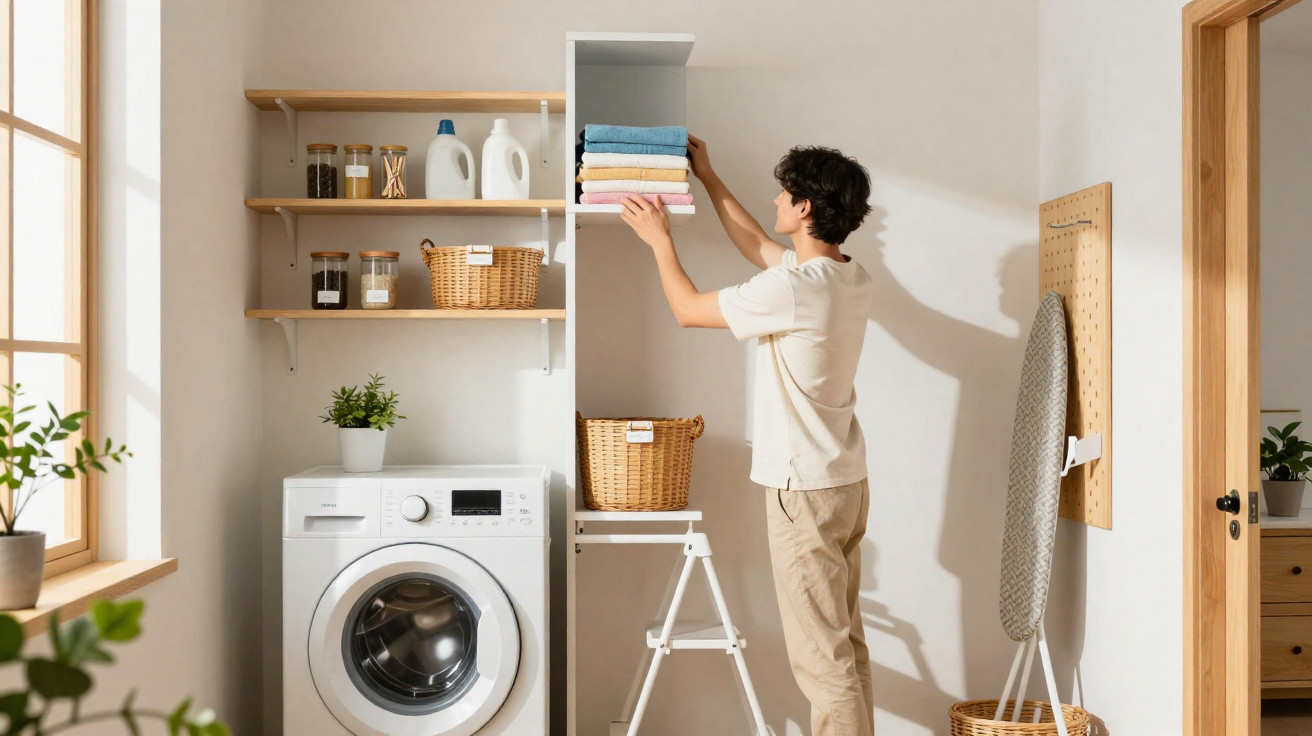
Most people see only the floor when they look at a laundry room: the overloaded basket, the hamper and the drying rack left half open like a damaged wing. But the most valuable space is overhead. Walls, doors and even the side of the washing machine are unused surfaces that could hold half the clutter without taking up any floor area.
Once you begin to look upwards, the room takes on a completely different feel. Instead of resignation, you start to see opportunities.
Imagine a slim laundry nook that is scarcely wider than the washing machine and tumble dryer. The wall on the left has nothing but peeling paint, while the right-hand side holds a jumble of brooms and the ironing board that crashes down every time the door is opened.
A friend of mine, fed up with stumbling over everything, fitted a narrow rail-and-hook system along one wall, with a shallow shelf above the appliances. The change was remarkable. Detergent, stain removers, dryer balls and cleaning sprays all moved onto the wall. Within an hour, the floor was clear. Her children stopped asking, “Have you seen the lint roller?” because it now had an obvious, visible place at eye height.
The principle is straightforward. We are naturally inclined to fill flat surfaces, from worktops and the top of the tumble dryer to laundry baskets. You put down one item “for a second”, then the pile gradually expands. Vertical storage interrupts that habit. Shelves, pegboards, rails and wall-mounted baskets give intentional, assigned places to things that would otherwise wander around.
When every item can hang or slide into a place, clutter has nowhere to settle.
What once seemed like a very small room can begin to work like a neatly arranged shed, with every centimetre serving a purpose.
Create laundry room storage zones that work
The approach that makes the biggest difference is to stop seeing a “laundry room” and start seeing a “mini warehouse with sections”. Allocate one shelf to laundry, another to cleaning and another to general household overflow. Breaking the room into zones turns an undefined mess into manageable parts.
Begin with three essential areas: a washing zone, a drying zone and a household-storage zone. Even the smallest room can accommodate each one on a separate shelf, in a basket or in its own corner.
Everyone knows the feeling: you are already running late and searching behind detergent bottles for the stain remover that seems to have disappeared last Tuesday. One reader solved this by putting together an “emergency grab” basket for her laundry room containing stain pens, a sewing kit, a lint roller, safety pins and a fabric shaver.
She called it “Last-Minute Fixes” and positioned it at arm level directly above the washing machine. Now, when somebody calls, “Mum, there’s a stain!”, she takes one basket rather than searching through a black hole. That one clearly defined zone quietly cut minutes from their hectic mornings.
Zoning succeeds because it changes the laundry room from a dumping place into a map. Your mind settles when it knows precisely where each category belongs. One shelf becomes the “washing brain” of the home, while another serves as the “cleaning headquarters.” A third can store kitchen roll, pet food or bulk toilet roll.
Realistically, nobody maintains this perfectly every day. Yet, once the zones are in place, it is far more difficult for unrelated items to creep into them. Anything that fits no zone becomes immediately noticeable. That small obstacle can prevent your laundry room from becoming a black hole again.
Underused ideas that triple storage
Start with the most neglected surface: the rear of the door. An over-door rack with pockets or shelves can store clothes pegs, tumble-dryer sheets, laundry bags for delicates, spare lightbulbs, pet leads and even small bottles of cleaning product. That single flat area can do the work of half a cupboard.
Next, consider the sides of your appliances. Magnetic shelves and hooks attach to the metal, providing room for detergent, measuring scoops and microfibre cloths. Rather than being a plain white box, your washing machine becomes an organised command centre.
One major error is making the system unnecessarily complicated. Small baskets for every possible category, labels in three languages and containers so attractive that you hesitate to touch them can all create a setup you stop using after a week.
Your laundry room storage needs to be easy enough to maintain on a lazy day. Choose large open bins over awkward little boxes. Use clear jars only when you will genuinely refill them. Fit hooks for everyday items, such as the laundry bag, reusable shopping bags, dustpan and dog towel. And do not feel guilty if the labels are handwritten or uneven. A slightly imperfect arrangement that gets used is better than a Pinterest-ready system you abandon.
“Storage that only works on a good day is bad storage,” says a professional organizer I spoke with. “Your laundry room has to stay functional even when you’re tired, rushed, or just don’t care. That’s the real test.”
- Choose stackable, open-front bins for detergents and cleaning supplies, allowing you to take out one product without lifting everything else.
- Fit a wall-mounted fold-down drying rack so floor space is available whenever it is not needed.
- Install a narrow shelf immediately above the appliances for daily essentials that remain within arm’s reach.
- Add a rail with S-hooks to hold spray bottles, laundry bags for delicates and cleaning cloths.
- Slot a slim wheeled trolley between the washing machine and wall for spare vinegar, bicarbonate of soda and extra sponges.
How an organised laundry room helps the whole home
When the laundry room no longer feels like a battleground, an unexpected change follows: the rest of the home feels able to breathe. Coats move onto the hooks there rather than gathering on chairs. The junk drawer gets smaller because batteries, bulbs, tape and tools have a simple, defined spot on a laundry shelf.
This small room becomes the behind-the-scenes area of everyday life. It gets no praise or spotlight, but it provides a calm, useful place where items begin and end their cycle.
You may find that opening the door no longer makes you feel instantly overwhelmed. The sound of the machine becomes less like background noise and more like proof that the home is quietly looking after itself. A spare set of sheets, rolled and stacked; a clearly labelled box of lightbulbs; a hook where the dog lead always hangs: these are modest, almost unseen luxuries.
The methods are simple and, once noticed, nearly self-evident. Make use of the walls. Split the room into zones. Pick storage that still works on a bad day. The true transformation does not come from products or attractive baskets, but from the way this previously ignored room starts making daily life easier rather than exhausting you.
| Key point | Detail | Value for the reader |
|---|---|---|
| Use vertical space | Walls, doors and appliance sides provide storage through shelves, hooks and racks | Clears the floor and immediately reduces visual clutter |
| Create clear zones | Separate areas for washing, cleaning and household overflow | Makes items quicker and more intuitive to find and put away |
| Keep systems lazy-proof | Large bins, simple labels and daily essentials that are easy to reach | Keeps storage useful on busy days instead of falling apart over time |
FAQ:
- How do I organise a very small laundry cupboard? Focus on the walls and door: shallow shelves above the appliances, an over-door organiser and a narrow wheeled trolley between the washing machine and wall can greatly increase storage without requiring more floor space.
- Is it safe to store cleaning products in the laundry room? Yes, provided they are kept high up or in closed bins if you have children or pets, and away from heat sources; label them and group them by type to prevent spills or accidental mixing.
- What’s the best way to store detergents and liquids? Use strong baskets or trays to catch leaks, keep heavy bottles on lower shelves and place everyday products at chest height so you do not need to lift them over your head.
- How can I add drying space without a large rack? Fit a wall-mounted fold-down rack, a ceiling-mounted pulley rack or a tension rod between two walls for hangers, then fold it away or slide it aside when it is not being used.
- How often should I rethink my laundry room setup? Carry out a quick review every few months: donate anything you never use, alter zones if your routine has changed and add storage only when it solves a specific, genuine problem.




Comments
No comments yet. Be the first to comment!
Leave a Comment