
Cold mornings, damp floors and a stubborn door that groans whenever you pass through: it is a small problem that can become a major daily annoyance.
In both period properties and new-build homes, millions of internal doors gradually drop by a few millimetres each year. The effects may seem outsized: scraping sounds, damaged floor finishes and the feeling that your front door has suddenly put on ten kilos. Yet this household frustration usually has a straightforward mechanical cause – and it can often be resolved quickly without sanding or using power tools.
Why doors suddenly start scraping in winter
As temperatures fall and humidity rises, doors seldom remain precisely where the joiner originally fitted them. Timber responds to moisture, floors shift and frames can twist slightly. Just one icy week in January may turn an effortlessly opening door into a daily struggle.
Usually, two factors combine to cause the issue:
- Moisture in the air, which causes timber to expand and alter its shape.
- Hinges wearing out or becoming loose through years of regular use.
In many homes, particularly those constructed before modern moisture-control measures, frames and floors move slightly as the seasons change. Combine this with a weighty solid-timber door and gravity gradually draws it downwards. The drop is rarely more than a few millimetres, but that is enough for its lower edge to catch on floor tiles.
Uneven gaps around the door frame and a faint scratch on the floor usually point to a hinge problem, not a carpentry disaster.
Examine the gaps surrounding the door carefully. A larger gap at the top on the handle side, or one corner sitting visibly lower, normally means the structure has not failed; the door has simply moved out of alignment.
How to spot a door that needs lifting, not sanding
Many householders immediately reach for a plane or sandpaper. Although that approach can work, it permanently removes material. A brief check will often reveal that the door itself is sound and is merely hanging at an incorrect angle.
Key signs to watch – with your eyes and ears
- Dragging noise occurring at the same place near the floor each time the door opens or closes.
- Black or shiny streak visible on tiles, laminate or carpet pile directly beneath the door’s swing path.
- Uneven gap between the door and frame, with one corner wider than another.
- Metallic creak from the hinge side rather than a softer timber-on-timber noise.
Gently raise the door by its handle while it is half open. If there is slight vertical movement, the hinges are allowing more play than they should. This is usually encouraging: the issue can often be fixed without cutting or trimming the door.
Before shaving off the bottom of a door, check if a 10-minute hinge adjustment brings it back to level. Often, it does.
The fast hinge adjustment that lifts most sagging doors
The fastest solution rarely creates any sawdust. In most instances, tightening and slightly repositioning the hinges raises the door sufficiently to clear the floor. It is a simple method requiring only basic equipment.
Step-by-step: raising a door with a shim, not a sander
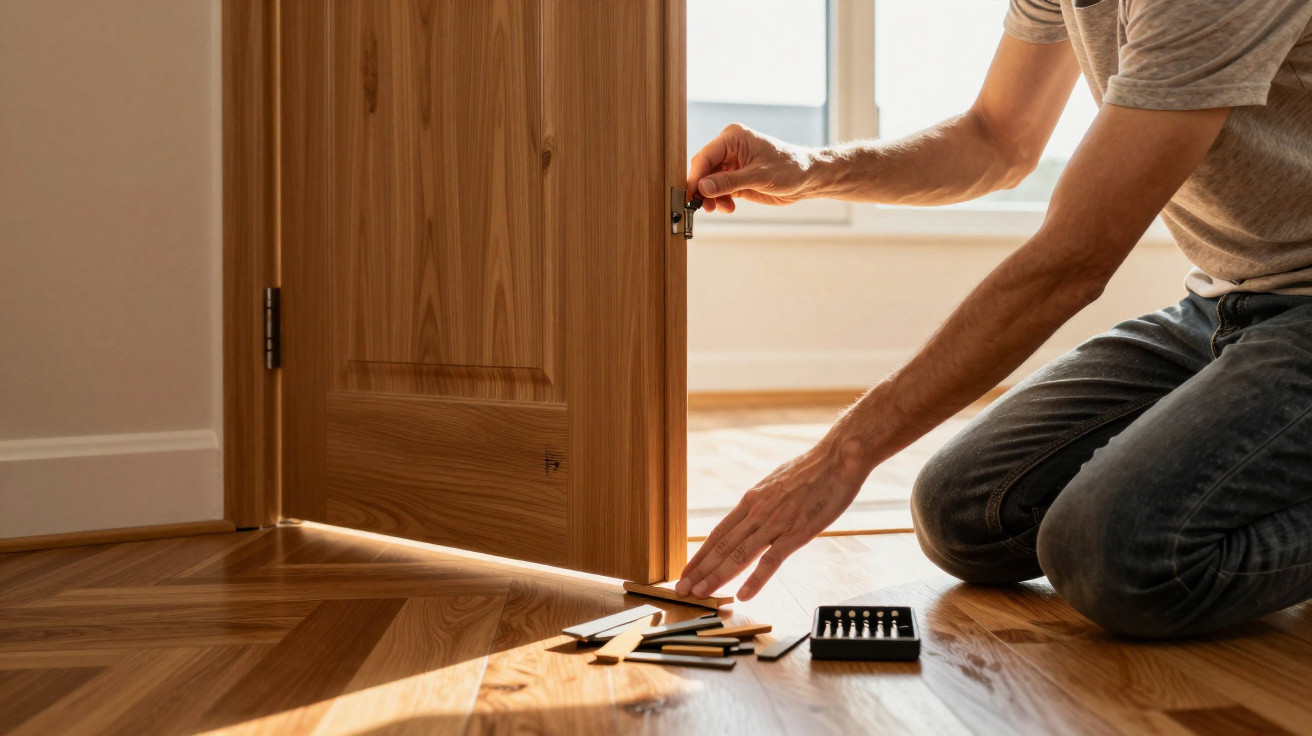
First, support the door so that it cannot fall while you work. Place a timber wedge or a stack of old magazines beneath the open door to provide enough lift and support.
| Step | What to do | What to check |
|---|---|---|
| 1 | Support the door with a wedge near the latch side. | The door should no longer rest on the floor. |
| 2 | Tighten the screws on the top hinge first. | Listen for creaks reducing as the hinge pulls tight. |
| 3 | Loosen the top hinge screws slightly, slide in a thin shim behind the hinge plate, then retighten. | Check the bottom edge of the door: has the clearance improved? |
| 4 | Repeat with the middle or lower hinge if needed. | The door should swing without scraping at any point. |
A thin shim – such as a small metal washer or a tidily cut section of stiff card – moves the hinge a fraction away from the frame. Shifting the top hinge outwards by one or two millimetres tilts the door and raises its bottom edge. The improvement can feel substantial in everyday use, even though it is barely visible.
A single washer behind the top hinge can lift a standard interior door by several precious millimetres.
When you should replace or add hinges
Certain doors need more than a minor adjustment. Where hinges are clearly bent, corroded or loose enough to rattle, lifting the door will only be a temporary measure. A modest upgrade is worthwhile in these circumstances.
Many modern hinges have small adjustment screws, enabling you to move a door up, down, left or right without making new holes. Swapping old basic hinges for adjustable versions can turn a troublesome door into one that can be fine-tuned within minutes.
- For heavy doors, fitting a third hinge in the centre distributes the weight and helps prevent future sagging.
- For bathrooms and kitchens, stainless-steel or brass hinges withstand moisture more effectively over time.
- For front doors, stronger hinges improve both clearance and security.
When installing replacement hinges, use longer screws where practical, allowing them to engage with the studwork or solid timber behind the frame. This straightforward step limits movement, especially in plasterboard or hollow partition walls.
Tools that make the job calmer and cleaner
The repair remains straightforward when all equipment is ready before you remove the first screw. Professional joiners depend on a small selection of basic tools, which can mean the difference between an easy task and a frustrating afternoon.
- A crosshead and flat-head screwdriver, or a low-speed drill/driver
- A small spirit level to establish whether the door is leaning
- Thin shims: metal washers, plastic spacers or offcuts of strong card
- Replacement screws, in case the existing screws are stripped
- A lightweight hammer for stubborn hinge pins
Protect the floor by placing a folded towel or a carpet offcut beneath the door while working. Should the door slip or shift unexpectedly, this extra layer protects both the tiles and your peace of mind. Thin work gloves are also useful, particularly around old painted hinges that may conceal splinters or flaking metal.
When scraping isn’t just about the hinge
Occasionally, adjusting the hinges improves matters without fully resolving them. In that case, the cause may lie beyond the door itself.
- Check the threshold or floor finish: distorted timber thresholds and loose tiles can lift enough to obstruct the door.
- Inspect for moisture damage: expanded floorboards close to bathrooms or exterior doors may indicate a leak rather than a joinery problem.
- Assess room humidity: in especially damp spaces, a basic dehumidifier or improved ventilation may reduce the door’s size again over several days.
A door that swells every winter may be telling you something about the building’s moisture, not just its hardware.
Preventing the next winter of scraping doors
After the door is swinging freely again, a simple maintenance routine can keep it that way. Hinges do not generally fail at once; they deteriorate over time, and a few minutes of attention each season helps manage that wear.
- Wipe dust from hinges monthly with a dry cloth to remove grit that behaves like sandpaper.
- Put a drop of light oil or silicone spray on every hinge pin three or four times annually.
- Check hinge screws briefly when seasonal temperatures change, particularly following very damp weather.
If you live somewhere with pronounced seasonal variation, treat doors as you would windows: expect movement and inspect them as part of your autumn and spring home-maintenance routine. Dealing with a mild creak in October can prevent a serious floor-scraping problem by January.
When lifting a door becomes a bigger home check
A troublesome door can occasionally point to a wider issue. Persistent scraping in one part of the home, cracks developing around frames or doors that still fail to latch after hinge adjustment may signal structural movement. This does not necessarily indicate serious danger, but it does warrant closer investigation.
Surveyors commonly consider door behaviour a minor but informative indicator when assessing older homes. A door that once shut smoothly but becomes misaligned after heavy rain could suggest foundation movement, a leaking pipe below the floor or decayed timber within the frame. In such cases, the quick hinge adjustment still addresses the symptom, while a more thorough inspection helps safeguard the property over time.
For most homes, however, the explanation is reassuringly ordinary: a heavy door, worn hinges, a wet winter and a floor bearing the consequences. A couple of washers, a steady hand and ten peaceful minutes with a screwdriver will often restore what people really want: doors that shut with a quiet click rather than a grinding protest.





Comments
No comments yet. Be the first to comment!
Leave a Comment