
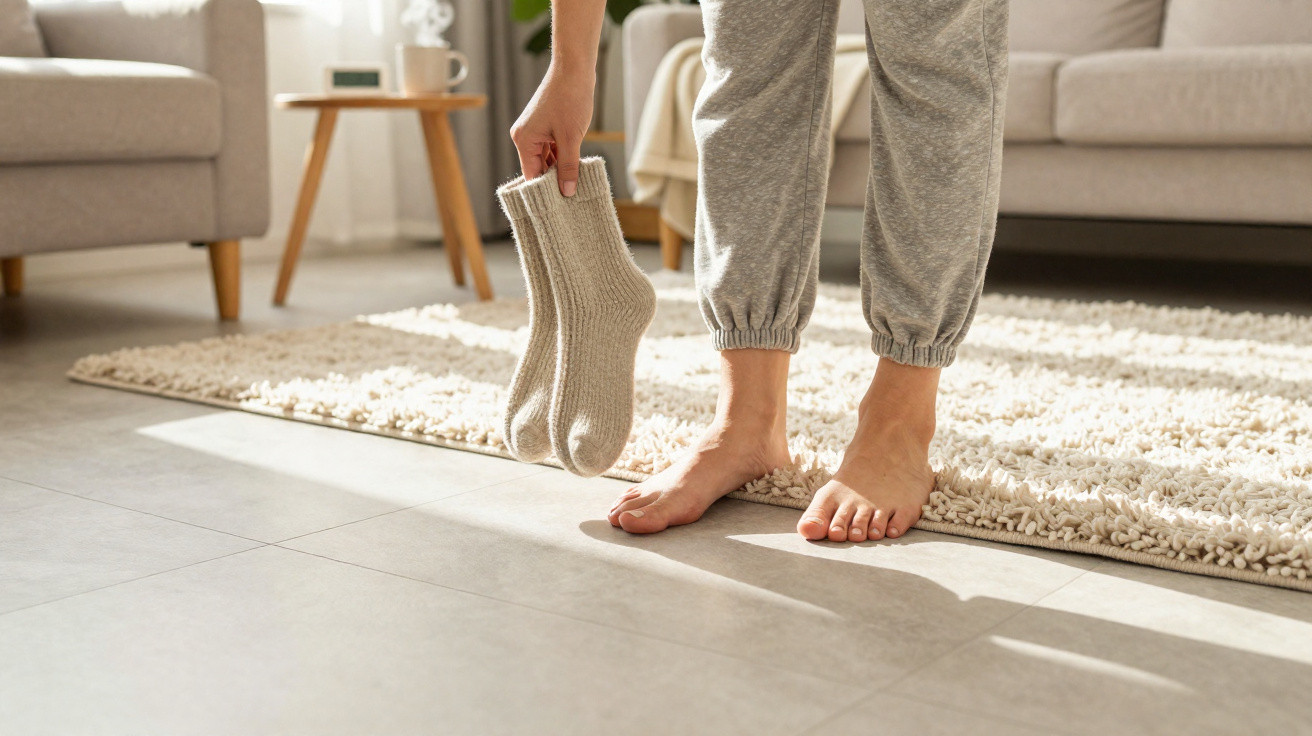
The tiles seem innocent at first glance.
They are clean, pale and flawlessly smooth beneath the kitchen light. But the moment your bare foot leaves the rug and touches the floor, the shock is immediate. A narrow surge of cold travels up your leg and into your spine, and that cosy morning abruptly feels far less cosy.
You clasp your mug, turn the heating up by another degree, yet your toes still feel like little ice cubes. Your shoulders tighten. You tug your jumper closer and wonder how an ordinary floor can disrupt the comfort of your entire body.
It is such an everyday action-walking barefoot to put the kettle on, check on the children or feed the cat-yet your whole body responds. Your feet make up only a small percentage of you, so why can they make everything feel cold?
Why cold floors make your whole body shiver
Step from a warm carpet onto a stone floor in winter and your body responds before your mind has caught up. Your breathing catches for a moment. Your shoulders lift. Your jaw clenches slightly, entirely on its own.
The meeting between bare skin and a cold surface is immediate and intense. There is no cushioning fabric and no time delay. Your soles are full of temperature sensors, which sound the alarm so quickly that your body is reacting before you can properly think, “wow, that’s freezing”.
You are not merely “a bit chilly”. For several seconds, it can feel as though someone has opened a window somewhere inside your body.
Picture a typical winter evening in a flat with smart, modern tiles. The heating is set to 21°C, candles are lit and Netflix is ready. You leave the sofa to get a glass of water. You take two steps on the living-room rug, then your foot hits the kitchen floor-and the mood is gone.
Your toes sting, your ankles tighten and, by the time you reach the sink, your entire body feels cooler than it did half a minute earlier. You may even put on a hoodie that you did not need five minutes before. The room has not become colder; your perception of warmth has changed.
We seldom consider it, but floors remove heat with remarkable efficiency. According to building engineers, bare feet on tiles at 15°C lose substantially more body heat than hands exposed to air at the same temperature. The solid surface continually draws in warmth, while your skin gives it up without resistance.
The explanation is straightforward physics combined with complicated human biology. Your body aims to hold its core-your chest and organs-at roughly 37°C. Your extremities are less of a priority. Once your soles meet a cold floor, the blood vessels in your feet constrict to preserve warm blood for vital areas.
That vasoconstriction does not remain confined to your toes. It sends a warning through the system: there is a risk of cooling. Your nervous system answers by tensing muscles, increasing your metabolism slightly and sometimes producing small shivers. All because a few millimetres of skin have met a surface that eagerly absorbs heat.
The air may be a comfortable 20–21°C, but a 10–12°C floor beneath your feet can take over the whole experience. The brain does not simply read the thermostat; it reads the soles. When your feet report “ice rink”, your body moves into a mild winter mode, regardless of the figure on the wall.
Small changes that stop cold floors from chilling your whole body
The simplest solution begins before your brain even notices the cold: add a barrier. Putting a layer between your skin and the floor can transform the experience. Thick socks, slippers with a substantial sole or even slightly unattractive but indispensable indoor clogs can serve as your personal protection.
You do not need specialist equipment. An ordinary pair of wool socks can greatly reduce heat loss. Their fibres hold air, and air transfers heat slowly. Your feet remain warmer, your blood vessels stay more relaxed and your shoulders and jaw do not become armour every time you cross the hall at night.
It may not look glamorous, but it works before the cold floor gets any say in the matter.
A second step is to create “warm islands” around your home. Place a rug beside the bed, another by the sink and a soft runner in the corridor that otherwise feels like a walk through a fridge. You are converting an icy route into a series of safe places to land.
Consider your regular journeys: bed to bathroom, sofa to kitchen, desk to coffee machine. Add warmth wherever your feet most often touch down. The morning dash to the toilet becomes less punishing. A late-night glass of water no longer causes a head-to-toe chill.
Let’s be honest: nobody manages this perfectly every day, but a few useful habits can at least give you a better chance. You will notice the difference within the first week.
There is also a psychological aspect that we do not usually connect with cold floors. When your body feels under a mild thermal assault, your stress level rises slightly. Muscles brace more firmly, breathing becomes a little shallower and your general sense of well-being quietly declines in the background.
One thermal comfort specialist told me something that stayed with me:
“Cold feet are like a low-level alarm constantly beeping in your nervous system. You don’t always hear it, but it wears you down.”
A handful of simple habits can settle that alarm before it exhausts you:
- Put on something warm as soon as you get out of bed.
- Warm your feet before bed with a hot-water bottle or a warm bath.
- Flex your toes and ankles every hour when you work from home.
- Layer rugs rather than depending on one thin mat over stone or tiles.
- Keep a pair of proper indoor shoes that you genuinely enjoy wearing.
How this tiny change rewires your sense of comfort
Cold floors rarely take centre stage in conversations about comfort. We tend to blame the windows, an ageing heater, the weather or the draught beneath the door. Yet your feet are quietly directing the scene.
Look after them and the experience shifts. The same room, thermostat and outdoor temperature can suddenly feel more liveable, gentler and less unwelcoming in the morning. Family breakfasts last longer. You can concentrate at your desk rather than curling your toes beneath the chair.
It is an unseen improvement that your nervous system detects well before your conscious mind does.
Paying attention to your feet can also feel unexpectedly grounding. You begin to notice where you stand, how your body responds and when tension appears. A cold tile at 6 a.m. becomes more than an irritation; it is a sign that perhaps your routine needs a small adjustment.
It may be as easy as laying down the rug you have been meaning to unroll. Or eventually buying the slippers you always overlook in the supermarket aisle. Or letting go of the “I must endure the cold like a hero” story that so many of us carry quietly.
We all know someone who walks barefoot across freezing floors as if it were nothing. Good for them. For everyone else, there is no prize for suffering quietly. Warm feet are not a luxury; they are a basic part of feeling at home in your own space.
Once you accept that, something changes. Instead of fighting your body, you begin to work alongside it. A few extra degrees of comfort at floor level can carry through the rest of the day: fewer shivers, less tension, better sleep and more patience with the people around you.
All because you paid attention to the small, stubborn message your soles have delivered every winter: the floor may look beautiful, but it is taking your warmth more quickly than you realise.
| Key point | Detail | Benefit for the reader |
|---|---|---|
| Cold floors drain body heat fast | Solid surfaces draw heat from bare feet far more quickly than cool air | Helps explain why you feel freezing even when the room appears warm |
| Feet signal the whole nervous system | Temperature sensors in the soles prompt vasoconstriction and muscle tension | Explains why a full-body chill can begin in your toes |
| Simple barriers change everything | Socks, slippers and rugs reduce heat loss and settle the “cold alarm” | Provides quick, realistic ways to feel warmer without turning up the heating |
FAQ:
- Does walking barefoot on cold floors really make you ill? Cold floors do not directly cause infections, but they can place your body under stress and reduce your general feeling of well-being, which may leave you feeling more vulnerable.
- Why do my feet feel freezing even when the room is warm? Your feet lose heat rapidly on cold surfaces, while your body protects its core by reducing blood flow to the extremities. As a result, they can feel icy despite a reasonable room temperature.
- Is it healthier to walk barefoot at home? On warm, safe surfaces, it may benefit posture and foot muscles. On very cold floors, however, the thermal stress often outweighs those benefits for many people.
- Are carpets really better than tiles for staying warm? Yes. Carpets and rugs trap air and provide insulation, slowing the transfer of heat from your feet and helping your entire body feel more comfortable.
- What is the best quick fix if my floors are always cold? Pair thick socks or suitable indoor shoes with rugs on your main walking routes-bed to bathroom, sofa to kitchen and desk to door-for a rapid, noticeable difference.

Comments
No comments yet. Be the first to comment!
Leave a Comment