
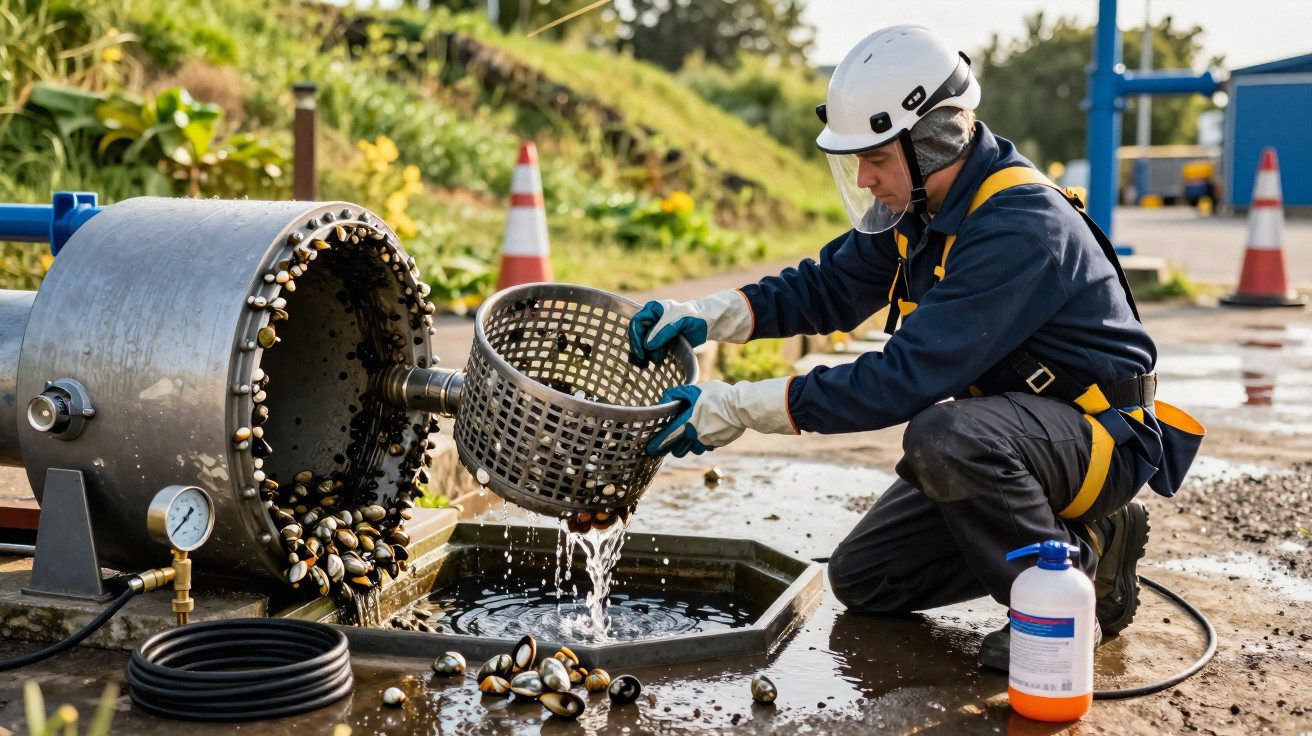
Deep beneath Britain’s reservoirs, an unseen struggle is consuming budgets, restricting water flows and making maintenance more difficult.
For most households, tap water appears straightforward: turn the tap and water comes out. Yet behind this everyday action, UK water companies are increasingly dealing with invasive mussels that fasten themselves to pipes, screens and tunnels, reducing capacity and increasing operating costs year after year.
The hidden £8 million issue in the UK water network
Figures from the industry, referenced by Water UK and academic partners, estimate that invasive species cost water infrastructure more than £8 million each year. A substantial proportion is linked to mussels, including zebra and quagga mussels, which flourish on artificial structures.
Dense mussel colonies can turn smooth pipelines into rough, constricted channels, quietly stealing capacity from critical water assets.
These creatures can cling to nearly every hard surface. After becoming established, they spread across:
- intake screens and metal grilles at rivers and reservoirs
- raw-water culverts and tunnels
- pump housings and valves
- channels and pipework at treatment works
Every colony reduces the usable space within a pipe. In time, this may lower flow rates, change pressure and require operators to make pumps work harder simply to maintain standard output. Energy costs increase, maintenance periods become more restricted, and staff spend more time on underwater inspections and clearance work.
Why the costs continue to return
Routine work that never truly stops
Rather than being a single repair, mussel management operates like an ongoing subscription cost for the network. Removing them once does not solve the problem: the same section of pipe may need work again within months or several years, depending on conditions in the area.
Industry case studies indicate that companies must account for:
| Type of impact | How it shows up |
|---|---|
| Operational costs | Regular inspections, specialist diving teams, confined-space work |
| Energy use | Pumps operating against greater resistance, less efficient hydraulics |
| Asset wear | More frequent starts and stops, increased vibration, quicker corrosion on surfaces |
| Capacity loss | Lower flow through major intakes, requirement for back-up routes |
Some UK water companies now include mussel control in routine asset management plans. Cleaning an intake or tunnel once every decade is no longer sufficient where larvae continue to arrive from upstream canals and lakes. Managers instead arrange:
- frequent monitoring of recognised “hot spots”
- risk assessments for crucial trunk mains and intakes
- contingency arrangements when a structure must be taken out of service
The annual spend rarely appears on bills as a separate line, yet it shapes how companies set tariffs, plan investments and manage risk.
As these are operating costs rather than major high-profile schemes, customers rarely see them. There is no ribbon-cutting or new dam-only additional labour, specialist contractors and more regular shutdowns built into everyday operations.
How invasive mussels reduce flow and put pressure on infrastructure
When biology meets hydraulics
The most vulnerable locations are where infrastructure connects with open water. At these intakes, screens and bars remove debris before water enters raw-water tunnels. Mussels settle on this metalwork and on top of one another, creating dense, layered mats.
The accumulation acts rather like limescale in a kettle, but at an industrial scale. The rougher a pipe’s inner surface becomes, the more turbulence the water encounters and the more energy is required to force it through. Across months and years, operators may experience:
- reduced flow rates at an unchanged pump setting
- larger pressure losses between the intake and treatment plant
- higher energy consumption for every cubic metre of water supplied
Engineers commonly make technical adjustments in response, including revised pumping patterns, changed valve settings and, in certain cases, capital projects for additional screening stages or bypasses. Every change brings further cost and complexity.
High-risk, complex maintenance work
Removing thick colonies is not as simple as using a pressure washer. Many obstructed areas are underwater, far underground or within confined structures that offer limited access. Safety requirements demand careful preparation, with teams taking turns in and out of hazardous spaces.
Water companies need to allow for:
- diving work at river intakes and reservoirs
- scaffolding or temporary platforms within large tunnels
- managed pump and valve shutdowns to prevent surges
- environmentally compliant disposal of the mussel material removed
Every intervention brings its own risk: to workers in confined spaces, to service continuity and to already stretched budgets.
Even where teams can keep assets operating while cleaning takes place, the task may pull technicians away from other maintenance work. Over the course of a year, such decisions influence asset condition and the likelihood of failures elsewhere across the network.
A £1.8 billion warning about invasive species
Water represents only part of the cost
The water sector’s £8 million cost forms part of a far wider economic picture. Parliamentary briefings in the UK have estimated the overall annual cost of invasive non-native species at more than £1.8 billion. Although the estimate is over a decade old, it continues to inform government thinking in many sectors.
This total covers considerably more than mussels in pipes. It includes harm to:
- flood defences and drainage channels
- transport assets including ports and canals
- forestry, fisheries and agriculture
- ecosystems that underpin recreation and tourism
For mussels in particular, official briefings concerning quagga mussel sightings in British waters repeatedly identify risks to infrastructure and water quality. The listed concerns include blocked abstraction points, changed nutrient levels and ecological disturbance in lakes used to supply drinking water.
Once an invasive mussel species gains a foothold in a catchment, complete removal becomes unlikely; managers shift from eradication to long-term containment.
This change means regulators and water companies must regard mussel control as a permanent system cost, rather than a temporary emergency response. Budgets for “biofouling control” compete against spending on sewage improvements, leakage reduction and new water mains.
New tools: from BioBullets to tighter prevention rules
Targeted technologies within pipes
Traditional approaches, including chemical dosing, high-pressure jets and mechanical scraping, can create environmental and safety disadvantages, prompting researchers to seek alternatives. BioBullets, a UK-developed method, is intended to target zebra mussels from inside the pipe network.
Research associated with the University of Cambridge describes BioBullets as delivering toxic agents in a form that mussels readily filter and consume. The particles then degrade, leaving less persistent chemical residue than conventional dosing programmes. Trials involving several UK water companies examined whether the technique could:
- recover capacity in partly blocked pipes
- reduce how often high-risk clearance work is required
- limit downtime for critical assets
These technologies do not eliminate the requirement for manual cleaning, but they may extend the interval between interventions and reduce the overall cost. They also create fresh regulatory questions, since companies must demonstrate that treatments neither threaten drinking water safety nor damage downstream ecosystems.
Prevention through behaviour and governance
Technology can address only part of the issue. Mussel larvae are easily carried on fishing equipment, boat hulls and even scientific equipment transferred between rivers and lakes. As a result, modest leisure activities can introduce new infestations into important drinking water sources.
Water companies and UK authorities promote prevention campaigns built around straightforward actions: clean, drain and dry equipment before taking it from one water body to another. They also use permit requirements, checkpoints at certain access locations and guidance for divers, anglers and sailors.
Stopping a mussel from arriving in a reservoir usually costs far less than managing that reservoir once a dense colony has formed.
From a planning perspective, preventative action must compete with other public priorities. However, the long-term figures make the point plainly: each large reservoir kept free from infestation avoids decades of repeated operating costs, benefiting both future consumers and those today.
What this means for bills, resilience and future planning
The persistent burden created by invasive mussels adds another element to the broader discussion around UK water bills and service standards. Companies are already expected to reduce leakage, improve sewage systems and respond to droughts and floods driven by climate change. Every additional recurring expense narrows their flexibility.
Regulators must determine how much of this concealed fight can be absorbed within existing efficiency targets, and how much may need public funding or increased tariffs. Should climate change encourage the wider spread of species tolerant of warmer water, the £8 million cost of mussel and invasive-species control in water networks could rise.
For engineers, the problem is also influencing design. Future pipelines and intakes may require smoother internal surfaces, altered flow arrangements or integrated access for cleaning robots to reduce colonisation. Reservoir operating rules could also change to lessen conditions favoured by mussels, including extended periods of stable, warm water near infrastructure.
The wider infrastructure lesson is straightforward. Biological threats cannot be contained within environmental policy alone. When an invasive organism attaches itself to a critical asset, it changes safety plans, budgets and long-term investment decisions, while staying almost entirely unnoticed by people who simply expect water when they turn on the tap.



Comments
No comments yet. Be the first to comment!
Leave a Comment