
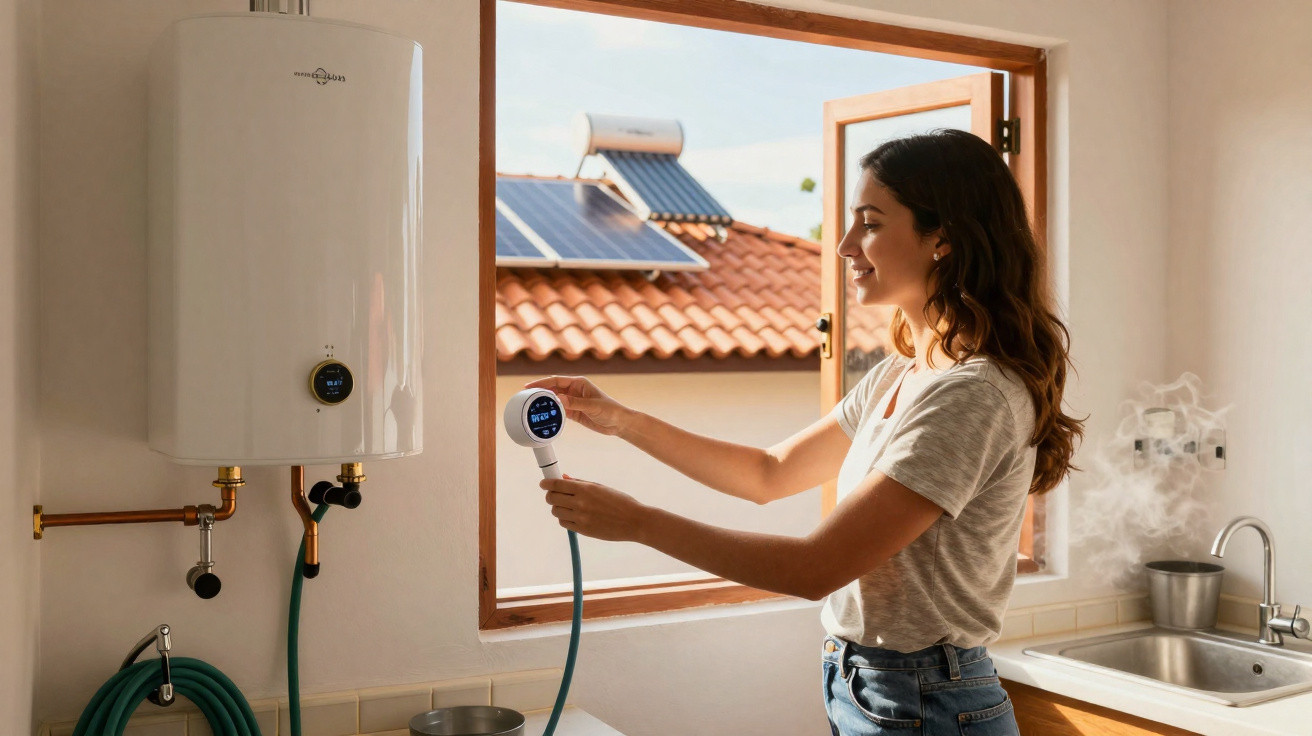
All these small comforts rely on the same unseen routine: somewhere, fuel is being burned. A gas boiler, oil tank or electric immersion heater quietly consuming kilowatts that now cost more than many of us care to look at on the bill.
But what if the whole arrangement were slightly… misguided? Not the technology itself, but the assumption behind it: that hot water must always require a flame or a power-hungry heating element drawing energy at that very moment.
Across the UK and Europe, a low-key community of DIY enthusiasts, retired engineers and mildly obsessive neighbours is doing something unusual. They heat water every day while their “real” boiler remains idle. Often, they do it with equipment that appears far too basic to be effective.
There is no magic involved. The answer is a loophole that exists in nearly every home, largely unnoticed.
Why “fuel-free” hot water is not a fantasy
On a dull Tuesday in Leeds, 42-year-old Mark stands beside a tangle of pipework, a second-hand hot-water cylinder and a rather weathered solar panel. Rather than being fitted to his roof, the panel sits on a homemade timber frame in his garden, angled towards one of the few clear areas of sky.
“Gas is just for backup now,” he says with a shrug as the digital thermostat slowly rises. “On a good day the boiler doesn’t even fire.” His cylinder is heating from what most people would dismiss as “nothing”: weak sunshine and a spare trickle of electricity his home was not using.
It is not pretty, but it works without fuss.
The same approach is being repeated in thousands of homes. Some people set up small solar water heaters on sheds or balconies. Others install a £40 diverter that detects when rooftop solar is being exported to the grid, then sends that unused electricity straight to an immersion heater. A handful take it further, recovering waste heat from the backs of fridges, air-conditioning condensers or even a server rack humming away in a spare room.
None of these arrangements defies physics. They simply reclaim energy that would otherwise be lost: a kilowatt of solar power sold back to the grid for pennies, warm air discharged from a heat pump into open space, or heat lingering in an airing cupboard that is already as hot as a radiator.
Energy does not disappear; it leaks away, escapes and goes unnoticed. DIY systems make use of those losses. They do not produce “free” hot water. Instead, they transfer heat from somewhere you do not need it into a cylinder where you certainly do.
Once you recognise it, “fuel-free” hot water seems less like wishful thinking and more like a matter of plumbing, timing and confidence.
The straightforward loophole in your roof, wiring and walls
The most widespread method is almost brutally straightforward: use electricity you have already paid for at a time when you do not need it. A small device known as an immersion diverter monitors your household electricity flow closely. When your home is consuming less power than your solar panels generate, the surplus would normally be exported to the grid.
The diverter intervenes by quietly feeding that excess into the ordinary immersion heater in your hot-water cylinder. There are no switches to operate and no apps to inspect every hour. Instead, heat is added in the background whenever surplus electricity is available.
On a sunny day, your water can go from merely warm to properly hot while you are at work.
For households without solar panels, timing is the loophole. Economy 7 and other off-peak tariffs are still available, even if they are less fashionable than solar arrays. With a basic timer, an immersion heater can be restricted to the cheapest two or three hours overnight. By morning, you have a cylinder full of hot water at a fraction of the daytime cost.
Jess, a nurse who works night shifts in a small Bristol flat, did exactly this. She asked a local electrician to fit a smart plug and timer to her ageing immersion heater. Her monthly hot-water cost fell so dramatically that she phoned her supplier, partly convinced an error had been made.
Nothing extraordinary had occurred. Her system had simply stopped heating water when everybody else was boiling kettles.
Beyond timers and diverters, the ideas become more inventive. Some DIYers fit compact heat-pump water heaters in garages, drawing low-grade heat from the air and transferring it into a cylinder very efficiently. Others attach inexpensive “thermosyphon” solar tubes to a garden wall: water rises as it heats, returns as it cools, and circulates in a quiet, gentle loop powered solely by the sun.
This is not free energy. It means capturing what your home was already losing to the sky or exchanging with the grid for very little. The loophole is not a device; it is the gap between the time energy is available and the time you actually want a shower.
How to start heating water “without fuel”
The first meaningful step is not buying equipment. It is identifying your own losses and opportunities. Walk around your home asking one question: where are heat or electricity being wasted right now? Consider the boiler flue blasting hot air into cold surroundings, an always-on immersion heater cycling in mid-afternoon, or radiators running while windows are left ajar.
Then compare those losses with the times you genuinely need hot water. Do you shower in the morning or at night? Are you out all day? Do children turn the taps into Niagara Falls every evening? This kind of audit can feel almost embarrassingly simple. Yet most people never do it once in their entire life.
Only after you understand your own routine does the appropriate DIY solution become clear: a diverter, a timer, small solar thermal equipment, or a combination of all three.
For many UK homes, the easiest gain comes from scheduling a standard immersion heater. A high-load-rated smart plug connected to the immersion element can be programmed to operate, for example, from 2am to 4am. Combined with an off-peak tariff, it charges your hot-water “battery” when electricity costs least. Your boiler remains available for bleak, dark winter mornings when the cylinder has run cold.
Another route is to make use of existing solar PV. If you already have panels, an immersion diverter can often be added by a qualified electrician. It is hardly glamorous: a small box near the consumer unit and a new cable leading to the cylinder. Yet many households find their boiler runs noticeably less, particularly from April to September.
For those who are a little more adventurous, small solar thermal kits are now available partly preassembled. They include a couple of collectors, a pump station and insulated pipework. Fitted to a shed roof or balcony rail, they can lift water from cold to comfortably tepid on a bright spring day, reducing the work the boiler must do later.
This is often where people encounter an emotional barrier: guilt about “not being handy”, concern about making a dangerous bodge, or memories of the shelf that once tore out of the wall. Many people quietly retreat at this stage.
Let us be honest: nobody really does this every day.
Most successful projects begin almost painfully small: lowering a cylinder thermostat by a few degrees, installing an inexpensive digital timer, or asking a neighbour who is “into this stuff” to look over a plan. It might mean calling a local installer and saying plainly, “I don’t want a full system yet, I just want to use what I already have a bit better.”
The most significant mistakes are seldom technical; they concern expectations. People expect winter sunshine to supply an entire home, a £30 gadget to halve their bill overnight, or everything to work perfectly in the first weekend.
When the first monthly bill arrives and is only slightly lower, some abandon the idea. Those who continue adjusting-moving a timer here, adding a little pipe insulation there-gradually find that their boiler stays silent for longer periods. The real difference lies in the small, unexciting changes that accumulate.
“The odd thing is, once you start catching wasted energy, you can’t unsee it,” says Hannah, 38, who fitted a solar diverter in her semi-detached in Nottingham. “You walk into other people’s houses and notice hot airing cupboards venting into cold lofts. It feels like watching money evaporate.”
She laughs as she recalls her first “almost free” bath: a long soak on a June evening, knowing the gas meter had not moved once that day. It was not life-changing, merely quietly satisfying.
- Begin with what you already have: a cylinder, tariff and any existing solar.
- Choose one measure: a timer, diverter or small solar thermal system.
- Monitor one thing for three months: boiler running time or kWh used.
Living with quieter boilers and bigger questions
Once a DIY hot-water system becomes part of daily life, something unexpected happens: the persistent background worry about energy begins to ease. You still examine bills and still wince at price increases, but the feeling of complete helplessness starts to loosen.
On a wet Manchester morning, the boiler may fire for the first time in several days-and you notice it precisely because that has become unusual. The rumble feels less like an ongoing drain and more like a backing singer stepping in for a solo.
The change is subtle, but it can spread. People who start tinkering with hot water often begin asking other awkward questions. Why does a tumble dryer release warm air outdoors rather than into a small heat-recovery box? Why is the loft hatch uninsulated while the rest of the roof is wrapped up? Why do we accept electronics running hot for no clear reason?
In a group chat in a small Welsh town, neighbours exchange photographs of improvised but safe pipe insulation and solar-heated paddling pools used as pre-heaters for the main cylinder. None of it resembles the polished advertising of major energy brands. Yet all of it challenges the old belief that hot water requires a constant supply of fuel.
We have all experienced the moment when a hot tap splutters cold halfway through a shower, leaving us oddly betrayed. The deeper point is about not being entirely dependent on that tap: about changing the rules of timing and waste just enough for your home to work with you a little better.
Making hot water without “fuel” will never mean making it without energy. The laws of thermodynamics remain intact. What is possible is something messier and more human: using the energy your life already gives off, at the appropriate time and in the right place.
Once you find that loophole, it becomes difficult not to mention it to somebody else.
| Key point | Detail | Why it matters to the reader |
|---|---|---|
| Identify energy losses | Notice where heat and electricity are wasted, including flues, immersion heaters and timings | Helps you select the easiest and least expensive solution to implement |
| Use off-peak hours and solar surplus | Timers, smart plugs and diverters direct “extra” energy towards hot water | Reduces bills without radically changing comfort or habits |
| Start small and adjust regularly | Change one setting, monitor the effect and refine it month by month | Limits risk, keeps you in control and reveals genuine savings over time |
FAQ
- Can I really heat water without using any gas or oil at all? During summer or milder months, yes: many homes achieve this with solar PV diverters or small solar thermal panels, keeping the boiler solely for backup.
- Is a DIY system safe if I’m not a professional? Low-risk changes, such as timers, insulation and changes in usage, are very safe; anything involving mains wiring or pressurised systems should be handled by a qualified installer.
- Do I need rooftop solar panels to benefit from this? No. Even without PV, you can use off-peak tariffs, improve the controls on your immersion heater and make small changes to when you heat water.
- How much money can I realistically save? Results vary, but many households report reducing hot-water fuel use by 30–70% between spring and autumn once their systems are properly adjusted.
- What if the sun doesn’t shine where I live? Overcast areas still receive diffuse solar energy; combined with good insulation and smart controls, that modest contribution can still reduce how frequently your boiler needs to fire.



Comments
No comments yet. Be the first to comment!
Leave a Comment