
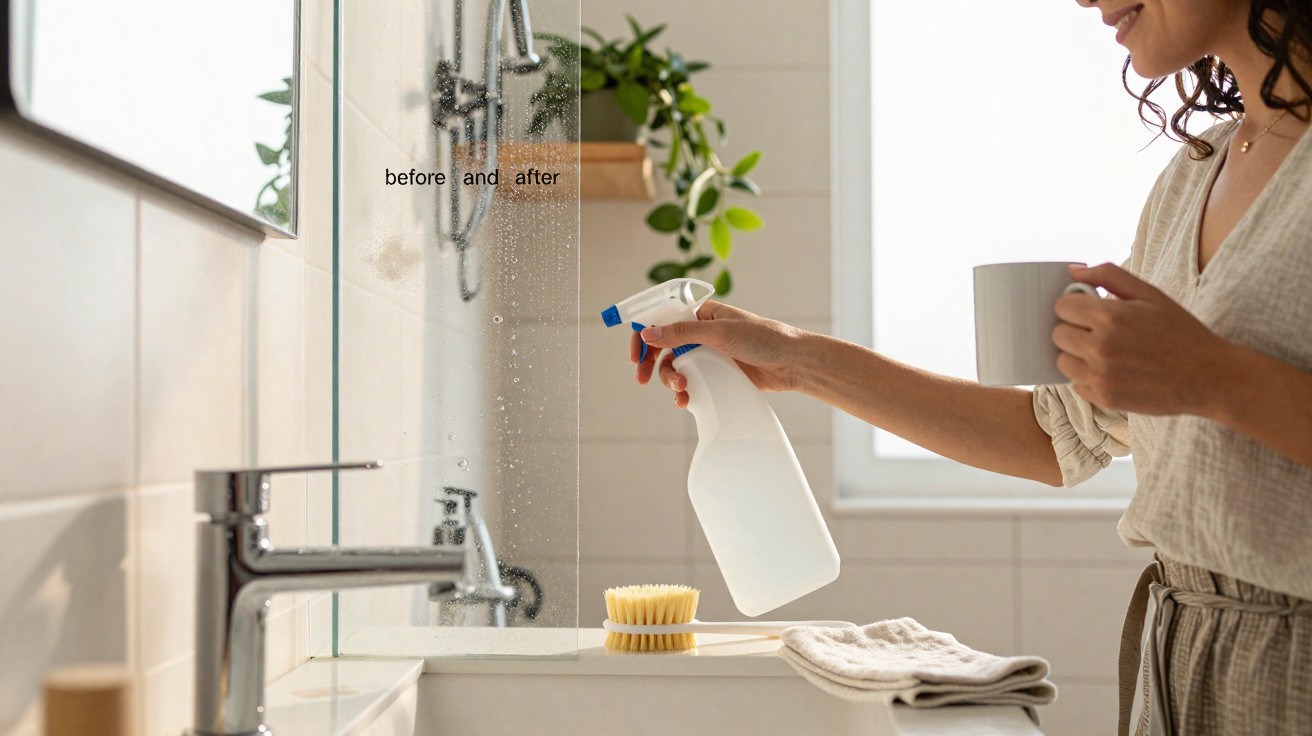
In the morning, light often falls directly onto the shower screen and exposes what you would rather not notice: dull, white, sometimes rough marks that make the bathroom look as though it has never been cleaned. Yet you cleaned it on Saturday. Limescale returns quickly, particularly in hard-water areas, appearing on taps, the shower head, seals and glass with an almost insulting regularity. The good news is that removing it does not necessarily require an hour of scrubbing or harsh products. Above all, it needs time to loosen.
Limescale does not come off through elbow grease
We all know the situation: you pick up a sponge, work at the tap, then realise the white mark has barely shifted. Limescale is a mineral deposit left behind as water dries, and its hard texture makes it seem as though you need to scrub even harder.
In areas with very hard water, deposits can return to a shower door within a few days. Depending on water hardness, measured in French degrees, water often exceeds 30 °f; it will then leave these well-known whitish marks more readily, especially on black or chrome surfaces.
The useful approach is to dissolve the deposit before trying to remove it. A mild acid, such as white vinegar or citric acid, reacts with limescale and softens it; the sponge is only needed at the end, almost as a finishing touch. Leaving the product on does much of the work.
A simple method that works while you do something else
For a tap, shower screen or standard tiles, soak kitchen roll in warmed white vinegar and place it directly over the marks. Leave it for between 30 minutes and one hour, without allowing the product to dry out completely, then rinse with clean water and wipe with a microfibre cloth.
For a limescale-covered shower head, an old freezer bag is genuinely useful: pour vinegar into it, secure it around the shower head with an elastic band and leave it in place overnight. By the next day, water will often flow better, while the small holes clear with a simple rinse. Let us be honest: nobody really does this every day.
For heavy marks, powdered citric acid can sometimes be more effective than vinegar, provided you follow the dosage instructions on the packaging and wear gloves.
“When dealing with limescale, the right approach is not to persist: wet it, wait, then wipe it away.”
- Never mix vinegar, citric acid or descaler with bleach.
- Always test the product on a small, inconspicuous area.
- Rinse surfaces thoroughly after the contact time.
Mistakes that turn a small mark into a chore
The first mistake is reaching for an abrasive sponge as soon as chrome loses its shine. It can scratch the finish, causing tiny marks that are initially invisible but then trap even more deposits over the following weeks. After descaling, a damp microfibre cloth followed by a dry cloth is often enough.
Take care with delicate materials too: marble, natural stone, travertine and some older grout do not tolerate acidic products. In these cases, choose a pH-neutral cleaner made for stone, or ask the surface manufacturer for advice before trying a homemade solution.
The habit that makes all the difference takes ten seconds after a shower: use a squeegee on the screen and wipe away drops left on the tap. It is not dramatic, but it is a highly effective form of prevention. Less water left to dry means less limescale settling in.
A spotless bathroom without giving up your Sunday
An immaculate bathroom is not necessarily one that smells of cleaning product from ten metres away, nor one scrubbed until your wrist aches. More often, it is one where minor marks have not had time to become crusty deposits, thanks to a few simple habits repeated whenever you think of them.
You can keep a spray bottle of diluted vinegar beneath the basin, a squeegee beside the shower and two clean microfibre cloths in a drawer. The whole routine quickly changes: cleaning is no longer the job you put off until Sunday evening, but a series of short, almost unnoticed actions.
There is also a very personal question: how far do you want to pursue perfection in a room used every day? A faint mark on a shower screen is not a domestic failure. Finding a gleaming tap again without spending an hour scrubbing, however, brings the kind of small, practical relief worth sharing.
| Key point | Detail | Added value for the reader |
|---|---|---|
| Contact time | Vinegar or citric acid gradually dissolves the deposit. | Less effort and less scrubbing. |
| Delicate surfaces | Natural stone and marble require a pH-neutral product. | Prevents stains and irreversible damage. |
| Daily prevention | A squeegee and microfibre cloth after showering limit dried droplets. | Less frequent limescale marks. |



Comments
No comments yet. Be the first to comment!
Leave a Comment